

Skitsofrenia
Miten viitata Käypä hoito -suositukseen? «K1»1
Keskeinen sanoma
- Skitsofrenia on vakava, monimuotoinen psyykkinen sairaus, jonka ennustetta voidaan parantaa varhaisella tunnistamisella, varhain aloitetulla hoidolla ja aktiivisella kuntoutuksella.
- Skitsofrenian hoito perustuu
- pitkäjänteiseen, luottamukselliseen hoitosuhteeseen
- yksilölliseen, potilaan ja hänen lähiomaistensa tarpeet huomioon ottavaan, säännöllisesti tarkistettavaan hoitosuunnitelmaan.
- Hoidossa keskeisiä ovat
- psykoosilääkitys, jossa pyritään tehokkaan oirelievityksen lisäksi pienimpään tehokkaaseen annokseen ja haittavaikutusten minimoimiseen
- potilaan ja hänen perheensä koulutuksellinen terapia (psykoedukaatio)
- psykososiaalisen yksilöhoidon spesifiset muodot, kuten kognitiivinen käyttäytymisterapia (KKT)
- potilaan toimintakykyä ja elämänlaatua lisäävät monipuoliset psykososiaalisen kuntoutuksen muodot
- työkuntoutuksen ja tuetun työllistymisen edistäminen.
- somaattisen terveyden arviointi, sen edistäminen ja erityisesti kardiometabolisten riskien pienentäminen heti ensipsykoosista lähtien.
- Pitkäaikaishoidossa tärkeitä ovat
- potilaiden aktiivinen tukeminen hoitoon sitoutumiseen
- uusien sairausjaksojen ehkäisy
- mielekäs päiväohjelma ja sosiaaliset suhteet
- potilaiden integroiminen yhteiskuntaan
- joustavat palvelut kriisitilanteissa.
- Alueelliset hoitopalvelut tulee järjestää siten, että eriasteisesti sairastavat potilaat saavat yksilöllisiä tarpeitaan vastaavan hoidon ja kuntoutuksen joustavasti ja integroidusti. Psykososiaalisten hoito- ja kuntoutuspalveluiden tasa-arvoinen alueellinen saatavuus tulee turvata.
- Jotta tehokkaiksi osoittautuneet menetelmät saadaan osaksi hoitojärjestelmäämme, terveydenhuollon ja sosiaalitoimen henkilökunnalle on järjestettävä koulutusta.
- Skitsofrenian hyvä avohoitopainotteinen hoito edellyttää riittäviä henkilöstö- ja osaamisresursseja.
Tiivistelmä ja potilasversio
- Suosituksen tiivistelmä «Skitsofrenia»1 ja lyhyt abstrakti englanniksi «Schizophrenia»2
- Suosituksen yleiskielinen potilasversio suomeksi «Skitsofrenia»3 ja ruotsiksi «Schizofreni»4
Keskeisiä hoitoa koskevia taulukoita
- Taulukko «Fyysisen terveyden seurantaan liittyvät mittaukset ja verikokeet ...»1 Fyysisen terveyden seurantaan liittyvät mittaukset ja verikokeet
- Taulukko «Psykoosilääkkeiden ominaisuuksia ...»2 Psykoosilääkkeiden ominaisuuksia
- Taulukko «Psykoosilääkkeiden keskeiset yhteisvaikutukset1...»5 Psykoosilääkkeiden keskeiset yhteisvaikutukset
Kohderyhmät
- Suositus on tarkoitettu skitsofreniapotilaiden tutkimiseen, hoitoon ja kuntoutukseen osallistuville lääkäreille ja muulle sosiaali- ja terveydenhuollon henkilökunnalle sekä skitsofreniapotilaille ja näiden omaisille.
- Lapsuusiän skitsofrenia ei kuulu suosituksen piiriin.
Tausta
Mikä on skitsofrenia?
- Skitsofrenia on heterogeeninen psykoottinen mielenterveyden häiriö, joka ilmenee harhaluuloina, aistiharhoina, hajanaisena ajatteluna ja puheena, kognitiivisten toimintojen häiriöinä, poikkeavana motorisena käyttäytymisenä ja negatiivisina oireina, kuten aloitekyvyttömyytenä tai sosiaalisena vetäytymisenä. Skitsofreeninen oireprofiili voi vaihdella yksilöittäin suuresti.
- Skitsofreniapotilaalla ilmenee yleensä myös muita oireita, kuten ahdistusta ja masennusta.
Etiologia ja patogeneesi
Stressi-alttiusmalli
- Skitsofrenian synty voidaan ymmärtää stressi-alttiusmallin eli stressi-haavoittuvuusmallin pohjalta «Meehl PE. Schizotaxia, schizotypy, schizophrenia. ...»1, «Wahlberg KE, Wynne LC, Oja H ym. Gene-environment ...»2. Mallin mukaan skitsofrenia puhkeaa siihen alttiilla henkilöillä vuorovaikutuksessa ympäristöstä tulevien stressitekijöiden kanssa.
Geneettinen alttius
- Skitsofreniaan liittyy usean melko yleisen geenin suhteellisen pienen riskin ja harvinaisten geenien kopiolukumuutosten suuremman riskin geneettinen alttius «Sullivan PF, Daly MJ, O'Donovan M. Genetic archite...»3, «Suvisaari J. Skitsofrenian genetiikka – joko kliin...»4, jotka vuorovaikutuksessa keskenään ja ympäristötekijöiden kanssa johtavat ilmiasultaan vaihteleviin taudinkuviin. Tätä nykyä tunnetut skitsofreniaan yhdistetyt suuren riskin kopiolukumuutokset ovat kuitenkin harvinaisia. Viimeisimpien tutkimusten mukaan niitä on tavattu alle 5 %:lla skitsofreniaan sairastuneista «Marshall CR, Howrigan DP, Merico D ym. Contributio...»5.
- Käytännössä tärkein skitsofreniaa ennakoiva riskitekijä on ensiasteen sukulaisella esiintyvä skitsofrenia tai muu psykoosi. Tällöin sairastumisriski on noin kymmenkertainen (noin 10 %) normaaliväestöön verrattuna «Gottesman II. Schizophrenia epigenesis: past, pres...»6. On kuitenkin muistettava, että valtaosassa tapauksista skitsofreniaan sairastuneen perheessä ei esiinny skitsofreniaa eikä muitakaan psykooseja.
Ympäristötekijät
- Ympäristöön liittyviä riskitekijöitä voivat olla muun muassa odottavan äidin stressi, raskaudenaikaiset ja synnytyksen komplikaatiot ja nälkiintyminen «Huttunen MO, Niskanen P. Prenatal loss of father a...»7, «Dalman C, Allebeck P, Cullberg J ym. Obstetric com...»8, «Dalman C. [Obstetric complications and risk of sch...»9 sekä lapsuudessa sairastetut keskushermoston infektiot «Rantakallio P, Jones P, Moring J ym. Association b...»10. Myös lapsuus- ja nuoruusiän traumoihin ja kaltoin kohteluun «Janssen I, Krabbendam L, Bak M ym. Childhood abuse...»11, «Varese F, Smeets F, Drukker M ym. Childhood advers...»12, «Bonoldi I, Simeone E, Rocchetti M ym. Prevalence o...»13, «Trauelsen AM, Bendall S, Jansen JE ym. Childhood a...»14, maahanmuuttoon ja siihen liittyvään syrjäytymiseen «Cantor-Graae E, Pedersen CB, McNeil TF ym. Migrati...»15, psykososiaaliseen vähäosaisuuteen «Selten JP, van der Ven E, Rutten BP ym. The social...»16 sekä huumeiden, ennen muuta kannabiksen, käyttöön «Large M, Sharma S, Compton MT ym. Cannabis use and...»17, «Marconi A, Di Forti M, Lewis CM ym. Meta-analysis ...»18, «Bourque J, Afzali MH, Conrod PJ. Association of Ca...»19 liittyy suurentunut skitsofrenian riski.
- Nykykäsityksen mukaan skitsofreniapotilaan keskushermoston häiriö on syntynyt paljon ennen ensimmäisten psykoottisten oireiden ilmaantumista. Sen mukaan jo ennen syntymää alkanut geneettisten ja varhaisten ympäristötekijöiden yhteisvaikutus on johtanut keskushermoston normaalista poikkeavaan kehityskaareen ja myöhäisessä nuoruusiässä päättyvän hermoverkoston kypsymiskehityksen häiriöön «Gottesman II, Bertelsen A. Confirming unexpressed ...»20, «Demjaha A, MacCabe JH, Murray RM. How genes and en...»21, «Birnbaum R, Weinberger DR. Genetic insights into t...»22. On kuitenkin huomattava, etteivät läheskään kaikki keskushermoston varhaiset kehityshäiriöt johda skitsofreniaan sairastumiseen.
Dopamiinin säätelyhäiriö
- Psykoottisen häiriön välittävistä psykopatologisista mekanismeista tunnetuin on tyvitumakkeiden dopamiinin säätelyhäiriö, ja kaikki tunnetut psykoosilääkkeet salpaavatkin postsynaptisia dopamiinireseptoreita «Hietala J, Syvälahti E, Vuorio K ym. Presynaptic d...»23, «Howes OD, Egerton A, Allan V ym. Mechanisms underl...»24.
Esiintyvyys, ilmaantuvuus ja elinaikainen riski
- Eri maissa ja eri aikoina tehtyjen epidemiologisten tutkimusten mukaan skitsofrenian ilmaantuvuus (insidenssi) on noin 15 uutta tapausta väestön 100 000 henkeä kohden ja elinaikainen esiintyvyys (prevalenssi) noin 8,6 väestön 1 000 henkeä kohden. Vaihtelu eri tutkimusten välillä on kuitenkin suurta. Psykoosien ilmaantuvuudessa ei näytä olevan selvää aikamuutosta, mutta psykoosien sisällä skitsofrenian osuus näyttää pienentyneen «McGrath J, Saha S, Chant D ym. Schizophrenia: a co...»25, «Kirkbride JB, Errazuriz A, Croudace TJ ym. Inciden...»26. Skitsofrenian ilmaantuvuus näyttää olevan etnisten vähemmistöjen keskuudessa suurempi kuin kantaväestössä «Kirkbride JB, Errazuriz A, Croudace TJ ym. Inciden...»26.
- Skitsofrenian ja skitsoaffektiivisen ja skitsofreniformisen häiriön yhteenlaskettu elinikäinen esiintyvyys on Suomessa 1,26 %, mikä on 36 % kaikista elinaikaisista psykooseista «Perälä J, Suvisaari J, Saarni SI ym. Lifetime prev...»27.
- Skitsofrenia puhkeaa miehillä keskimäärin aikaisemmin kuin naisilla, ja miehillä skitsofrenian esiintyvyys on myös hieman suurempaa (1,4:1) kuin naisilla «McGrath J, Saha S, Chant D ym. Schizophrenia: a co...»25, «Häfner H. From Onset and Prodromal Stage to a Life...»28.
- Skitsofrenia voi puhjeta missä iässä hyvänsä, mutta vanhuusikäisillä sen ilmaantuvuus on huomattavasti pienempi kuin työikäisillä. Keskimääräisen eliniän pidentymisen vuoksi vanhuusikäisten skitsofreniapotilaiden määrä on kuitenkin kasvussa «Talaslahti T, Alanen HM, Leinonen E. [Severe psych...»29. Vanhuusiässä skitsofreniaan sairastuneilla esiintyy nuorena sairastuneita useammin vainoharhaisuutta ja aistiharhoja mutta harvemmin ajatushäiriöitä tai kognitiivisia puutosoireita «Häfner H. From Onset and Prodromal Stage to a Life...»28.
- Suomen väestöstä 0,5–1,5 % sairastaa skitsofreniaa. Tämän perusteella Suomessa on noin 55–65000 skitsofreniapotilasta.
Kliininen kuva ja diagnoosi
- Psykoosisairauksien oireet voidaan jakaa ilmaantumisjärjestyksessä
- riskivaiheen oireisiin, jotka voivat kestää muutamasta päivästä vuosiin ja voivat välillä hävitä. Ensimmäistä psykoosia edeltäneet riskivaiheen oireet kestävät yleensä pidempään kuin psykoosin uudelleen puhkeamista edeltävät oireet «Yung AR, McGorry PD. The prodromal phase of first-...»30. Ks. kohta Psykoosiriskin diagnosointi «A1»2.
- akuuttivaiheen oireisiin, joista yleisimpiä ovat positiiviset oireet
- jälkioireisiin, joista yleisimpiä ovat negatiiviset oireet.
- Tautiluokituksen ICD-10 mukaiset skitsofrenian oireet ovat
- positiiviset oireet (psykoottiset oireet)
- aistiharhat (erityisesti kuuloharhat)
- harhaluulot (varsinkin eriskummalliset)
- puheen ja käyttäytymisen hajanaisuus
- negatiiviset oireet
- tunneilmaisun latistuminen
- puheen köyhtyminen
- tahdottomuus
- kyvyttömyys tuntea mielihyvää
- vetäytyminen ihmissuhteista ja sosiaalisten kontaktien puute.
- positiiviset oireet (psykoottiset oireet)
- Lisäksi suurella osalla skitsofreniapotilaista esiintyy
- kognitiivisia puutosoireita
- yleisessä kognitiivisessa suoriutumisessa
- tarkkaavaisuudessa ja keskittymisessä
- muistissa (erityisesti työmuistissa)
- näönvaraisessa hahmottamisessa
- tiedon prosessointinopeudessa
- toiminnanohjauksessa
- ahdistus- ja mielialaoireita, unettomuutta ja eriasteista itsetuhoisuutta.
- kognitiivisia puutosoireita
- Voimassa olevan tautiluokituksen mukaan psykoottisten oireiden tulee kestää vähintään yhden kuukauden ajan, ennen kuin skitsofreniadiagnoosi voidaan tehdä «Skitsofrenian diagnostiset kriteerit ICD-10-tautiluokituksen mukaan»1, «Komulainen J, Lehtonen J, Mäkelä, M ym. Psykiatria...»31.
- Skitsofreniadiagnoosi on aina kliininen ja perustuu potilaan
- oireiden ja toimintakyvyn kehitystä koskeviin esitietoihin
- psykiatriseen ja somaattiseen tutkimukseen.
- Diagnoosin tekee psykiatrian erikoislääkäri – nuorilla potilailla nuorisopsykiatrian erikoislääkäri – ICD-10-tautiluokituksen kriteerien perusteella «Skitsofrenian diagnostiset kriteerit ICD-10-tautiluokituksen mukaan»1, «Komulainen J, Lehtonen J, Mäkelä, M ym. Psykiatria...»31 käyttämällä hyväkseen moniammatillisen työryhmän tekemän tutkimuksen tuloksia.
- Ennen kuin skitsofreniadiagnoosi on varmistunut, on syytä puhua psykoosista.
- Diagnoosin varmistuttua on aiheellista käyttää skitsofrenia-termiä. Tällöin potilaalle ja hänen läheisilleen tulee antaa asianmukaista tietoa skitsofreniasta ja sen hoidosta siten, että korostetaan sairauden monimuotoisuutta ja sitä, että toipumismahdollisuudet ovat asianmukaisessa hoidossa hyvät «Hotti A. Mitä psykiatrinen potilas haluaa tietää? ...»32. Informaatio pyritään antamaan siten, että vältetään sairaan häpeäleimaamista (stigmatisointia).
Psykoosipotilaan tutkiminen
- Psykiatrinen tutkimus käsittää
- potilaan kliinisen ja toiminnallisen tilan arvioinnin
- perhehaastattelun ja lasten tilanteen arvioinnin.
- Perheen lasten ja nuorten tilannetta on syytä arvioida yhteistyössä neuvola- ja kouluterveyden huollon sekä tarvittaessa lasten- ja nuorisopsykiatrian ja lastensuojelun kanssa. Myös omaisten havainnot ja kokemukset potilaan voinnista ja sen muutoksista voivat osaltaan tukea taudinmääritystä.
- Skitsofreniapotilaan tutkiminen edellyttää laajaa perehtymistä potilaan kliinisiin oireisiin ja toimintakyvyn häiriöihin ja hänen lähipiiriinsä, joten tutkiminen on syytä suorittaa vaiheittain useampaan tutkimuskertaan jaettuna.
Kliinisen tilan arviointi
- Kliinisen tilan arviointi perustuu psykiatriseen haastatteluun, jonka tukena suositellaan käytettäväksi standardoituja mittareita (esim. BPRS, joka on saatavana www.mielenterveystalo.fi -sivuston «http://www.mielenterveystalo.fi»1 ammattilaisosiossa BPRS+3-versiona, ja PANSS). Ne lisäävät haastattelun luotettavuutta ja kattavuutta. Strukturoidut mittarit mahdollistavat kliinisen tilan muutosten seurannan ja soveltuvat myös muun hoitohenkilökunnan käyttöön. Mittarit takaavat sen, että samat asiat tulevat kysytyiksi jokaisella haastattelukerralla, jolloin potilaan vointia voidaan seurata pitkäjänteisesti. Mittarien tulokset on helppo siirtää sairauskertomukseen ja poimia siitä digitaalisesti.
- Skitsofreniapotilaan kliinisen psykiatrisen tutkimuksen tulee sisältää seuraavat arviot:
- suvun psykiatriset sairaudet
- psykoosia edeltänyt psykiatrinen oireilu
- skitsofrenian positiiviset ja negatiiviset oireet
- mieliala, myös mielialan elämän aikainen vaihtelu
- ahdistuneisuus, varsinkin sosiaalinen ahdistuneisuus ja pakko-oireet
- itsetuhoisuus
- väkivaltaisuus
- traumakokemukset ja traumaoireilu
- alkoholin ja huumeiden käyttö
- tupakointi ja nuuskan käyttö
- somaattinen terveydentila ja somaattiset sairaudet
- psykiatrinen hoitohistoria
- sairastumista edeltänyt psykososiaalinen kehitys (ystävyys- ja parisuhteet, opiskelu- ja työ)
- psykososiaalinen nykytilanne
- kulttuurillinen tausta «Temmingh H, Stein DJ. Anxiety in Patients with Sch...»33, «DeTore NR, Gottlieb JD, Mueser KT. Prevalence and ...»34.
Toimintakyvyn ja sosiaalisen tilanteen arviointi
- Skitsofreniaan liittyy usein myös sosiaalisen toimintakyvyn heikkenemistä (ks. kuva «Skitsofreenisen psykoosin puhkeaminen ja kulku»1), joka voi ilmetä vaikeuksina selviytyä työssä, sosiaalisissa suhteissa, arkiaskareissa ja sosiaalietuuksien hankkimisessa «Salokangas RK, Saarinen S. Deinstitutionalization ...»35, «Honkonen T, Saarinen S, Salokangas RK. Deinstituti...»36, «Honkonen T, Stengård E, Virtanen M ym. Employment ...»37.
- Toimintakyvyn arviointi on syytä tehdä jokaiselle skitsofreniapotilaalle, mieluiten hänen omassa elinympäristössään. Työssä olevilla toimintakyvyn arviointi tehdään yhteistyössä työterveyshuollon kanssa. Ks. lisätietoa menetelmistä «Sosiaalisen toimintakyvyn mittarit»2.
- Toimintakykyä arvioitaessa on suositeltavaa käyttää hyväksi standardoituja mittareita «Kim T. Mueser, Dilip V. Jeste. Clinical Handbook o...»38. Esimerkiksi alun perin DSM-IV:ään sisältyvä toimintakyvyn arviointiin tarkoitettu SOFAS-asteikko (ks. Käypä hoito -suositus Depressio, taulukko 8 «Depressio»5). DSM-5-luokitus suosittaa WHODAS 2.0:aa toimintakyvyn arviointiin. Ks. lisätietoa Toimia-tietokannasta «https://www.terveysportti.fi/apps/dtk/tmi»2.
- Myös potilaan sosioekonominen tilanne ja mahdollisesti tarvittavat sosiaaliset etuudet tulee arvioida. Suositeltavinta on, että sen tekee sosiaalityöntekijä.
- Psykoottinen häiriö voi rajoittaa ajoneuvon kuljettamista.
- Ajoterveysarviointi tehdään Liikenteen turvallisuusviraston lääkäreille laatiman voimassa olevan ohjeen mukaan «https://www.traficom.fi/sites/default/files/media/regulation/Ajoterveyden%20arviointiohjeet%20laakareille.pdf»3. Ohje pohjautuu Euroopan unionin direktiiviin vuodelta 2006 «https://eur-lex.europa.eu/legal-content/FI/TXT/PDF/?uri=CELEX%3A02006L0126-20180722&qid=1546607700920&from=FI»4.
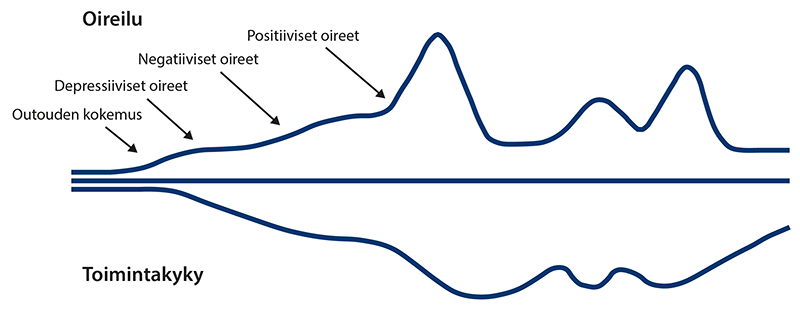
Skitsofreenisen psykoosin puhkeaminen ja kulku.
Psykologinen ja neuropsykologinen tutkimus
- Psykologiset, varsinkin neuropsykologiset, puutosoireet ennakoivat tavallista heikompaa sosiaalista ennustetta ja niihin voidaan vaikuttaa hoidollisin keinoin, joten niiden arviointi on tarpeen «Green MF, Kern RS, Braff DL ym. Neurocognitive def...»39, «Barch DM. Neuropsychological abnormalities in schi...»40. Jokaiselle skitsofreniapotilaalle tulee siten tehdä psykologinen tutkimus (kognitiivisen toimintakyvyn arviointi mukaan luettuna) tai laaja neuropsykologinen tutkimus. Tutkimus on syytä tehdä vasta, kun potilas on toipunut akuutista psykoosista.
- Psykologinen tutkimus sisältää psyykkisen toimintakyvyn ja persoonallisuuden arvioinnin ja neuropsykologisina osioina kielellisen ja visuospatiaalisen päättelysuoriutumisen, prosessointinopeuden, tarkkaavuuden, kielellisten ja näönvaraisten muistitoimintojen ja työmuistin sekä toiminnanohjauksen kartoituksen. Myös sosiaalista kognitiota on syytä arvioida «Savla GN, Vella L, Armstrong CC ym. Deficits in do...»41. Neuropsykologinen tutkimus kohdistuu laaja-alaisemmin ja syvällisemmin kognitiiviseen suoriutumiseen kuin psykologinen tutkimus «Reichenberg A. The assessment of neuropsychologica...»42, «Schulz SC, Murray A. Assessing cognitive impairmen...»43, «Schaefer J, Giangrande E, Weinberger DR ym. The gl...»44.
- Psykologinen ja neuropsykologinen tutkimus ovat tärkeitä potilaan hoidon ja kuntoutuksen suunnittelussa «Spaulding WD, Fleming SK, Reed D ym. Cognitive fun...»45, «Bryce S, Sloan E, Lee S ym. Cognitive remediation ...»46.
- Neuropsykologisessa tai psykologisessa tutkimuksessa todettavat neurokognitiiviset ja sosiaalisen kognition häiriöt ennakoivat heikentynyttä toiminnallista ennustetta. Negatiiviset oireet voivat vahvistaa tätä yhteyttä «Grant N, Lawrence M, Preti A ym. Social cognition ...»47, «Green MF, Llerena K, Kern RS. The "Right Stuff" Re...»48, «Mahmood Z, Burton CZ, Vella L ym. Neuropsychologic...»49, «Milev P, Ho BC, Arndt S ym. Predictive values of n...»50.
Erotusdiagnostiikka
- Psykiatrisessa erotusdiagnostiikassa on huomioitava
- psykoottistasoiset mielialahäiriöt (esim. psykoottinen mania- tai depressiojakso)
- akuutit ja ohimenevät psykoottiset häiriöt
- lapsivuodepsykoosi
- harhaluuloisuushäiriöt
- päihdepsykoosit
- pakko-oireinen häiriö
- persoonallisuushäiriöt
- vaikeat, psykoottisina oireina ilmenevät dissosiaatiohäiriöt
- laaja-alaiset kehityshäiriöt, kuten autismikirjon häiriöt.
- Skitsofrenian, skitsoaffektiivisen häiriön ja kaksisuuntaisen mielialahäiriön erotusdiagnostiikassa on tärkeää selvittää psykoottisten ja mielialaoireiden esiintymisajat ja vaikeusasteet koko elämän ajalta. Pelkkä ajankohtaisten oireiden arviointi ei riitä.
- Somaattisessa erotusdiagnostiikassa on huomioitava
- neurologiset sairaudet, kuten
- temporaaliepilepsia
- aivokasvain ja -verenvuoto
- aivovamma
- muistisairaudet
- Huntingtonin tauti.
- etenevät muistisairaudet vanhuusiässä psykoosiin sairastuneilla
- päihteiden (esim. hallusinogeenit, amfetamiini, alkoholi ja kannabis) käyttö
- eräiden lääkkeiden (esim. glukokortikoidit, antikolinergit ja levodopa) haittavaikutukset
- keskushermostoinfektiot (esim. enkefaliitti, myös autoimmuunienkefaliitti, neurosyfilis ja HIV)
- endokriiniset sairaudet (esim. hypo- tai hypertyreoosi, hyperkalsemia, Addisonin tauti ja Cushingin tauti)
- metaboliset häiriöt (esim. porfyriat ja Wilsonin tauti)
- vitamiininpuutokset (esim. B12-vitamiinin puutos)
- autoimmuunisairaudet (esim. MS-tauti, systeeminen lupus erythematosus, vaskuliitit ja autoimmuunienkefaliitit)
- raskasmetallimyrkytykset
- kromosomihäiriöt (esim. 22q11.2-deleetio-oireyhtymä eli velokardiofasiaalinen oireyhtymä).
- neurologiset sairaudet, kuten
Psykiatriset samanaikaissairaudet (komorbiditeetti)
- Skitsofrenian kanssa samanaikaisesti esiintyvien psykiatristen häiriöiden, kuten mieliala- ja ahdistuneisuushäiriöiden, nimeämisessä samanaikaissairauksiksi (komorbideiksi) ei ole vakiintunutta käytäntöä.
- Tutkimusten mukaan 50 % skitsofreniapotilaista täyttää elämänsä aikana kliinisen depression ja lähes sama osuus päihde- tai huumehäiriödiagnoosin kriteeri ja noin 35 % skitsofreniapotilaista kärsii jostain ahdistuneisuushäiriöstä, joista yleisimpiä ovat sosiaalisten tilanteiden pelko, pakko-oireinen häiriö ja paniikkihäiriö tai traumaperäisestä stressihäiriöstä «Buckley PF, Miller BJ, Lehrer DS ym. Psychiatric c...»51, «Temmingh H, Stein DJ. Anxiety in Patients with Sch...»52.
- Päihdehäiriöiden toteamiseksi on syytä haastatella potilaan lisäksi myös hänen läheisiään «Drake RE, Osher FC, Noordsy DL ym. Diagnosis of al...»53 ja käyttää somaattisen tutkimuksen lisänä laboratoriomäärityksiä «Brady K, Casto S, Lydiard RB ym. Substance abuse i...»54.
- Kansainvälisten tutkimusten perusteella joka neljäs skitsofreniapotilas kärsii elämänsä aikana alkoholiongelmasta «Koskinen J, Löhönen J, Koponen H ym. Prevalence of...»55 ja joka neljäs käyttää kannabista «Koskinen J, Löhönen J, Koponen H ym. Rate of canna...»56. Aiemmissa suomalaisissa aineistoissa päihdeongelmaisten osuudet ovat olleet hieman pienempiä «Räsänen P, Tiihonen J, Isohanni M ym. Schizophreni...»57, «Salokangas RKR, Stengård E, Honkonen T, Koivisto A...»58.
- Päihdeongelmat (suomalaisissa tutkimuksissa keskeisesti alkoholin lisäksi amfetamiini, kannabis ja opioidit), ovat usein alihoidettuja skitsofreniapotilailla, vaikka ne komplisoivat hoitoa muun muassa suurentamalla sairaalahoitojaksojen uusiutumisen riskiä «Kivimies K, Repo-Tiihonen E, Kautiainen H ym. Opio...»59, «Kivimies K, Repo-Tiihonen E, Kautiainen H ym. Como...»60.
- Suomalaisessa rekisteriaineistossa kannabispsykooseista noin puolet tarkentui viidessä vuodessa skitsofreniaksi «Niemi-Pynttäri JA, Sund R, Putkonen H ym. Substanc...»61.
Somaattiset samanaikaissairaudet ja niiden seuranta
- Skitsofreniapotilailla esiintyy runsaasti somaattisia sairauksia «Viertiö S, Perälä J, Saarni SI, Partti K, Saarni S...»62, «Eskelinen, Saana. Skitsofreniapotilaiden somaattis...»63, «Yang M, Chen P, He MX ym. Poor oral health in pati...»64, kuten
- sydän- ja verisuonitauteja
- aineenvaihduntasairauksia (esim. tyypin 2 diabetes ja metabolinen oireyhtymä)
- pientä D-vitamiinipitoisuutta
- heikentynyttä luuston terveyttä
- keuhkosairauksia (esim. keuhkoahtaumatauti)
- suun sairauksia.
- Skitsofreniapotilaiden ylikuolleisuus aiheutuu pääosin somaattisista sairauksista, etenkin sydän- ja verisuonitaudeista, syövistä ja hengitystiesairauksista «Crump C, Winkleby MA, Sundquist K ym. Comorbiditie...»65, «Keinänen J, Mantere O, Markkula N ym. Mortality in...»66.
- Somaattisille sairauksille altistavat muun muassa epäterveelliset elintavat (mm. tupakointi ja vähäinen liikunta), lihavuus, psykiatrinen lääkehoito, psykoosisairauden oireet (esim. aloitekyvyttömyys) sekä köyhyys ja syrjäytyminen «Viertiö S, Perälä J, Saarni SI, Partti K, Saarni S...»62, «Eskelinen, Saana. Skitsofreniapotilaiden somaattis...»63, «Nordentoft M, Wahlbeck K, Hällgren J ym. Excess mo...»67.
- Skitsofreniapotilaan somaattisen tilan selvittämiseen ja sen seurantaan ei ole kiinnitetty riittävästi huomiota «Viertiö S, Perälä J, Saarni SI, Partti K, Saarni S...»62, «Eskelinen, Saana. Skitsofreniapotilaiden somaattis...»63, «Mitchell AJ, Delaffon V, Vancampfort D ym. Guideli...»68.
- Psykiatrisen erikoissairaanhoidon tulisi varmistaa, että skitsofreniapotilas on käynyt riittävässä määrin somaattisten sairauksien tarkastuksissa ja seurannassa, että oireet on tutkittu ja että hän on saanut niihin asianmukaista hoitoa. Tarvittaessa tulee olla yhteydessä perusterveydenhuoltoon, työterveyshuoltoon tai somaattiseen erikoissairaanhoitoon «Nationella riktlinjer för vård och stöd vid schizo...»69.
- Säännöllinen hammashuolto ja tuki suun hygieniasta huolehtimiseen tulee varmistaa.
- Myös skitsofreniapotilaan näkökyky tulee tarkistaa ja näöntarkastuksista tulee huolehtia «Viertiö S, Perälä J, Saarni SI, Partti K, Saarni S...»62.
Fyysisen terveyden arvioiminen, hoito ja seuranta
- Skitsofreniapotilaan fyysisen terveyden tutkimisen, hyvän somaattisten sairauksien hoidon ja seurannan tavoitteena on potilaiden ylikuolleisuuden vähentäminen ja elämänlaadun parantaminen.
- Kaikille ensipsykoosipotilaille tulee tehdä somaattisen tilan arvio (neurologinen arvio mukaan luettuna), tarpeelliset laboratoriotutkimukset ja tarvittaessa kuvantamistutkimukset.
- Ensipsykoosipotilaalta tulee tarkistaa paino, verenpaine ja vyötärönympärys ja niitä tulee seurata säännöllisesti (ks. taulukko «Fyysisen terveyden seurantaan liittyvät mittaukset ja verikokeet ...»1).
- Ensipsykoosipotilaasta suositellaan otettavaksi seuraavia verikokeita:
- PVK, CRP, ALAT, GT, Krea, Na, K, lipidit, fP-Gluk, HbA1c, TSH, D-25, EKG (etenkin QT-aika), CDT ja U-huumeseula.
- Muita harkinnan mukaan otettavia veritutkimuksia ovat hCG (fertiili-ikäisillä naispotilailla) ja autoimmuunienkefaliittimarkkerit (pakettitutkimukset esim. Huslab Li-AitNeu ja S-AitNeu) sekä lääkehoidon suunnittelua varten lääkkeiden metaboliaan osallistuvien entsyymien geneettiset variaatiot (esim. CYP2D6, CYP1A2 jne.).
- Skitsofreniaa ei voida todeta laboratoriokokeilla, eikä siihen liity minkään yksittäisten laboratorioarvojen säännönmukaisia poikkeavuuksia.
- Elintapojen, kuten ruokavalion, liikuntatottumusten ja tupakoinnin, selvittäminen ja sukurasitteen kartoittaminen kuuluvat psykoosipotilaan tutkimukseen.
- Lääkehoitojen mahdolliset vaikutukset fyysiseen terveyteen tulee huomioida muun somaattisen seurannan lisäksi. Ks. taulukko «Psykoosilääkkeiden ominaisuuksia ...»2, «Dietsche B, Kircher T, Falkenberg I. Structural br...»82.
- Jos todetaan somaattisia sairauksia tai niiden riskitekijöitä, tulee – mieluiten yhteistyössä perusterveydenhuollon kanssa – aloittaa asianmukainen hoito ja tehdä jatkohoitosuunnitelma mahdollisimman pian psykoosisairauden diagnosoimisen jälkeen «Eskelinen, Saana. Skitsofreniapotilaiden somaattis...»63. Ks. Käypä hoito -suositukset Dyslipidemiat «Dyslipidemiat»6, «Dyslipidemiat. Käypä hoito -suositus. Suomalaisen ...»71, Kohonnut verenpaine «Kohonnut verenpaine»7, «Kohonnut verenpaine. Käypä hoito -suositus. Suomal...»72, Tyypin 2 diabetes «Tyypin 2 diabetes»8, «Tyypin 2 diabetes. Käypä hoito -suositus. Suomalai...»73, Krooninen sepelvaltimo-oireyhtymä «Krooninen sepelvaltimo-oireyhtymä»9, «Stabiili sepelvaltimotauti. Käypä hoito -suositus....»74 ja Lihavuus (lapset, nuoret ja aikuiset) «Lihavuus (lapset, nuoret ja aikuiset)»10, «Lihavuus (aikuiset). Käypä hoito -suositus. Suomal...»75.
- Skitsofreniapotilaan somaattisen tutkimuksen merkitys on toisaalta psykoosin mahdollisten somaattisten syiden sulkemisessa pois (ks. kohta Erotusdiagnostiikka «A2»3) ja toisaalta skitsofreniaan ja sen hoitoon usein liittyvien somaattisten sairauksien toteamisessa ja seurannassa (ks. kohta Somaattiset samanaikaissairaudet ja niiden seuranta «A3»4).
- Potilaan fyysinen terveys ja etenkin sydän- ja verisuonitautien ja metabolisten sairauksien riskitekijät tulee huomioida heti ensipsykoosista lähtien.
Kuvantamistutkimukset
- Lähes 30 %:lla skitsofreniapotilaista ilmenee neuroradiologisia löydöksiä, mutta valtaosa niistä on kuitenkin kliinisesti vähämerkityksellisiä «Lubman DI, Velakoulis D, McGorry PD ym. Incidental...»76. Ilman neurologisten oireiden esiintymistä aivokuvantaminen yksinään ei näytä antavan diagnostista lisähyötyä «Rutiininomainen ensipsykoosipotilaiden kuvantaminen ilman neurologisia oireita ei näytä tuottavan diagnostista lisähyötyä.»C.
- Varsinkin akuuteissa päivystystilanteissa aivojen tietokonekuvausta, magneettikuvausta ja EEG:tä käytetään tarvittaessa muiden keskushermoston sairauksien sulkemiseen pois. Ks. Lääkärin käsikirjan artikkelit Psyykkisten oireiden somaattisia syitä «Psyykkisten oireiden somaattisia syitä»1 ja Äkillinen sekavuustila (delirium) «Äkillinen sekavuustila (delirium)»2 (vaatii käyttöoikeuden).
- Huomattavalla osalla skitsofreniapotilaista tavataan magneettitutkimuksissa useiden aivorakenteiden poikkeavuuksia, kuten pienentyneet aivojen, hippokampuksen ja mantelitumakkeen tilavuudet ja laajentuneet aivokammiot. Myös monen skitsofreniapotilaan aivojen kuorikerroksen harmaa aine on vähentynyt varsinkin otsa- ja ohimolohkojen alueilla «Keshavan MS, Collin G, Guimond S ym. Neuroimaging ...»77, «Kuo SS, Pogue-Geile MF. Variation in fourteen brai...»78.
- Aivojen sivukammioiden ja harmaan aineen muutokset liittyvät skitsofreniapotilaiden kliiniseen ennusteeseen «van Haren NE, Hulshoff Pol HE, Schnack HG ym. Prog...»79, «Davis KL, Buchsbaum MS, Shihabuddin L ym. Ventricu...»80, «Lieberman J, Chakos M, Wu H ym. Longitudinal study...»81. Merkittävä kuorikerroksen harmaan aineen vähenemä ennakoi psykoosiriskissä olevien potilaiden sairastumista psykoosiin, ja ensipsykoosiin sairastuneiden otsalohkon kuorikerroksen harmaa aine ohenee ajan myötä. Suurinta harmaan aineen väheneminen on huonon ennusteen potilailla «Dietsche B, Kircher T, Falkenberg I. Structural br...»82. Aivojen kokonaistilavuuden etenevä pieneneminen liittyy myös huonoon kliiniseen ja sosiaaliseen ennusteeseen «van Haren NE, Hulshoff Pol HE, Schnack HG ym. Prog...»79. Kognitiivisen remediaation ja käyttäytymisterapian teho näyttää olevan parempi potilailla, joilla on vähän harmaan aineen katoa «Keshavan MS, Collin G, Guimond S ym. Neuroimaging ...»77.
- On aiheellista uskoa, että aivokuvantaminen voi auttaa psykoosipotilaiden luokittelussa kliinisesti, hoidollisesti ja ennusteellisesti hyödyllisiin alaryhmiin «Dazzan P, Arango C, Fleischacker W ym. Magnetic re...»83, minkä vuoksi kaikille ensipsykoosiin sairastuneille on syytä tehdä aivojen magneettikuvaus ja harkinnan mukaan uusia kuvaus potilaan sairauden jatkuessa.
- Jos skitsofreniapotilaalla todetaan laajentuneet aivokammiot tai harmaan aineen vähenemistä, hänen hoidossaan tulee erityisesti painottaa psykososiaalisia ja neurokognitiivisia hoito- ja kuntoutustoimenpiteitä. Lääkehoidon teho on tällöin heikompi ja varhain aloitetusta klotsapiinihoidosta saattaa olla hyötyä.
| Esimerkkejä seurattavista arvoista | Seurantaväli ensipsykoosista tai lääkehoidon aloittamisesta* |
|---|---|
| * Yksilöllinen arvio ja kliininen tilanne huomioitava | |
| Lipidit (kol, LDL, HDL, trigly) | Heti, 3 kk:n kuluttua, 6 kk:n kuluttua ja vuosittain |
| Verensokeri (fP-Gluk) | Heti, 3 kk:n kuluttua, 6 kk:n kuluttua ja vuosittain |
| Syke ja verenpaine | Heti, 1 kk:n välein 3 kk:n ajan ja vuosittain |
| Vyötärönympärys | Heti ja vuosittain |
| Paino | Heti, 6 viikon ajan viikoittain, 3 kk:n välein vuoteen saakka ja sitten vähintään vuosittain |
| EKG | Heti, 3 kk:n kuluttua ja vuosittain |
| ALAT | Heti, 3 kk:n kuluttua ja vuosittain |
| PVK | Heti, 3 kk:n kuluttua ja vuosittain |
| CDT, U-huume | Heti, seuranta tarpeen mukaan |
| Lääkeaine | Annos 1 (mg) | Valmistemuoto | Haittavaikutuksia | Muuta huomattavaa |
|---|---|---|---|---|
| * Ummetus on tavallinen haittavaikutus, joka voi hoitamattomana johtaa paralyyttisen
ileuksen kehittymiseen ja tulee huomioida kaikilla potilailla «Chen HK, Hsieh CJ. Risk of gastrointestinal Hypomo...»316. ** Verenkuvaseuranta ennen hoidon aloitusta (alle 10 vrk), kerran viikossa 18 viikon ajan, sen jälkeen kerran kuukaudessa ja lisäksi 4 viikkoa hoidon lopettamisen jälkeen. |
||||
| Perinteiset psykoosilääkkeet | ||||
| Flupentiksoli | 3–15 | Tabletti | Ekstrapyramidaalioireet, väsymys, hypotensio | |
| Haloperidoli | 4–10 | Tabletti, nieltävä neste | Ekstrapyramidaalioireet, tardiivi dyskinesia, QTc-ajan piteneminen | EKG ennen hoidon aloittamista, 1 ja 3 kk sen jälkeen ja myöhemmin vuosittain |
| Klooripromatsiini | 200–800 | Tabletti, nieltävä neste | Antikolinergiset haitat, valoyliherkkyys, kolestaattinen hepatiitti, väsymys, QTc-ajan piteneminen painonnousu, metaboliset haitat | EKG ennen hoidon aloittamista, 1 ja 3 kk sen jälkeen ja myöhemmin vuosittain |
| Klooriprotikseeni | 200–800 | Tabletti | Antikolinergiset haitat, väsymys, ekstrapyramidaalioireet | |
| Levomepromatsiini | 100–400 | Tabletti, nieltävä neste | Asentohypotensio, väsymys | |
| Perfenatsiini | 4–24 | Tabletti | Väsymys, ekstrapyramidaalioireet | |
| Sulpiridi | 400–1 600 | Tabletti, kapseli | Väsymys, asentohypotensio, maidoneritys | |
| Tsuklopentiksoli | 15–80 | Tabletti, tipat | Ekstrapyramidaalioireet, hikoilu | |
| Uudemmat psykoosilääkkeet | ||||
| Aripipratsoli | 10–30 | Tabletti, nieltävä neste | Rauhattomuus, unettomuus, pahoinvointi | Joillakuilla potilailla dopaminergiset haitat, kuten pelihimo tai hyperseksuaalisuus |
| Asenapiini | 10–20 | Tabletti | Uneliaisuus, ahdistuneisuus, ekstrapyramidaalioireet | Myyntilupa: keskivaikean tai vaikean manian hoitoon aikuisilla |
| Brekspipratsoli | 2–4 | Tabletti | Akatisia, painon nousu, prolaktiinipitoisuuden suureneminen | Käytettävä tavanomaista pienempää annosta, jos potilaalla on käytössään voimakkaita CYP2D6:n tai CYP3A4:n estäjiä tai potilas on CYP2D6:n hidas metaboloija |
| Karipratsiini | 1,5–6 | Tabletti | Akatisia, päänsärky, unettomuus | |
| Ketiapiini | 150–800 | Tabletti | Uneliaisuus, asentohypotensio, ummetus, suun kuivuminen metaboliset haitat, painonnousu, QT-ajan pidentyminen | |
| Klotsapiini | 200–900 | Tabletti | Verenkuvanmuutokset, epileptiset kohtaukset, ummetus*, painonnousu, metabolinen oireyhtymä, lisääntynyt syljeneritys, kardiomyopatia, EEG-muutokset tavallisia | Agranulosytoosiriskin vuoksi käyttö rajattu potilaille, jotka joko ovat hoitoresistenttejä tai eivät siedä muita psykoosilääkkeitä; pakollinen verenkuvan seuranta** (infektion yhteydessä suljettava pois agranulosytoosi); EEG:tä harkittava ennen hoidon aloittamista ja 2 kk sen jälkeen; painon seuranta, ei aiheuta ekstrapyramidaalioireita tai prolaktiinipitoisuuden suurenemista |
| Lurasidoni | 37–148 | Tabletti | Ekstrapyramidaalioireet, pahoinvointi, uneliaisuus | Lääke tulee ottaa aterian yhteydessä (suurentaa hyötyosuutta) |
| Olantsapiini | 10–20 | Tabletti | Metaboliset haitat, painonnousu, väsymys | Painon seuranta |
| Risperidoni | 2–8 | Tabletti, nieltävä neste | Ekstrapyramidaalioireet, unettomuus, ahdistuneisuus, painonnousu, metaboliset haitat, prolaktiinipitoisuuden suureneminen | |
| Sertindoli | 12–20 | Tabletti | Huimaus, suun kuivuminen, uneliaisuus, ejakulaatin pienentynyt määrä painonnousu, ortostaattinen hypotensio, nenän tukkoisuus | Pakollinen EKG-seuranta (QT-aika) (ks. valmisteyhteenveto, hidas annoksen suurentaminen) |
| Tsiprasidoni | 40–160 | Kapseli | Uneliaisuus, pahoinvointi, ekstrapyramidaalioireet | Lääke tulee ottaa aterian yhteydessä (suurentaa hyötyosuutta) |
| 1 Akuuttihoidon enimmäisannos. Ylläpitohoidon enimmäisannokset ovat pienempiä, esimerkiksi klooripromatsiinin ja klooriprotikseenin 600 mg/vrk ja haloperidolin 12 mg/vrk «Lehman AF, Steinwachs DM. Translating research int...»217. | ||||
| Pitkävaikutteiset lihakseen ruiskutettavat psykoosilääkkeet | ||||
| Perinteiset psykoosilääkkeet | ||||
| Haloperidolidekanoaatti | 50–300 | Depotliuos | Antoväli yleensä 4 viikkoa | |
| Tsuklopentiksolidekanoaatti | 200–500 | Depotliuos | Antoväli yleensä 1–4 viikkoa | |
| Uudemmat psykoosilääkkeet | ||||
| Aripipratsoli | 300–400 | Depotsuspensio | ||
| Olantsapiini | 150–300/2 viikkoa/300–405 mg/4 viikkoa | Depotsuspensio | Hyvin harvinaisena injektionjälkeinen oireyhtymä 3 tunnin sisällä injektion annosta (yliannostuksen kaltaisia oireita), pistospaikkareaktiot (kipu, kyhmyt) | Antoväli vaihteleva, ks. tuotetiedot. Pistoksen jälkeinen seuranta 3 tunnin ajan Aloitusannos on ylläpitoannosta suurempi |
| Paliperidonipalmitaatti | 25–150/kk
175–525/3 kk |
Depotsuspensio | Kuten risperidoni | Paliperidoni on risperidonin aktiivinen metaboliitti 9-hydroksirisperidoni. Eri valmistemuodot annosteluun kuukauden tai 3 kuukauden välein. |
| Risperidoni | 25–50 | Depotsuspensio | Antoväli yleensä 2 viikkoa | |
Itsetuhokäyttäytymisen riskin arviointi
- Skitsofreniapotilailla on suurentunut itsemurhariski «Palmer BA, Pankratz VS, Bostwick JM. The lifetime ...»84.
- Itsemurhan riski on suurimmillaan sairauden alkuvaiheessa, ensimmäisen psykoosin «Chan SKW, Chan SWY, Pang HH ym. Association of an ...»85 ja sairaalasta kotiutumisen jälkeen, mutta se säilyy suurena myös myöhemmin «Chung DT, Ryan CJ, Hadzi-Pavlovic D ym. Suicide Ra...»86.
- Itsemurhariskiä suurentavat muun muassa masennusoireet, aiemmat itsemurhayritykset, päihdeongelmat, huono hoitoon sitoutuminen ja positiiviset psykoottiset oireet «Hawton K, Sutton L, Haw C ym. Schizophrenia and su...»87, «Hor K, Taylor M. Suicide and schizophrenia: a syst...»88, «Haglund A, Lysell H, Larsson H ym. Suicide Immedia...»89.
- Skitsofreniapotilaiden itsemurhien ehkäisyssä keskeisiä ovat riskin tunnistaminen, hyvä hoito kokonaisuudessaan, psykoosioireiden hoito ja samanaikaisen depression tai päihdeongelman hallinta «Sher L, Kahn RS. Suicide in Schizophrenia: An Educ...»90. Ks. lisätietoa myös «Itsemurhien ehkäisy ja itsemurhaa yrittäneen hoito...»91.
Väkivaltaisuus ja väkivallan kohteeksi joutuminen
- Hoitamaton ensipsykoosi suurentaa väkivaltaisen käytöksen riskiä. Väkivaltaisuuden riskiarviossa tulisi kiinnittää erityistä huomiota päihteiden väärinkäyttöön ja epäsosiaalisiin persoonallisuuden piirteisiin «Räsänen P, Tiihonen J, Isohanni M ym. Schizophreni...»57, «Large MM, Nielssen O. Violence in first-episode ps...»92, «Fazel S, Gulati G, Linsell L ym. Schizophrenia and...»93, «Fullam RS, Dolan MC. Executive function and in-pat...»94.
- Väkivaltaisuuden arviointiin on olemassa strukturoituja arviointimenetelmiä (esim. START ja HCR-20).
- Toisaalta on huomattava, että skitsofreniapotilailla itsellään on riski joutua väkivallan uhreiksi. Suomalaisessa tutkimuksessa 4,8 % skitsofreniapotilaista oli joutunut väkivaltarikoksen uhriksi ja 2,3 % osoittautui väkivaltarikoksen tekijäksi «Salokangas RKR, Stengård E, Honkonen T, Koivisto A...»58.
Skitsofrenian vaiheet
Vaihekäsitys
- Skitsofrenian kulku on yksilöllinen, mutta siinä voidaan erottaa viisi vaihetta «McGorry PD, Nelson B, Goldstone S ym. Clinical sta...»95, joista kaksi ensimmäistä edeltävät ensipsykoosia. Psykoosin vaiheiden tuntemus auttaa kliinikkoa valitsemaan asianmukaiset hoitokokonaisuudet jo sairauden varhaisvaiheessa, jolloin interventioiden vaikuttavuus on todennäköisesti parempi ja niiden haittavaikutukset pienempiä kuin silloin, jos hoidot aloitettaisiin psykoosin myöhemmässä vaiheessa.
| Vaihe | Tilan kuvaus |
|---|---|
| 1Seurantatutkimusten mukaan ensi kertaa hoitoon tulleista skitsofreniapotilaista (taulukon kohta 2), 28–30 % toipuu täysin yhden tai useamman sairausepisodin jälkeen, 49–53 % toipuu osittain, 13–14 % kroonistuu ja 5–9 %:n taudinkuva vaihtelee «Bleuler M. The Schizophrenic Disorders. Long-term ...»96, «Salokangas RKR, Stengård E, Räkköläinen V, Alanen ...»97. | |
| 0 | Suurentunut psykoosin riski; ei ajankohtaisia oireita; ensiasteen sukulaisilla vakava mielenterveyden häiriö |
| 1a | Lieviä epäspesifisiä oireita; lieviä neurokognitiivisia muutoksia, ahdistusta ja masennusta |
| 1b | Psykoosiriskioireita; kohtalaisia neurokognitiivisia muutoksia ja toimintakyvyn heikkenemistä (GAF 70) |
| 2 | Ensipsykoosi; huomattavia neurokognitiivisia muutoksia ja toimintakyvyn huomattava heikkeneminen (GAF 30-50) |
| 3a | Epätäydellinen toipuminen ensipsykoosista; voi johtaa vaiheeseen 4 |
| 3b | Psykoosin uusiutuminen ja osittainen toipuminen; jäännösoireita; ensipsykoosiin nähden heikentynyt toimintakyky ja alentunut neurokognitiivinen taso |
| 3c | Toistuvia psykoottisia episodeja |
| 4 | Vaikea-asteinen, jatkuva psykoosi ja neurokognitiivisten toimintojen defekti |
Oireeton henkilö, jonka ensiasteen sukulaisella on vakava mielenterveyden häiriö (vaihe 0)
- Skitsofrenian syitä ei vielä tunneta niin hyvin, että taudin ehkäiseminen (primaaripreventio) olisi mahdollista. Pääpaino skitsofrenian ja muiden psykoosien ehkäisyssä onkin ennakko-oireiden tunnistamisessa ja oireilevien varhaisessa hoidossa «Salokangas RKR, Suomela T. Psykoosin varhaistunnis...»98.
- Euroopan psykiatriyhdistyksen (EPA) suosituksen mukaan kliininen psykoosiriskiarvio on syytä tehdä myös potilaalle, jolla on geneettinen riski ja muita kuin psykoosiriskioireita tai merkittävä toimintakyvyn heikkenemä. Psykoosiriskin arvio on kuitenkin syytä rajoittaa hoitoa hakeviin potilaisiin «Schultze-Lutter F, Michel C, Schmidt SJ ym. EPA gu...»99. Ks. taulukko «Euroopan psykiatriyhdistyksen (EPA) suositus psykoosiriskin tunnistamiseksi (kriteerit muokattu lähteen Schultze-Lutter ym. 2015 pohjalta)...»4.
- Suomalaisen tutkimuksessa psykiatriseen avohoitoon hakeutuneiden 15–36-vuotiaiden ryhmässä, jossa psykoosiriski on suurimmillaan, psykoosiriskipotilaiden osuudeksi tuli 6,6 väestön 10000 henkeä kohden «Salokangas RKR, Stengård E, Honkonen T, Koivisto A...»58.
- Tämän vaiheen potilaista vain pieni osa sairastuu psykoosiin, ja hoidon painopiste on mielenterveyttä tukevassa neuvonnassa ja ongelmanratkaisun tukemisessa sekä koulutuksellisessa perheterapiassa.
Psykoosiriski (vaihe 1)
- Psykoosin puhkeamista edeltää yleensä ei-psykoottisten ja lievien psykoottistyyppisten oireiden värittämä prodromaali- eli ennakko-oirevaihe «Marshall M, Rathbone J. Early intervention for psy...»102. Psykoosiriski ei ole tautiluokituksen (ICD-10) mukainen psykiatrinen diagnoosi.
- Psykoosiriskivaiheessa (clinical high risk to psychosis) voidaan erottaa kaksi toisiaan
täydentävää ja usein päällekkäin esiintyvää oirekuvaa «Schultze-Lutter F, Michel C, Schmidt SJ ym. EPA gu...»99:
- 1) välittömän psykoosiriskin (ultra high risk) oireet, jotka voivat ilmetä vaimentuneina (attenuated) tai lyhytaikaisina, ohimenevinä (brief limited intermitted) psykoottisina oireina tai geneettiseen riskiin liittyvänä toimintakyvyn heikkenemisenä «Luutonen S, Heinisuo A-M, Ilonen T ym. Vakavien mi...»103, «Klosterkötter J, Schultze-Lutter F, Bechdolf A ym....»104
- 2) perusoireet (basic symptoms), jotka ilmenevät outoina subjektiivisina ja itse raportoituina kokemuksina ajattelun, motoriikan ja havaintojen alueella sekä itseä tai ympäristöä koskevina outouden ja muuntumisen tuntemuksina «Schultze-Lutter F, Michel C, Schmidt SJ ym. EPA gu...»99, «Huber G, Gross G, Schüttler R ym. Longitudinal stu...»105.
- Molempien ennakko-oirevaiheiden aikana ja jo ennen niitä ilmenee yleensä myös epäspesifisiä oireita, kuten ahdistuneisuutta ja masentuneisuutta.
- Psykoosiin sairastuneiden psykoosiriskipotilaiden osuudet vaihtelevat tutkimusten ja seuranta-ajan mukaan. Vuoden seurannassa hoitoon tulosta keskimäärin 22 % (17–28 %) ja kahden vuoden seurannassa 29 % (23–36 %) psykoosiriskipotilaista on sairastunut psykoosiin «Fusar-Poli P, Borgwardt S, Bechdolf A ym. The psyc...»106. Välittömän psykoosiriskin potilaista noin 15 % ja perusoireilevista noin 25 % sairastuu vuoden aikana psykoosiin «Schultze-Lutter F, Michel C, Schmidt SJ ym. EPA gu...»99. Viimeaikaisissa tutkimuksissa psykoosiin sairastuneiden riskipotilaiden osuudet ovat pienentyneet «Fusar-Poli P, Cappucciati M, Borgwardt S ym. Heter...»100, «Oliver D, Kotlicka-Antczak M, Minichino A ym. Meta...»101.
- Läheskään kaikki psykoosiriskin potilaat eivät sairastu psykoosiin, mutta he kärsivät melko vaikeista psyykkisistä oireista, kuten ahdistuneisuudesta, masentuneisuudesta ja toimintakyvyn heikkenemisestä, ja tarvitsevat siten psykiatrista hoitoa «Fusar-Poli P, Borgwardt S, Bechdolf A ym. The psyc...»106, «Yung AR, Phillips LJ, McGorry PD ym. Prediction of...»107, «Miller TJ, McGlashan TH, Rosen JL ym. Prospective ...»108, «Ruhrmann S, Schultze-Lutter F, Klosterkötter J. Ea...»109, «Drake RJ, Lewis SW. Early detection of schizophren...»110, «Cannon TD, Cadenhead K, Cornblatt B ym. Prediction...»111, «Ruhrmann S, Schultze-Lutter F, Salokangas RK ym. P...»112.
- Psykoosiriskissä olevien hoitoa voidaan perustella myös sillä, että huomattava osa heidän psykososiaalisista ongelmistaan jatkuu, vaikka heidän psykoosiin sairastumisensa voidaan tehokkaalla hoidolla estää. Lisäksi psykoosiriskissä olevilla esiintyy usein myös hoitoa vaativaa itsetuhoisuutta «Kelleher I, Corcoran P, Keeley H ym. Psychotic sym...»113, «Salokangas RKR, Patterson P, Hietala J ym. Childho...»114.
Psykoosiriskin diagnosointi
- Euroopan psykiatriyhdistyksen (EPA) suosituksen «Schultze-Lutter F, Michel C, Schmidt SJ ym. EPA gu...»99 mukaan hoitoon hakeutunut potilas on vaarassa sairastua psykoosiin, jos hänellä esiintyy ainakin yksi vaimentunut psykoottinen oire tai ainakin kaksi perusoiretta tai ainakin yksi nopeasti ohimenevä psykoottinen häiriö (taulukko «Euroopan psykiatriyhdistyksen (EPA) suositus psykoosiriskin tunnistamiseksi (kriteerit muokattu lähteen Schultze-Lutter ym. 2015 pohjalta)...»4).
| A. Ainakin yksi vaimentunut psykoottinen oire: | 1. Itseen kohdistuva harhainen merkityselämys (kohdistamisharha), jota potilas ei välittömästi tajua harhaiseksi |
| 2. Havaintopoikkeama tai aistihairahdus, johon kuitenkin säilyy sairauden oivallus | |
| 3. Hajanainen kommunikointi tai puhe, joka on kuitenkin vielä ymmärrettävää | |
| B. Ainakin kaksi subjektiivisesti koettua tai raportoitua kognitiivista perusoiretta: | 1. Ajatusten häiriintyminen; merkityksettömien ajatussisältöjen tunkeutuminen mieleen kesken ajattelun |
| 2. Ajatusten salpautuminen; ei johdu keskittymis- tai huomiokyvyn puutteesta | |
| 3. Ajatuspaine; ajatukset rientävät aiheesta toiseen ja poikkeavat puheen yleisestä aihepiiristä. | |
| 4. Häiriö jokapäiväisen puheen ymmärtämisessä | |
| 5. Häiriö jokapäiväisen puheen tuottamisessa | |
| 6. Kyvyttömyys jakaa huomiota eri aistialueiden tehtävien kesken, jotka yleensä eivät vaadi täyttä keskittymistä. Esimerkiksi voileivän tekeminen ja toiselle ihmiselle puhuminen eivät onnistu samanaikaisesti. | |
| 7. Kyvyttömyys välittömästi tunnistaa ja tajuta erilaisia käsitteellisiä, kuvainnollisia tai symbolisia sisältöjä, kuten sananlaskuja tai sanontoja, kuten "Sanasta miestä, sarvesta härkää" | |
| 8. Subjektiivinen itseen kohdistuva merkityselämys (kohdistamisharha), joka lähes välittömästi tajutaan virheelliseksi | |
| 9. Huomion juuttuminen näkökentän merkityksettömiin yksityiskohtiin, joiden vuoksi huomion kiinnittäminen oleellisempiin ärsykkeisiin häiriintyy | |
| C. Ainakin yksi ohimenevä psykoottinen oire: | 1. Ajatusharha (deluusio) |
| 2. Aistiharha (hallusinaatio) | |
| 3. Hajanainen ajattelu | |
| Huom. | Kohtien A ja B oireiden aikana sairauden oivallus säilyy. Kohdassa C sairauden oivallus katoaa lyhyeksi aikaa. |
Psykoosiriskissä olevan potilaan hoito
- Kliinisessä psykoosiriskissä olevan potilaan hoidon tavoitteena on 1. ehkäistä psykoosin puhkeaminen ja 2. estää potilaan sosiaalisen, koulutuksellisen ja ammatillisen toimintakyvyn heikkeneminen ja parantaa sitä.
- Psykoosiriskissä olevien potilaiden kontrolloituja interventiotutkimuksia on tehty suhteellisen vähän. Erityyppisiä interventioita käsittäneen meta-analyysin mukaan psykoosin puhkeamista on voitu ensimmäisen 12 kuukauden aikana vähentää 54 % (NNT 9) ja pidemmän seurannan aikana 37 % (NNT 12). Varsinkin kognitiivinen käyttäytymisterapia (KKT) ja psykoosilääkehoito ovat näissä meta-analyyseissä osoittautuneet tehokkaiksi «van der Gaag M, Smit F, Bechdolf A ym. Preventing ...»115, «Schmidt SJ, Schultze-Lutter F, Schimmelmann BG ym....»116. Eri hoitomenetelmien tehokkuuden välillä ei kuitenkaan ole merkittäviä eroja «Davies C, Cipriani A, Ioannidis JPA ym. Lack of ev...»117.
- Psykoosilääkitys saattaa siirtää psykoottisen häiriön puhkeamista ja vähentää psykoosiriskissä olevien psykoottisia oireita «McGorry PD, Yung AR, Phillips LJ ym. Randomized co...»118, «Phillips LJ, McGorry PD, Yuen HP ym. Medium term f...»119, «McGlashan TH, Zipursky RB, Perkins D ym. Randomize...»120, «Woods SW, Tully EM, Walsh BC ym. Aripiprazole in t...»121, «Tsujino N, Nemoto T, Morita K ym. Long-term Effica...»122, «Psykoosilääkitys saattaa siirtää psykoottisen häiriön puhkeamista ja vähentää vaimentuneita psykoottisia oireita psykoosiriskissä olevilla potilailla.»C.
- Psykoosilääkkeen yhdistäminen psykososiaaliseen interventioon saattaa vähentää psykoottista ja muuta oireilua ja parantaa toimintakykyä «Ruhrmann S, Bechdolf A, Kühn KU ym. Acute effects ...»123, «McGorry PD, Nelson B, Phillips LJ ym. Randomized c...»124, «Psykoosilääkkeen yhdistäminen psykososiaaliseen interventioon saattaa vähentää psykoottista ja muuta oireilua ja parantaa toimintakykyä mutta tuskin soveltuu ensivaiheen hoidoksi psykoosiriskissä olevilla potilailla.»C.
- Pitkäketjuisten monityydyttymättömien omega-3-rasvahapojen tehosta psykoosiriskissä olevien hoidossa on saatu ristiriitaisia tuloksia «Amminger GP, Schäfer MR, Papageorgiou K ym. Long-c...»125, «Nelson B, Amminger GP, Yuen HP ym. NEURAPRO: a mul...»126, «Pitkäketjuisten monityydyttymättömien omega-3-rasvahapojen tehosta psykoosiriskissä olevien hoidossa on saatu ristiriitaisia tuloksia.»C.
- KKT saattaa siirtää psykoottisen häiriön puhkeamista ja vähentää psykoottisia oireita psykoosiriskissä olevilla potilailla «Morrison AP, French P, Walford L ym. Cognitive the...»127, «Morrison AP, French P, Parker S ym. Three-year fol...»128, «Addington J, Epstein I, Liu L ym. A randomized con...»129, «Morrison AP, French P, Stewart SL ym. Early detect...»130, «van der Gaag M, Nieman DH, Rietdijk J ym. Cognitiv...»131, «Ising HK, Kraan TC, Rietdijk J ym. Four-Year Follo...»132, «Ising HK, Lokkerbol J, Rietdijk J ym. Four-Year Co...»133, «Kognitiivinen psykoterapia (KKT) saattaa siirtää psykoottisen häiriön puhkeamista ja vähentää psykoottisia oireita sekä saattaa olla kustannustehokasta psykoosiriskissä olevilla potilailla.»C.
- Useita psykososiaalisia hoitomuotoja sisältävä integroitu interventio ilmeisesti pienentää psykoottisen häiriön riskiä varhaisessa psykoosiriskissä olevilla potilailla «Bechdolf A, Wagner M, Ruhrmann S ym. Preventing pr...»134, «Useita psykososiaalisia hoitomuotoja sisältävä integroitu interventio ilmeisesti vähentää psykoottisen häiriön riskiä varhaisessa psykoosiriskissä olevilla potilailla.»B.
- Perheeseen fokusoitu psykososiaalinen interventio saattaa parantaa perheen sisäistä kommunikaatiota ja vähentää psykoosiriskissä olevan psykoottisia oireita «O'Brien MP, Miklowitz DJ, Candan KA ym. A randomiz...»135, «Miklowitz DJ, O'Brien MP, Schlosser DA ym. Family-...»136, «Perhefokusoitu psykososiaalinen interventio saattaa parantaa perheen sisäistä kommunikaatiota ja vähentää psykoosiriskissä olevan psykoottisia oireita.»C.
- EPA:n suosituksen «Schmidt SJ, Schultze-Lutter F, Schimmelmann BG ym....»116 mukaan psykoosiriskipotilaan hoito on syytä toteuttaa vaiheittain etenevää hoitomallia noudattaen «Klosterkötter J, Schultze-Lutter F, Bechdolf A ym....»104, «McGorry PD, Nelson B, Amminger GP ym. Intervention...»137 siten, että ensi vaiheessa sovelletaan KKT:tä. Jos psykoterapeuttinen intervention teho on osoittautunut riittämättömäksi, mukaan liitetään pieniannoksinen psykoosilääke, mieluiten uudempi psykoosilääke. Tilanteissa, joissa vaimentuneisiin tai lyhytaikaisiin psykoottisiin oireisiin liittyy aggressiivisuutta tai itsetuhoisuutta, psykoosilääkkeen aloittaminen jo ensivaiheessa on aiheellista «Galletly C, Castle D, Dark F ym. Royal Australian ...»138. Tutkimuksissa käytetyt hoidot ovat kestäneet 6–12 kuukautta, joten pidemmistä hoidoista ei ole näyttöä. Pitkäaikaista psykoosilääkettä ei suositella käytettäväksi psykoosiriskissä olevan hoidon ensivaiheessa.
- Psykoosiriskipotilaan muita häiriöitä, ennen muuta masennusta ja ahdistuneisuushäiriöitä, tulee hoitaa asianomaisten hoitosuositusten mukaisesti.
Ensipsykoosi (vaihe 2)
- Psykoosin varhainen tunnistaminen tapahtuu useimmiten perusterveydenhuollossa. Ensipsykoosiin sairastuneen tarkempi diagnostiikka ja hoidon käynnistäminen kuuluvat erikoissairaanhoitoon, jonne potilas tulee ohjata.
- Hoito aloitetaan heti psykoosioireiden ilmaannuttua, koska hoitamattoman psykoosin kesto ja hoidon aloittamisen viivästyminen heikentävät ennustetta «Penttilä M, Jääskeläinen E, Hirvonen N ym. Duratio...»139, «Marshall M, Lewis S, Lockwood A ym. Association be...»140.
- Keskeistä on aloittaa psykoosilääkehoito ja yksilöllisen tarpeen mukainen psykososiaalinen hoito, joka sisältää psykoedukaatiota ja jossa huomioidaan potilaan läheiset.
- Psykoosilääkehoidon aloittaminen ei vaikuta kielteisesti psykoosin pitkäaikaiskulkuun «Goff DC, Falkai P, Fleischhacker WW ym. The Long-T...»141.
- Ensipsykoosin akuuttivaiheessa hoidon tavoitteena on psykoosioireiden tehokas vähentäminen
ja toimintakyvyn palauttaminen
- sopivalla lääkityksellä
- hoidollisella vuorovaikutuksella
- psykoedukaatiolla
- kognitiivisella käyttäytymisterapialla
- turvallisen hoitoympäristön keinoin
- aloittamalla mahdollisten samanaikaissairauksien hoito.
- Akuuttivaiheessa selvitetään myös potilaan puolison ja lasten tilanne ja heidän mahdollinen hoidon tarpeensa.
- Akuuttivaiheen hoitomyöntyvyyttä ja -tuloksia parantavat
- luottamuksellinen yhteistyösuhde potilaan ja hänen perheensä kanssa
- potilaan perheen kriisiavun luonteinen tuki.
- Akuuttivaiheessa potilasta hoidetaan
- avohoidon keinoin siihen hyvin perehtyneessä psykiatrisessa työryhmässä (esim. psykoosityöryhmässä) tai
- psykiatrisella akuuttiosastolla.
- Psykoottisen potilaan sairaalahoitoon lähettäminen on aiheellista, jos
- potilas on itsetuhoinen tai väkivaltainen
- potilaan käyttäytymistä ohjaavat voimakkaasti aistiharhat tai harhaluulot tai
- potilaan tutkiminen ja hoito eivät onnistu paikallisen avohoidon resurssein.
- Psykoosilääkityksen aloittaminen
- perustuu aina yksilölliseen potilaan tilanteen arvioon ja
- on hoidon alkuvaiheessa aiheellista erityisesti positiivisten oireiden lievittämiseksi.
- Jos psykoosilääkitys aloitetaan perusterveydenhuollossa, psykiatrin konsultaatio on aiheellinen.
- Ensipsykoosin jälkeen on suositeltavaa ohjata potilaat 2–3 vuoden ajaksi tiiviimpää seurantaa ja monipuolista kuntoutusta (kognitiivinen kuntoutus mukaan luettuna «Bryce SD, Rossell SL, Lee SJ ym. Neurocognitive an...»142, «Ventura J, Subotnik KL, Gretchen-Doorly D ym. Cogn...»143), sisältävään avohoitoon «Morin L, Franck N. Rehabilitation Interventions to...»144. Tähän avohoitoon tulee sisältyä lääkehoidon lisäksi psykoedukaatiota, tukea perheille tai omaisille ja psykososiaalisia hoito- ja kuntoutusmuotoja, myös ammatillista kuntoutusta potilaan yksilöllisen tarpeen mukaan.
Uusiutuva sairausjakso tai osittainen toipuminen (vaiheet 3a–c)
- Hyvässä hoidossa tavoitteena ovat oireettomuus, relapsien esto, toimintakyvyn tukeminen ja toimivan yksilöllisesti räätälöidyn lääkehoidon toteuttaminen. Näyttö kuvataan myöhemmin yksittäisten lääkkeiden ja psykososiaalisten menetelmien osalta tarkemmin.
- Hoidon jatkamisen yleisiin periaatteisiin kuuluvat lääkehoidon ylläpitäminen, psykoosien uusiutumisen esto ja sosiaalinen kuntoutus sekä potilaan ja hänen läheistensä tukeminen.
Psykoosin uusiutumisen esto
- Skitsofrenian hoidon suurimpia ongelmia ovat
- huono kiinnittyminen hoitoon
- lääkehoidon keskeytyminen ja siitä seuraava psykoosivaiheen uusiutuminen.
- Psykoosin uusiutumisen riski suurenee, jos potilaalla ilmenee muutoksia
- somaattisessa terveydentilassa
- sosiaalisissa suhteissa tai
- muussa elämäntilanteessa.
- Psykoosivaiheiden uusiutumista voidaan ehkäistä
- tukemalla hoitomyöntyvyyden rakentumista ja säilymistä
- varmistamalla potilaan tarvitseman hoidon jatkuminen
- harkitsemalla injektiohoidon aloittamista
- minimoimalla lääkehoidon haittavaikutukset
- käyttämällä lääkityksen ohella myös psykososiaalisia hoitomuotoja ja vertaistuen mahdollisuuksia.
- Keskeistä psykoosin uusiutumisen ehkäisyssä on, että «Mueser KT, McGurk SR. Schizophrenia. Lancet 2004;3...»145
- koulutuksellisen terapian keinoin vahvistetaan potilaan ja hänen läheistensä valmiuksia havaita psykoosia ennakoivat oireet
- tunnistetaan mahdolliset psykoosia ennakoivat oireet, laaditaan kriisihoitosuunnitelma ja autetaan potilasta välttämään riskikäyttäytymistä (esim. alkoholin ja huumausaineiden käyttöä)
- jos lääkehoito on keskeytynyt, se käynnistetään uudelleen tai meneillään olevaa lääkehoitoa tehostetaan
- pidetään yllä realistista toivoa «Cullberg J. Psykoser. Stockholm: Bokförlaget Natur...»146, «DeSisto M, Harding CM, McCormick RV ym. The Maine ...»147 ja
- otetaan huomioon sairastumiseen mahdollisesti liittyvät traumaattiset kokemukset «Meyer H, Taiminen T, Vuori T ym. Posttraumatic str...»148.
- Psykoosin kolmannen vaiheen hoidossa korostuvat erilaiset psykososiaalisen kuntoutuksen muodot ja niiden lääkehoitoon ja muihin biologisiin hoitoihin yhdistäminen.
Pitkäkestoinen psykoosi (vaihe 4)
- Skitsofreniapotilaan hoidon tulee jatkua aktiivisena myös psykoosin neljännessä vaiheessa. Tällöin hoidossa korostuvat psykoosilääkehoidon ylläpito ja mahdollinen tehostaminen (klotsapiini), toimintakykyä ylläpitävät ja kohentavat psykososiaalisen kuntoutuksen muodot, tuetut asumispalvelut sekä fyysistä kuntoa ylläpitävät, somaattisia sairauksia ehkäisevät ja hyvää hoitoa tukevat toimenpiteet.
Hoitojen integrointi
- Skitsofrenian hoidossa keskeistä on erilaisten hoitojen ja kuntoutuksen yhdistäminen siten, että ne muodostavat potilaan elämäntilanteeseen soveltuvan ja toipumista edistävän kokonaisuuden, joka vastaa hänen yksilöllisiin tarpeisiinsa «Alanen YO. Skitsofrenian syyt ja tarpeenmukainen h...»149, «Barrowclough C, Tarrier N, Lewis S ym. Randomised ...»150. Hoitojen integroinnissa yhteistyö eri kunnallisten ja yksityisten sosiaali- ja terveydenhoitoyksiköiden (työterveys mukaan luettuna) on tärkeää. Myös terveyskäyttäytymistä tukevat interventiot on hyvä toteuttaa näiden yhteistyökumppaneiden kanssa.
- Integroitu hoito-ohjelma, johon kuuluivat tehostettu avohoito, koulutuksellinen usean perheen ryhmähoito, sosiaalisten taitojen harjoittelu ja psykoosilääkitys, vähensi ensipsykoosiin sairastuneiden oireilua ja kohensi heidän toimintakykyään kahden ensivuoden aikana enemmän kuin tavallinen hoito «Rosenbaum B, Valbak K, Harder S ym. Treatment of p...»151.
- Psykososiaalisten hoitomuotojen yhdistäminen lääkehoitoon «Mueser KT, McGurk SR. Schizophrenia. Lancet 2004;3...»145, «Bustillo J, Lauriello J, Horan W ym. The psychosoc...»152, «Penn DL, Waldheter EJ, Perkins DO ym. Psychosocial...»153
- lievittää oireita
- kohentaa psykososiaalista toimintakykyä
- estää uusia psykoosijaksoja ja sairaalahoitoja.
- Varsinkin nuorten, osittain toipuneiden skitsofreniapotilaiden osalta tulee kiinnittää
erityistä huomiota työhön tukemiseen ja ammatillisen kuntoutukseen.
- Nuorten ja työelämään vakiintumattomien osalta ammatillinen kuntoutus kuuluu yleensä Kelalle «https://www.kela.fi/ammattillinen-kuntoutus-nain-haet»5 ja työelämässä olevien osalta työeläkelaitoksille.
- Nuorten (16–29-vuotiaat) ammatillista kuntoutusta voi ennen diagnoosien tekemistä
hakea toimintakyvyn heikkenemisen perusteella Kelasta myös suullisesti ilman lääkärinlausuntoa
«https://www.kela.fi/nuoren-ammatillinen-kuntoutus»6.
- Tällöin hakemuksen yksilöllisessä käsittelyssä arvioidaan keskeisesti toimintakyvyn heikkenemistä ja mahdollisten toimenpiteiden soveltuvuutta mutta hakijan ei itse tarvitse tietää, mitä ammatillista kuntoutusmuotoa (NUOTTI-valmennus, ammatillinen kuntoutusselvitys, työllistymistä edistävä ammatillinen kuntoutus tai koulutuskokeilu) hän hakee. Ks. lisätietoa Kelan etuuksista psykoosisairauksissa «Kelan etuudet skitsofreniaa sairastavalle»3.
Hoitomuodot
Hoitosuunnitelma
- Skitsofreniapotilaan hoito perustuu psykiatrin ja moniammatillisen työryhmän tekemään tutkimukseen ja sen pohjalta laadittuun kirjalliseen hoitosuunnitelmaan, joka räätälöidään potilaan yksilöllisten tarpeiden mukaan.
- Hoitosuunnitelman lähtökohtina ovat potilaan yksilölliset tarpeet «Alanen YO, Anttinen EE, Kokkola A, ym. Treatment a...»154. Niiden pohjalta hoitosuunnitelmaan kirjataan hoidon ja kuntoutuksen tavoitteet sekä keinot tavoitteiden saavuttamiseksi.
- Hoitosuunnitelma tulee tehdä toipumisorientaation hengessä tulevaisuuteen suuntautuvasti «Toipumiseen fokusoitu kognitiivinen terapia saattaa parantaa toimintakykyä ja lievittää negatiivisia ja positiivisia oireita kroonisilla skitsofreniapotilailla.»C.
- Hoitosuunnitelma laaditaan yhteistyössä potilaan kanssa ja vuorovaikutuksessa hänen perheensä kanssa, jolloin se on myös tärkeä psykososiaalisen intervention muoto. Potilaan lasten tilanne ja tuen tarve tulee myös selvittää.
- Hoitosuunnitelmassa otetaan kantaa seuraaviin, psykiatrisessa arviossa esiin tulleisiin
potilaskohtaisiin seikkoihin:
- psykiatrinen oireilu (psykoottiset, negatiiviset, mielialaan ja ahdistuneisuuteen liittyvät oireet, traumaoireet, itsetuhoisuus ja aggressiivisuus sekä alkoholin ja huumeiden käyttö)
- sairastumista edeltänyt psykososiaalinen kehitys
- ihmissuhde-, opiskelu-, työ- ja muu sosiaalinen kokonaistilanne
- potilaan ja hänen perheensä psykososiaalinen elämäntilanne ja kulttuuritausta
- lääkehoidon ja psykososiaalisten interventioiden tarve
- ammatillisen kuntoutuksen tarve
- somaattinen terveydentila ja hoidon tarve.
- Hoitosuunnitelma on syytä tarkistaa säännöllisesti, aikuisilla vähintään kerran vuodessa ja nuorilla tiheämmin «Johnson S, Thornicroft G, Phelan M, Slade M. Asses...»155.
- Potilaan somaattinen terveydentila tulee selvittää, ja muut sairaudet hoitaa yhteistyössä perusterveydenhuollon ja somaattisen erikoissairaanhoidon kanssa.
- Jokaiselta potilaalta tulee kysyä heidän elintavoistaan (esim. tupakointi, ruokavalio ja liikunta). Lisäksi tulee selvittää kardiometaboliset riskitekijät ja tehdä niistä jatkohoitosuunnitelma.
- Moniammatillinen hoito- ja kuntoutussuunnitelma on suositeltavaa tehdä standardoituja mittareita «Phelan M, Wykes T, Goldman H. Global function scal...»156 hyväksi käyttäen.
Psykoosin biologiset hoidot
- Psykoosilääkitys on olennainen osa skitsofrenian hoitoa.
- Lääkityksen aloittamisesta ja sen muutoksista päättää lääkäri, mieluiten psykiatrian, oikeuspsykiatrian tai nuorisopsykiatrian erikoislääkäri. Päätös tulee pyrkiä tekemään yhteistyössä potilaan ja hänen lähipiirinsä kanssa.
- Psykoosilääkkeiden teho positiivisten oireiden hoidossa ja uusien psykoosivaiheiden estossa on kontrolloiduissa tutkimusasetelmissa osoitettu vakuuttavasti. Niiden teho negatiivisiin ja kognitiivisiin oireisiin on vähäisempi «Leucht S, Cipriani A, Spineli L ym. Comparative ef...»157, «Leucht S, Leucht C, Huhn M ym. Sixty Years of Plac...»158.
- Suomessa käytössä olevat psykoosilääkkeet ovat tutkimusten mukaan tehokkaita skitsofrenian akuutissa vaiheessa ja pitkäaikaishoidossa. Lääkityksen valinnassa tulee ottaa huomioon potilaan muu lääkitys ja yksilöllinen herkkyys haittavaikutuksille «Kumar A, Datta SS, Wright SD ym. Atypical antipsyc...»159, «Robinson DG, Schooler NR, Correll CU ym. Psychopha...»160.
- Haittavaikutusten vähentämiseksi skitsofrenian lääkehoidossa tulisi tehokkaan oirelievityksen lisäksi pyrkiä pienimpään tehokkaaseen vuorokausiannokseen «Carpenter WT Jr. Maintenance therapy of persons wi...»161.
- Lääkevasteeseen ja lääkehoitoon liittyvien haittavaikutusten (erityisesti tardiivi dyskinesia, painonnousu ja klotsapiinihoitoon liittyvät verenkuvamuutokset) esiintymiseen vaikuttavat geneettiset tekijät, mutta laajamittaiseen kliiniseen käyttöön sopivaa geenitestiä perinnöllisen riskin tunnistamiseksi ei vielä ole «Chowdhury NI, Remington G, Kennedy JL. Genetics of...»162. Lääkehoidon metaboliareittien yhteisvaikutusten osalta ks. lisätietoa taulukosta «Psykoosilääkkeiden keskeiset yhteisvaikutukset1...»5.
- Farmakogeneettistä testausta voidaan käyttää silloin, kun potilas kärsii huonosti lääkehoitoon reagoivasta psykoosista, ja erityisesti, mikäli käytetään CYP2D6-metaboloituvia psykoosilääkkeitä tai pyritään tehostamaan hoitovastetta samanaikaisella masennuslääkehoidolla. Laajamittaisen farmakogeneettisen testauksen kustannus-hyötyanalyysi edellyttää vielä lisätutkimuksia «Farmakogeneettisen tiedon käyttö psykoosilääkehoidon suunnittelussa»4.
- Psykoosilääkkeiden pitoisuusmäärityksiä tai farmakogeneettisen testauksen tietoja voidaan käyttää myös tilanteissa, joissa potilas kokee poikkeuksellisen voimakkaita lääkehaittoja. Tutkimustulokset CYP-polymorfismin ja lääkehaittojen välisistä yhteyksistä ovat kuitenkin vaihtelevia, ja lisätutkimuksia tarvitaan tältä alueelta «Farmakogeneettisen tiedon käyttö psykoosilääkehoidon suunnittelussa»4.
- Tässä suosituksessa psykoosilääkkeiden luokittelussa on käytetty päivitetyn Duodecimin Psykiatrian oppikirjan «Lönnqvist J, Henriksson M, Marttunen M, Partonen T...»163 mukaista jaottelua (perinteiset ja uudemmat psykoosilääkkeet).
Akuuttivaiheen psykoosilääkehoito
- Psykoosilääkkeet ovat tehokkaita skitsofrenian akuuttivaiheen oireiden hoidossa «Leucht S, Leucht C, Huhn M ym. Sixty Years of Plac...»158.
- Ensipsykoosissa riittävät yleensä pienemmät annokset kuin uusiutuneissa psykoosivaiheissa.
- Akuuttivaiheessa psykoosilääkettä tarvitaan yleensä suurempia vuorokausiannoksia kuin pitkäaikaishoidossa.
- Kun psykoosin akuutti vaihe on mennyt ohi ja potilaan tila on vakiintunut, lääkehoidossa tulee pyrkiä pienimpään tehokkaaseen vuorokausilääkeannokseen yhdellä lääkevalmisteella.
- Akuutin psykoosin hoidossa bentsodiatsepiinien yhdistämisestä psykoosilääkitykseen ei liene merkittävää hyötyä psykoosista toipumisen kannalta «Akuutin psykoosin hoidossa bentsodiatsepiinien yhdistämisestä psykoosilääkitykseen ei liene merkittävää hyötyä.»C, ja niiden pitkäaikainen käyttö suurentaa kuoleman riskiä «Tiihonen J, Suokas JT, Suvisaari JM ym. Polypharma...»164.
- Ensipsykoosiin sairastuneen suositeltava psykoosilääkkeen vuorokausiannos on esimerkiksi
8–24 mg perfenatsiinia, 2–4 mg risperidonia tai 7,5–15 mg aripipratsolia tai toissijaisena
vaihtoehtona 7,5–15 mg olantsapiinia. Mainitut annokset vastaavat 100–300 mg:aa klooripromatsiinia.
- Käytettyjä psykoosilääkkeitä vertailtaessa niiden annosten muuttaminen klooripromatsiiniekvivalenteiksi helpottaa antipsykoottisen tehon vertailua. Ks. lisätietoa esimerkiksi «Leucht S, Samara M, Heres S ym. Dose Equivalents f...»165.
- Uusiutuneessa psykoosissa suositeltava vuorokausiannos on 300–600 mg:n klooripromatsiiniannosta vastaava määrä psykoosilääkettä, esimerkiksi 16–24 mg perfenatsiinia, 4–6 mg risperidonia tai 10–30 mg aripipratsolia tai toisen linjan vaihtoehtona 10–30 mg olantsapiinia.
- Vaste psykoosilääkitykseen tulee esille 2–6 viikon kuluessa, joillekuille potilaille jo nopeammin, ja vaikutus positiivisiin oireisiin vakiintuu noin 6 viikon kuluessa. Teho negatiivisiin ja kognitiivisiin oireisiin ilmenee hitaammin.
- Klotsapiinin muita psykoosilääkkeitä parempaa tehoa lukuun ottamatta eri lääkeryhmien välillä ei ole ollut suuria tehoeroja skitsofreniaa sairastavien hoidossa, kun on käytetty vertailukelpoisia annoksia ja yksilöllistä lääkevalintaa ja annostelua «Tiihonen J, Wahlbeck K, Lönnqvist J ym. Effectiven...»166, «Davis JM, Chen N, Glick ID. A meta-analysis of the...»167, «Lewis SW, Davies L, Jones PB ym. Randomised contro...»168, «Rosenheck RA, Leslie DL, Sindelar J ym. Cost-effec...»169, «Gaebel W, Riesbeck M, Wölwer W ym. Maintenance tre...»170, «Psykoosilääkkeet ovat tehokkaita skitsofrenian akuuttioireiston hoidossa. Klotsapiinin muita psykoosilääkkeitä parempaa tehoa lukuun ottamatta eri lääkeryhmien välillä ei ole suuria tehoeroja skitsofreniaa sairastavien potilaiden hoidossa.»A.
- Uudemmat psykoosilääkkeet ovat ilmeisesti tehokkaita skitsofreniaan liittyvien negatiivisten oireiden hoidossa, mutta hoitovaste on positiivisia oireita pienempi «Toisen polven psykoosilääkkeet ovat ilmeisesti tehokkaita skitsofreniaan liittyvien negatiivisten oireiden hoidossa, mutta hoitovaste on positiivisia oireita pienempi.»B.
- Masennuslääkehoidon käyttö psykoosilääkehoidon rinnalla parantaa negatiivisten oireiden hoitovastetta «Masennuslääkehoidon käyttö psykoosilääkehoidon rinnalla parantaa negatiivisten oireiden hoitovastetta.»A.
- Jos potilaalle määrätään useaa lääkettä, tulee ottaa huomioon psykoosilääkkeiden erot
- reseptorivaikutuksissa
- farmakodynamiikassa
- farmakokinetiikassa
- kliinisesti merkittävissä yhteisvaikutuksissa (taulukko «Psykoosilääkkeiden keskeiset yhteisvaikutukset1...»5).
| Lääkeaine | Pääasialliset metaboliareitit | Lääke tai tekijä, johon liittyy yhteisvaikutuksia | |
|---|---|---|---|
| Pitoisuuksien suureneminen | Pitoisuuden pieneneminen | ||
| 1 Luettelo ei ole täydellinen. CYP = sytokromi P-450 UGT = UDP-glukuronosyylitransferaasi - Ks. myös taulukko «Psykoosilääkkeiden ominaisuuksia ...»2 Psykoosilääkkeiden ominaisuuksia. |
|||
| Asenapiini | CYP1A2 | e-pillerit, fluvoksamiini, norfloksasiini, siprofloksasiini | tupakointi, karbamatsepiini, rifampisiini |
| Haloperidoli | CYP2D6 CYP3A4 |
bupropioni, fluoksetiini, paroksetiini, terbinafiini, erytromysiini, itrakonatsoli, ketokonatsoli, klaritromysiini | fenobarbitaali, fenytoiini, karbamatsepiini, rifampisiini |
| Ketiapiini | CYP3A4 | erytromysiini, itrakonatsoli, ketokonatsoli, klaritromysiini | fenobarbitaali, fenytoiini, karbamatsepiini, rifampisiini |
| Klooripromatsiini | CYP1A2 CYP2D6 |
e-pillerit, fluvoksamiini, norfloksasiini, siprofloksasiini, bupropioni, fluoksetiini, paroksetiini, terbinafiini | tupakointi, karbamatsepiini, rifampisiini |
| Klotsapiini | CYP1A2 | e-pillerit, fluvoksamiini, norfloksasiini, siprofloksasiini | tupakointi, karbamatsepiini, rifampisiini |
| Olantsapiini | UGT1A4 CYP1A2 |
e-pillerit, fluvoksamiini, norfloksasiini, siprofloksasiini | tupakointi, karbamatsepiini, rifampisiini |
| Risperidoni | CYP2D6 | bupropioni, fluoksetiini, paroksetiini, terbinafiini | ei tunneta |
| Brekspipratsoli | CYP3A4 CYP2D6 |
bupropioni, fluoksetiini, paroksetiini, terbinafiini, erytromysiini, itrakonatsoli, ketokonatsoli, klaritromysiini | fenobarbitaali, fenytoiini, karbamatsepiini, rifampisiini |
| Karipratsiini | CYP3A4 | erytromysiini, itrakonatsoli, ketokonatsoli, klaritromysiini | fenobarbitaali, fenytoiini, karbamatsepiini, rifampisiini |
| Lurasidoni | CYP3A4 | erytromysiini, itrakonatsoli, ketokonatsoli, klaritromysiini | fenobarbitaali, fenytoiini, karbamatsepiini, rifampisiini |
| Sertindoli | CYP2D6 CYP3A4 |
bupropioni, fluoksetiini, paroksetiini, terbinafiini, erytromysiini, itrakonatsoli, ketokonatsoli, klaritromysiini | fenobarbitaali, fenytoiini, karbamatsepiini, rifampisiini |
Akuutin levottomuuden hoito
- Akuutissa psykoottisessa levottomuustilassa aikuispotilaalle voidaan antaa esimerkiksi 2 mg loratsepaamia yhdistettynä 2 mg:aan risperidonia tai 5–10 mg:aan olantsapiinia, jos lääkkeet voidaan ottaa suun kautta. Muussa tapauksessa voidaan antaa tsuklopentiksolia 50–100 mg lihakseen mahdollisesti yhdistettynä loratsepaamiin (2–4 mg lihakseen). Vaihtoehtoisesti voidaan käyttää uudemmista psykoosilääkkeistä aripipratsolia (9,75 mg lihakseen), olantsapiinia (10 mg lihakseen) tai tsiprasidonia (10 mg lihakseen).
- Akuutin psykoosin yhteydessä sedaatiota edellyttävissä tilanteissa voidaan lyhyen aikaa käyttää bentsodiatsepiinilääkitystä «Leucht S, Heres S, Kissling W ym. Evidence-based p...»171, «Bergman H, Bhoopathi PS, Soares-Weiser K. Benzodia...»172, «Dold M, Li C, Tardy M ym. Benzodiazepines for schi...»173.
- Bentsodiatsepiinien käyttämisestä psykoosiin liittyvän aggression tai agitaation hoitamisessa ei näyttäisi olevan hyötyä «Zaman H, Sampson SJ, Beck AL ym. Benzodiazepines f...»174.
Riittämätön vaste psykoosilääkehoitoon
- Jos potilas reagoi huonosti tehokkaalla annoksella toteutettuun psykoosilääkitykseen, se on syytä vaihtaa 4–6 viikon kuluttua «Kane JM, Leucht S, Carpenter D ym. The expert cons...»175.
- Kun lääkehoitovaste on riittämätön, tulee ensisijaisesti sulkea pois lääkkeen pitoisuusmäärityksin puutteellinen hoitomyöntyvyys ja nopeutunut lääkeainemetabolia.
- Myös päihteiden käyttö voi heikentää psykoosilääkkeiden tehoa ja altistaa tardiivin dyskinesian kehittymiselle.
- Jos hoitovaste on riittämätön, lääkehoidon tarkistamisen lisäksi tulisi kiinnittää huomiota psykososiaalisiin hoitomuotoihin ja ne tulisi liittää hoitokokonaisuuteen.
- KKT on ilmeisesti hyödyllinen skitsofreniapotilaan hoidossa, jossa lääkehoitovaste
on riittämätön.
- Lääkehoidosta kieltäytyneillä potilailla KKT saattaa pelkkään seurantaan verrattuna lievittää psykoosin oireita hoitoon motivoituneilla «Lääkehoidosta kieltäytyneillä potilailla kognitiivinen terapia verrattuna pelkkään seurantaan saattaa lievittää psykoosin oireita hoitoon motivoituneilla.»C.
Lääkehoitoresistenssi ja klotsapiini
- Kun potilas on 6 viikon ajan käyttänyt kahta eri tavalla vaikuttavaa psykoosilääkettä riittävin annoksin (taulukko «Psykoosilääkkeiden ominaisuuksia ...»2) ilman vastetta, kyseessä on lääkeresistenssi. Sitä esiintyy 5–25 %:lla skitsofreniapotilaista, useammin miehillä kuin naisilla «Brenner HD, Dencker SJ, Goldstein MJ ym. Defining ...»176.
- Klotsapiini on ensisijainen lääke muulle lääkehoidolle resistentin skitsofrenian lääkehoidossa.
Vaste siihen saattaa kuitenkin ilmaantua hitaasti.
- Klotsapiini on perinteisiä ja muita uudempia psykoosilääkkeitä tehokkaampi lääkehoitoresistentin skitsofrenian hoidossa «Klotsapiini on muita psykoosilääkkeitä tehokkaampi lääkehoitoresistentin skitsofrenian hoidossa.»A.
- Mielialan tasaajista lamotrigiini, topiramaatti ja natriumvalproaatti ilmeisesti lisäävät klotsapiinihoidon vastetta «Mielialan tasaajista lamotrigiini, topiramaatti ja natriumvalproaatti ilmeisesti lisäävät klotsapiinihoidon vastetta.»B.
- Ks. taulukko «Psykoosilääkkeiden ominaisuuksia ...»2 Psykoosilääkkeiden ominaisuuksia.
Pitkäaikainen psykoosilääkehoito
- Psykoosilääkkeet ovat tehokkaita uusien psykoosivaiheiden estossa «Psykoosilääkkeet ovat tehokkaita uusien psykoosivaiheiden estossa.»A.
- Koska uusiutumisriski on suuri «Kissling W, Leucht S. Results of treatment of schi...»177, uusiutumisvaiheita estävää psykoosilääkehoitoa tulisi ensimmäisen skitsofreniaryhmän psykoosin jälkeen jatkaa hoitovasteen saavuttamisen jälkeenkin 2–5 vuotta sen mukaan, kuinka vaikeita oireet ovat ja kuinka herkkä potilas on ulkoisille elämäntapahtumille «Korkeasta uusiutumisriskistä johtuen uusiutumisvaiheita estävää psykoosilääkehoitoa tulisi ensimmäisen skitsofreniaryhmän psykoosin jälkeen jatkaa 2–5 vuotta hoitovasteen saavuttamisen jälkeenkin riippuen oireiden vaikeusasteesta ja potilaan herkkyydestä ulkoisille elämäntapahtumille.»A.
- Skitsofreniapotilaan pitkäaikaishoidossa vuorokausiannoksen tulisi olla 150–400 mg:n klooripromatsiiniannosta vastaava määrä psykoosilääkettä, esimerkiksi 8–24 mg perfenatsiinia, 2–5 mg risperidonia tai 10–20 mg olantsapiinia.
- Vaikeiden skitsofreenisten psykoosien hoidossa joudutaan – parhaassa tapauksessa vain tilapäisesti – käyttämään suurempiakin vuorokausiannoksia, mutta tällöin neurologisten haittavaikutusten riski on huomattavan suuri.
- Uusiutuneen psykoosin hoidossa on syytä käyttää lääkettä, josta potilas on hyötynyt aikaisempien sairausvaiheiden aikana saamatta merkittäviä haittavaikutuksia.
- Relapsien estoon tarkoitettua psykoosilääkitystä ei ole suositeltavaa lopettaa ennen kuin ensipsykoosia seurannut oireeton kausi on kestänyt vähintään 2 vuotta. Tällöin lääkitystä tulee vähentää hitaasti, kuukausien kuluessa, ja samalla seurata tiiviisti psykoosia ennakoivien oireiden tai käyttäytymishäiriöiden ilmaantumista. Jos niitä ilmaantuu, lääkitys palautetaan aiemmalle tehokkaalle tasolle.
- Psykoosilääkehoidon nopea keskeytys voi johtaa vaikeaoireiseen relapsiin pitkänkin oireettoman vaiheen jälkeen «Purhonen M, Koponen H, Tiihonen J ym. Outcome of p...»178.
- Pitkäänkin jatkuneen psykoosilääkityksen lopettamiseen liittyy suurentunut psykoosin uusiutumisen riski «Tiihonen J, Tanskanen A, Taipale H. 20-Year Nation...»179.
- Osa skitsofreniapotilaista saattaa selvitä pidempiä aikoja oireettomina tai lähes oireettomina ilman psykoosilääkitystä «Goff DC, Falkai P, Fleischhacker WW ym. The Long-T...»141, «Wunderink L, Nieboer RM, Wiersma D ym. Recovery in...»180. Yksilötasolla ilman lääkehoitoa selviämistä ei pystytä ennustamaan «Moilanen J, Haapea M, Miettunen J ym. Characterist...»181.
- Lääkehoito toisen polven uudemmilla psykoosilääkkeillä keskeytyy harvemmin kuin perinteisillä psykoosilääkkeillä «Lääkehoito toisen polven psykoosilääkkeillä keskeytyy harvemmin kuin ensimmäisen polven psykoosilääkkeillä.»A.
- Toteutuva pitkäaikainen psykoosilääkehoito pienentää uusien sairaalajaksojen tarvetta ja skitsofreniapotilaiden kuolleisuutta, itsemurhakuolleisuus mukaan luettuna «Tiihonen J, Mittendorfer-Rutz E, Torniainen M ym. ...»182, «Vermeulen J, van Rooijen G, Doedens P ym. Antipsyc...»183, «Vermeulen JM, van Rooijen G, van de Kerkhof MPJ ym...»184.
Injektiolääkehoito
- Pitkävaikutteinen injektiolääkitys on harkittavissa oleva vaihtoehto kaikille skitsofreniapotilaille. Pitkävaikutteinen psykoosilääkeinjektio vähentää uusiutuvia sairaalahoitojaksoja ja hoitojen epäonnistumisia «Pitkävaikutteinen psykoosilääkeinjektio vähentää uusiutuvia sairaalahoitojaksoja ja hoitojen epäonnistumisia.»A.
- Pitkäaikaiseen injektiolääkitykseen liittyy noin 30 % pienempi kuolleisuus kuin suun kautta käytettyihin psykoosilääkkeisiin «Taipale H, Mittendorfer-Rutz E, Alexanderson K ym....»185.
- Pitkävaikutteista injektiolääkitystä voidaan harkita erityisesti, jos potilaan sairaudentunto tai hoitomyönteisyys ovat puutteelliset, potilas on kognitiivisesti heikentynyt tai käyttää päihteitä.
- Pitkävaikutteista injektiolääkitystä käytettäessä on syytä muistaa, että
- lääkeaineen vakiintunut pitoisuus saavutetaan hitaammin kuin suun kautta otettavilla psykoosilääkkeillä
- lääkehoidon siedettävyys ja annoksen optimointi vaativat erityistä huomiota.
- Näistä syistä on suositeltavaa seurata injektiolääkehoidon tehoa ja siedettävyyttä säännöllisesti, koska haitat voivat ilmaantua pidemmällä aikavälillä kuukausien kuluessa (taulukko «Psykoosilääkkeiden ominaisuuksia ...»2).
Psykoosilääkkeiden kombinointi
- Psykoosilääkkeitä tulee pyrkiä yleensä käyttämään monoterapiana, mutta osa potilaista saattaa hyötyä kahden psykoosilääkkeen samanaikaisesta käytöstä. Aripipratsolilisälääkitys saattaa vähentää negatiivisia oireita «Osa potilaista saattaa hyötyä hyötyy kahden psykoosilääkkeen samanaikaisesta käytöstä. Aripipratsolilisälääkitys on tutkimuksissa vähentänyt negatiivisia oireita.»C.
Psykoosilääkkeiden haittavaikutukset, niiden ehkäisy ja hoito
- Psykoosilääkkeiden pitkäaikaiskäyttöön liittyy useisiin elinjärjestelmiin kohdistuvia haittavaikutuksia «Psykoosilääkkeiden haittavaikutukset»5, «Hansen TE, Casey DE, Hoffman WF. Neuroleptic intol...»186, joiden takia lääkehoitoa tulee seurata säännönmukaisesti.
- Lääkkeen valinnalla ja sen mahdollisimman pienellä vuorokausiannoksella voidaan parhaiten ehkäistä psykoosilääkkeen haittavaikutuksia, varsinkin kun huomattava osa potilaista tarvitsee pitkäkestoisen psykoosilääkityksen.
- Psykoosilääkkeissä on eroja haittaoireiden kirjossa «Psykoosilääkkeissä on eroja haittaoirekirjossa.»B. Erityistä huomiota tulee kiinnittää verenkiertoelimistöön kohdistuviin, neurologisiin ja metabolisiin haittavaikutuksiin sekä muihin harvinaisempiin haittoihin «Lönnqvist J, Henriksson M, Marttunen M, Partonen T...»163, «Schneider-Thoma J, Efthimiou O, Bighelli I ym. Sec...»187, «Tiihonen J, Tanskanen A, Bell JS ym. Long-term tre...»188, «Siskind D, Myles N, Kisely S. Clozapine-balancing ...»189.
- Neurologisten haittaoireiden riskiä voidaan vähentää lääkevalinnalla ja kiinnittämällä huomiota lääkeannokseen. Mahdollisia neurologisia haittaoireita tulee seurata säännöllisesti osana hoitoa.
- Psykoosilääkkeiden aiheuttamien akuuttien neurologisten haittaoireiden hoitoon voidaan tilapäisesti käyttää antikolinergisia lääkkeitä, kuten biperideeniä 2–12 mg/vrk, mutta ne on purettava pois, kun asianmukaiset muutokset peruslääkitykseen on tehty.
- Antikolinergeja ei suositella pitkäaikaiseen käyttöön yhdessä psykoosilääkkeiden kanssa
antikolinergisten ja kognitiivisten haittojen välttämiseksi «Eum S, Hill SK, Rubin LH ym. Cognitive burden of a...»190, «Sathienluckana T, Unaharassamee W, Suthisisang C y...»191, «Ang MS, Abdul Rashid NA, Lam M ym. The Impact of M...»192.
- Aihetta on myös tutkittu vähän «Bergman H, Soares-Weiser K. Anticholinergic medica...»193.
- Bentsodiatsepiinit saattavat lyhytaikaisesti helpottaa antipsykoottisen lääkityksen aiheuttamaa akatisiaa «Lima AR, Soares-Weiser K, Bacaltchuk J ym. Benzodi...»194.
- Koska akuutit neurologiset haittaoireet liittyvät suureen tardiivin dyskinesian riskiin, niiden esiintymistä tulee erityisesti seurata ja niiden ilmaantuessa tulee siirtyä vähemmän haittaoireita aiheuttavaan lääkkeeseen. Pitkäaikaisseurannassa oireiden strukturoitu arviointi esimerkiksi eri arviointiasteikoilla (esim. AIMS josta lisätietoa «https://web.archive.org/web/20210921204338/http://www.cqaimh.org/pdf/tool_aims.pdf»7 tai Simpson-Angus oirekartoitus «Janno S, Holi MM, Tuisku K ym. Validity of Simpson...»195) on aiheellista.
- Jo kehittyneen dyskinesian vaikeutta voidaan vähentää siirtymällä klotsapiiniin tai käyttämällä tetrabenatsiinia, jos oireet ovat keskivaikeita tai vaikeita.
Lääkehoitomyöntyvyys
- Puutteellinen myöntyvyys lääkitykseen haittaa usein skitsofrenian hoitoa «Tiihonen J, Haukka J, Taylor M ym. A nationwide co...»196.
- Noin 30 % sairaalapotilaista ja 40–65 % avohoitopotilaista jättää ainakin ajoittain noudattamatta lääkitysohjeita «Tiihonen J, Haukka J, Taylor M ym. A nationwide co...»196.
- Hoitoon hyvin kiinnittyvillä potilailla psykiatrisen sairaalahoidon tarve on pienempi «Gilmer TP, Dolder CR, Lacro JP ym. Adherence to tr...»197.
- Parhaiten hoitomyöntyvyyttä ennustavat potilaan asenne käytettävää hoitoa kohtaan ja sairaudentunto.
- Hyvän hoidollisen yhteistyön luominen edellyttää potilasta kuuntelevaa ja yhteisiä tavoitteita asettavaa toimintatapaa. Säännöllisen lääkehoidon toteutumisella voi olla monia, yksilöllisesti arvioitavia esteitä.
- Potilaalle ja potilasryhmille «Lyhytkestoinen koulutuksellinen terapia todennäköisesti parantaa lääkehoitomyöntyvyyttä ja vähentää psykoosin uusiutumisriskiä.»B, potilaan perheelle «Psykoedukatiiviset perheinterventiot vähentävät psykoosirelapsin ja uuden sairaalahoidon riskiä sekä parantavat lääkemyöntyvyyttä.»A, «Ensipsykoosipotilaille tarkoitetut integroidut hoito-ohjelmat, jotka sisältävät psykoedukatiivista perhehoitoa ja kognitiivis-behavioraalista hoitoa, lievittävät oireita, parantavat sosiaalista toimintakykyä ja vähentävät sairauden uusiutumisia tavanomaista hoitoa enemmän.»A ja lähiomaisille «Omaisten osallistuminen psykoedukaatioon vähentää omaisten kokemaa kuormitusta ja saattaa vähentää kaikenlaista oireilua, kielteisiä potilaasta huolehtimiseen liittyviä kokemuksia ja epäadekvaatteja tunneilmaisuja (expressed emotion).»A, «Lyhytkestoinen koulutuksellinen terapia todennäköisesti parantaa lääkehoitomyöntyvyyttä ja vähentää psykoosin uusiutumisriskiä.»B annettu psykoedukaatio parantaa lääkemyöntyvyyttä.
- Puutteellista hoitomyöntyvyyttä voidaan kohentaa myös
- käyttämällä mahdollisimman yksinkertaisesti toteutettavia hoitoja
- säännöllisillä keskusteluilla lääkehoidon tarpeellisuudesta ja motivoivalla haastattelulla
- vertaistuen ja kokemusasiantuntijoiden käytöllä
- pyrkimällä oireita tehokkaasti lievittävään lääkitykseen
- minimoimalla lääkityksen haittavaikutukset
- kiinnittämällä huomiota hoidon jatkuvuuteen.
- Lääkkeiden säännöllistä ottoa voidaan myös tukea esimerkiksi dosetin ja kotisairaanhoidon avulla tai siirtymällä pitkävaikutteisiin injektioihin.
- Lääkemyöntyvyyttä edellä mainituin keinoin edistävät hoito-ohjelmat parantavat lääkehoidon säännöllisyyttä «Lääkemyöntyvyyttä eri keinoin edistävät hoito-ohjelmat parantavat lääkehoidon säännöllisyyttä.»A.
Neuromodulaatiohoidot
Sähköhoito
- Sähköhoidosta on skitsofreniassa hyötyä lyhyellä aikavälillä, mutta sen teho on psykoosilääkkeitä heikompi «Tharyan P, Adams CE. Electroconvulsive therapy for...»198, «Chanpattana W, Chakrabhand ML, Sackeim HA ym. Cont...»199, «Chanpattana W, Chakrabhand ML, Buppanharun W ym. E...»200, «Goswami U, Kumar U, Singh B. Efficacy of Electroco...»201, «Braga RJ, Petrides G. The combined use of electroc...»202.
- Loratsepaamin ohella sähköhoito on tehokas menetelmä katatonian hoidossa «Hawkins JM, Archer KJ, Strakowski SM ym. Somatic t...»203.
- Sähköhoidosta (elektrokonvulsiivisesta terapiasta) psykoosilääkehoitoon liitettynä saattaa olla hyötyä skitsofreniapotilaan hoidossa, jos vaste pelkkään lääkehoitoon on riittämätön «Elektrokonvulsiivinen terapia lienee tehokas hoitoresistentin skitsofrenian hoito.»C. Klotsapiinihoitoa saaneilla, hoitoresistenteillä skitsofreniapotilailla sähköhoidon lisääminen lääkehoitoon lisäsi toipuneiden osuutta 50 % «Petrides G, Malur C, Braga RJ ym. Electroconvulsiv...»204.
Transkraniaalinen magneettistimulaatio
- Transkraniaalinen magneettistimulaatio saattaa olla tehokas hoitomuoto hoitoresistenttien hallusinaatioiden hoidossa «Transkraniaalinen magneettistimulaatio saattaa olla tehokas hoitomuoto hoitoresistenttien hallusinaatioiden hoidossa.»C.
Psykoosin oheishäiriöiden hoidot
Ahdistuksen ja mielialahäiriöiden hoito
- Ahdistuneisuutta esiintyy noin 65 %:lla ja samanaikainen ahdistuneisuushäiriö on noin 38 %:lla skitsofreniapotilaista. Tavallisin samanaikainen ahdistuneisuushäiriö on sosiaalisten tilanteiden pelko. Skitsofreniapotilaiden ahdistuneisuuden tai samanaikaisten ahdistuneisuushäiriöiden lääkehoidossa voidaan käyttää uudempia psykoosilääkkeitä, SSRI-valmisteita tai mirtatsapiinia, mutta aiheesta tarvitaan lisää tutkimuksia «Temmingh H, Stein DJ. Anxiety in Patients with Sch...»33.
- Uudemmat psykoosilääkkeet ovat ilmeisesti tehokkaita myös skitsofreniaan liittyvien affektiivisten (mieliala- ja ahdistus-) oireiden hoidossa «Toisen polven psykoosilääkkeet ovat ilmeisesti tehokkaita skitsofreniaan liittyvien affektiivisten oireiden hoidossa.»B.
- Skitsofrenian alkuvaiheessa ilmenevän ahdistuneisuuden ja unettomuuden hoitoon on mahdollista käyttää lyhytaikaisesti (1–2 viikkoa) ahdistus- ja unilääkkeitä, kunnes psykoosilääkitys alkaa vähentää ahdistuneisuus- ja unettomuusoireita.
- Turvallinen ja selkeä hoitoympäristö ja supportiivinen psykoterapeuttinen keskustelu vähentävät psykoottisen potilaan ahdistuneisuutta.
- Skitsofreniaan usein liittyvä kliininen masennus tulee hoitaa masennuksen yleisten hoitoperiaatteiden mukaisesti «Fenton WS, McGlashan TH, Victor BJ ym. Symptoms, s...»205. Ks. Käypä hoito -suositukset Depressio «Depressio»5, «Depressio. Käypä hoito -suositus. Suomalaisen Lääk...»206, ADHD (aktiivisuuden ja tarkkaavuuden häiriö) «ADHD (aktiivisuuden ja tarkkaavuuden häiriö)»11, «ADHD (aktiivisuuden ja tarkkaavuuden häiriö). Käyp...»207 ja Traumaperäinen stressihäiriö «Traumaperäinen stressihäiriö»12, «Traumaperäinen stressihäiriö. Käypä hoito -suositu...»208.
- Mielialalääkkeiden käyttö on aiheellista skitsofreniapotilaan masennuksen hoidossa.
Serotoniiniselektiiviset masennuslääkkeet ja mirtatsapiini lievittävät masennusoireita
skitsofreniapotilaan masennuksen akuuttihoidossa «Serotoniiniselektiiviset masennuslääkkeet ja mirtatsapiini ovat tehokkaita skitsofreniapotilaan masennuksen akuuttihoidossa.»A.
- Fluvoksamiini voi suurentaa erityisesti klotsapiinipitoisuutta kliinisesti merkittävästi «Koponen HJ, Leinonen E, Lepola U. Fluvoxamine incr...»209.
- Ryhmässä toteutettava KKT saattaa lievittää sosiaalista ahdistuneisuutta, sosiaalisia pelkoja ja masentuneisuutta.
- Masentunut skitsofreniapotilas voi hyötyä KKT:stä tai ryhmähoidosta
- Jos skitsofreniapotilaan mieliala vaihtelee, hänelle voi olla hyötyä mielialaa tasoittavista lääkkeistä, kuten litiumista tai valproaatista «Lehman AF, Lieberman JA, Dixon LB ym. Practice gui...»210. Raskautta suunniteltaessa ja tilanteissa, joissa käytössä ei luotettavaa raskauden ehkäisyä, valproaattia ei saa käyttää «https://www.fimea.fi/-/uusia-ohjeita-valproaatin-kayttoon-raskaudenaikaisen-altistuksen-valttamiseksi»8.
- Lisätietoa mielialaa tasaavasta ja psykoosilääkehoidosta raskauden ja imetyksen aikana on lisätietoaineistossa «Kaksisuuntainen mielialahäiriö ja imetys»6 ja «Kaksisuuntainen mielialahäiriö ja raskaus»7.
Itsemurhien ehkäisy
- Tehokkaalla psykoosin ja masennuksen hoidolla voidaan pienentää skitsofreniapotilaan itsemurhan riskiä. Psykoosilääkkeen käyttö ja mielialalääkkeen käyttö yhdessä psykoosilääkkeen kanssa pienensi itsemurhan riskiä itsemurhaa yrittäneillä skitsofreniapotilailla «Haukka J, Tiihonen J, Härkänen T ym. Association b...»211.
- Klotsapiini saattaa olla myös muita antipsykootteja, olantsapiini mukaan luettuna «Klotsapiini on ilmeisesti olantsapiinia tehokkaampi itsetuhoisuuden hoidossa psykoosipotilailla.»B, tehokkaampi skitsofreniapotilaiden itsemurhien ehkäisyssä «Klotsapiini saattaa olla myös muita antipsykootteja tehokkaampi itsemurhien ehkäisyssä.»C.
- Oirekartoitusmittareita on saatavilla kootusti «Itsemurhien ehkäisy ja itsemurhaa yrittäneen hoito...»91. (Ks. Käypä hoito -suositus Itsemurhien ehkäisy ja itsemurhaa yrittäneen hoito, kappale: Itsemurhaa yrittäneen potilaan arviointi «Itsemurhien ehkäisy ja itsemurhaa yrittäneen hoito»13)
Päihdeongelmien ehkäisy ja hoito
- Skitsofreniapotilaan päihdehäiriö vaikeuttaa hoitoa ja usein huonontaa hoitotuloksia. Kaksoisdiagnoosipotilaiden mielenterveys- ja päihdeinterventiot on suositeltavaa järjestää integroituina saman työryhmän johdolla «De Witte NA, Crunelle CL, Sabbe B ym. Treatment fo...»213.
- Perheen tukeminen, psykoedukaatio, motivoiva haastattelu, KKT sekä kokemusasiantuntijoiden käyttö ovat suositeltavia menetelmiä. Parhaita tuloksia on saatu motivoivan haastattelun ja kognitiivisen käyttäytymisterapian tekniikoiden yhdistämisellä «Dumaine ML. Meta-analysis of interventions with co...»212, «Barrowclough C, Haddock G, Fitzsimmons M, Johnson ...»214. Ks. Käypä hoito -suositus Alkoholiongelmat «Alkoholiongelmat»14, «Alkoholiongelmat. Käypä hoito -suositus. Suomalais...»215.
Aggressiivisen käyttäytymisen hoito
- Psykoosilääkitys vähentää skitsofreniapotilaan aggressiivisuutta «Lehman AF, Lieberman JA, Dixon LB ym. Practice gui...»210. Klotsapiini on osoittautunut muita psykoosilääkkeitä tehokkaammaksi skitsofreniapotilaiden aggressioiden hallinnassa, joten sen käyttöä suositellaan skitsofreniapotilaan aggressiivisuuden ja väkivaltaisuuden hallintaan, ellei muulla psykoosilääkityksellä ole saatu riittävää vastetta «Lehman AF, Lieberman JA, Dixon LB ym. Practice gui...»210, «Frogley C, Taylor D, Dickens G ym. A systematic re...»216.
- Skitsofreniapotilaan aggressiivisen käyttäytymisen hallinnassa serotoniiniselektiiviset masennuslääkkeet tai okskarbatsepiini saattavat myös olla käyttökelpoisia psykoosilääkityksen rinnalla «Lehman AF, Steinwachs DM. Translating research int...»217, «Practice guideline for the treatment of patients w...»218.
Psykososiaaliset hoidot
Interventioiden kombinoiminen kuntoutusohjelmaksi
- Psykososiaalisten hoitojen ja kuntoutuksen tarve määräytyy potilaan psyykkisen tilan, toimintakyvyn sekä hänen perhe- ja sosiaalisen tilanteensa perusteella. Koska varsinkin vaikeammin sairailla esiintyy samanaikaisesti useanlaisia hoito- ja kuntoutustarpeita, interventiot tulee toteuttaa siten, että ne muodostavat toisiaan tukevan kokonaisuuden «Alanen YO. Skitsofrenian syyt ja tarpeenmukainen h...»149, «Alanen YO, Ugelstad E, Armelius B-Å, toim. Early t...»219, «Alanen YO. Skitsofrenian hoito. Duodecim 1984;100:...»220. Psykososiaaliset hoitointerventiot on syytä toteuttaa muihin hoitotoimenpiteisiin yhdistettyinä.
- Ensipsykoosin jälkeen skitsofreniapotilas on suositeltavaa ohjata 2–3 vuoden ajaksi tiiviimpään seurantaan ja monipuolista kuntoutusta sisältävään avohoitoon. Tähän avohoitoon tulee sisältyä psykoedukaatiota, tukea perheille tai omaisille «Psykoedukatiiviset perheinterventiot vähentävät psykoosirelapsin ja uuden sairaalahoidon riskiä sekä parantavat lääkemyöntyvyyttä.»A, psykoosirelapsin varhaisoireiden tunnistamisen harjoittelua ja psykoosioireiden hoitoon suunnattua KKT:tä sekä muita yksilöllisesti tarvittavia kuntoutustoimia, kuten kognitiivista kuntoutusta, «Lyhytkestoinen koulutuksellinen terapia todennäköisesti parantaa lääkehoitomyöntyvyyttä ja vähentää psykoosin uusiutumisriskiä.»B, «Omaisten osallistuminen psykoedukaatioon vähentää omaisten kokemaa kuormitusta ja saattaa vähentää kaikenlaista oireilua, kielteisiä potilaasta huolehtimiseen liittyviä kokemuksia ja epäadekvaatteja tunneilmaisuja (expressed emotion).»A, «Psykoosirelapsin varomerkkien tunnistamisen harjoittelu ilmeisesti vähentää relapsin ja uuden sairaalahoidon riskiä.»B, «Kognitiivis-behavioraalinen terapia (KBT) lievittää hieman skitsofreniapotilaiden hallusinaatioita ja deluusioita.»A, «Kognitiivinen lyhytterapia lievittää ilmeisesti skitsofrenian positiivisia oireita.»B, «Morin L, Franck N. Rehabilitation Interventions to...»144.
- Integroitu ensipsykoosikuntoutus parantaa potilaiden sosiaalista toimintakykyä, pienentää relapsiriskiä ja vähentää oireita tavanomaiseen hoitoon verrattuna «Ensipsykoosipotilaille tarkoitetut integroidut hoito-ohjelmat, jotka sisältävät psykoedukatiivista perhehoitoa ja kognitiivis-behavioraalista hoitoa, lievittävät oireita, parantavat sosiaalista toimintakykyä ja vähentävät sairauden uusiutumisia tavanomaista hoitoa enemmän.»A.
- Kokemusasiantuntijoiden käyttöä ja vertaistukeen perustuvia ryhmähoitoja suositellaan.
Koulutuksellinen terapia (psykoedukaatio)
- Koulutuksellinen terapia kuuluu jokaisen skitsofreniapotilaan hyvään hoitoon sekä yksilöllisenä että perhehoitona.
- Psykoedukaatio sisältää tiedon jakamista sairaudesta, sen hoidosta ja toipumisesta, uuden psykoosijakson varhaisoireiden tunnistamista, yhteisen toimintasuunnitelman tekemistä psykoosin uusiutumisen varalle ja perheen emotionaalisen taakan lievittämistä. Siihen voi kuulua myös perheen sisäisen kommunikaation ja ongelmanratkaisukyvyn parantamiseen tähtääviä toimia.
- Moniperheryhmässä potilaan omaiset saavat arvokasta vertaistukea.
- Kokemusasiantuntijoiden käyttö psykoedukaatiossa on suositeltavaa.
- Koulutuksellisen terapia «Psykoedukatiiviset perheinterventiot vähentävät psykoosirelapsin ja uuden sairaalahoidon riskiä sekä parantavat lääkemyöntyvyyttä.»A, myös lyhytkestoisena «Lyhytkestoinen koulutuksellinen terapia todennäköisesti parantaa lääkehoitomyöntyvyyttä ja vähentää psykoosin uusiutumisriskiä.»B, yhdistettynä muihin hoitomuotoihin ja psykoosin ennakko-oireiden seurantaan vähentää sairauden uusiutumista ja sairaalahoidon tarvetta.
- Omaisten osallistuminen psykoedukaatioon vähentää omaisten kokemaa kuormitusta ja saattaa vähentää kaikenlaista oireilua, kielteisiä potilaasta huolehtimiseen liittyviä kokemuksia ja epäadekvaatteja tunneilmaisuja (expressed emotion) «Psykoedukatiiviset perheinterventiot vähentävät psykoosirelapsin ja uuden sairaalahoidon riskiä sekä parantavat lääkemyöntyvyyttä.»A.
- Myös fyysisen terveyden huomioiminen, kuten terveellinen ruokavalio, terveellinen liikunta (ks. Käypä hoito -suositus Liikunta «Liikunta»15), yhteistyö perusterveydenhuollon kanssa, ehkäisyneuvonta ja perhesuunnittelu, kuuluvat sairauden alkuvaiheessa annettavaan psykoedukaatioon.
Yksilöpsykoterapiat
Kognitiivinen käyttäytymisterapia
- Kognitiivinen käyttäytymisterapia (KKT) lievittää skitsofreniapotilaiden positiivisia oireita «Kognitiivinen lyhytterapia lievittää ilmeisesti skitsofrenian positiivisia oireita.»B, kuten hallusinaatioita ja deluusioita «Kognitiivis-behavioraalinen terapia (KBT) lievittää hieman skitsofreniapotilaiden hallusinaatioita ja deluusioita.»A. Pelkästään oireiden hoitoon fokusoitu kognitiivis-behavioraalinen terapia näyttää olevan tehoton relapsien ehkäisyssä «Pelkästään oireiden hoitoon fokusoitu kognitiivis-behavioraalinen terapia näyttää olevan tehoton relapsien ehkäisyssä.»C. Kognitiiviseen käyttäytymisterapiahoitoon on siten sisällytettävä psykoosirelapsin varhaisoireiden tunnistamisen opastusta «Psykoosirelapsin varomerkkien tunnistamisen harjoittelu ilmeisesti vähentää relapsin ja uuden sairaalahoidon riskiä.»B.
- Lääkehoidosta huolimatta jatkuvien deluusioiden ja hallusinaatioiden hoitoon suositellaan vähintään 20 istuntoa sisältävää kognitiivista käyttäytymisterapiaa «Kognitiivis-behavioraalinen terapia (KBT) lievittää hieman skitsofreniapotilaiden hallusinaatioita ja deluusioita.»A. Lyhyempi, korkeintaan 10 istuntoa sisältävä hoito voi ilmeisesti myös lievittää oireita «Kognitiivinen lyhytterapia lievittää ilmeisesti skitsofrenian positiivisia oireita.»B.
- Tietoista läsnäoloa ja hyväksymis-omistautumisterapian menetelmiä hyväksi käyttävät kognitiiviset terapiat saattavat auttaa potilasta selviytymään vaikeiden käskevien ääniharhojen kanssa «Kognitiivinen käyttäytymisterapia (KBT) todennäköisesti saattaa parantaa lääkehoidosta huolimatta jatkuvien käskevien ääniharhojen kanssa selviytymistä.»C.
- Toipumiseen (Recovery orientation) fokusoitu kognitiivinen yksilöterapia saattaa parantaa kroonisten skitsofreniapotilaiden toimintakykyä ja lievittää heidän oireitaan «Toipumiseen fokusoitu kognitiivinen terapia saattaa parantaa toimintakykyä ja lievittää negatiivisia ja positiivisia oireita kroonisilla skitsofreniapotilailla.»C.
- KKT:n vaikutus negatiivisiin oireisiin on heikompi «Tavanomainen psykoosien hoitoon tarkoitettu kognitiivinen käyttäytymisterapia ei ilmeisesti ole tehokas negatiivisten oireiden hoidossa.»B. Sen sijaan kognitiivinen remediaatio lievittää negatiivisia oireita «Kognitiivinen remediaatio lievittää skitsofreniapotilaiden negatiivisia oireita.»A.
- Niin sanotun toipumisorientaation «Nordling E. Mitä toipumisorientaatio tarkoittaa mi...»221 periaatteiden sisällyttäminen psykoosin KKT-hoitoon saattaa parantaa toimintakykyä ja lievittää negatiivisia ja positiivisia oireita kroonisilla skitsofreniapotilailla «Toipumiseen fokusoitu kognitiivinen terapia saattaa parantaa toimintakykyä ja lievittää negatiivisia ja positiivisia oireita kroonisilla skitsofreniapotilailla.»C. Kuntoutus tuo tuloksia myös pitkään sairastaneilla mutta vaatii pitkään jatkuvia aktiivisia toimia.
Tukea antava terapia
- Supportiivinen eli tukea antava terapia on palvelujen käyttäjien suosimaa, ja sitä voivat antaa kaikki psykiatrian alan ammattityöntekijät. Inhimillinen myötäeläminen, rohkaisu ja käytännön arjen ongelmien yhdessä käsittely ovat itsessään tärkeitä asioita. Potilas tarvitseekin säännöllisen ja tukea antavan hoitosuhteen.
- Varsinkin masentunut tai ahdistunut skitsofreniapotilas hyötyy kokemuksen mukaan psykoterapeuttisesta tuesta. Siitä ei kuitenkaan näytä olevan lisähyötyä relapsien estossa ja sairaalahoitojen ehkäisyssä «Tukea antavasta terapiasta ei liene merkittävää lisähyötyä relapsien eston ja uuden sairaalahoidon riskin vähentämisen tarkoituksessa.»C.
- Supportiivinen psykodynaaminen terapia saattaa lievittää positiivisia oireita ja parantaa toimintakykyä ensipsykoosipotilailla «Supportiivinen psykodynaaminen terapia saattaa lievittää positiivisia oireita ja parantaa toimintakykyä ensipsykoosipotilailla.»C. Sen sijaan psykodynaamisiin tulkintoihin perustuvasta psykoterapiasta ei liene merkittävää hyötyä «Niukka näyttö viittaa siihen, että oivallukseen ja psykodynaamisiin tulkintoihin perustuvasta psykoterapiasta ei liene hyötyä skitsofrenian hoidossa.»C.
- Vertailututkimuksissa tukea antava terapia ei ole osoittautunut skitsofrenian oireiden hoidossa yhtä tehokkaaksi kuin erilaiset spesifiset terapiamuodot (mm. KKT ja erilaiset ryhmähoidot), joilla skitsofreniapotilaan hoitoa suositellaan täydennettävän.
Mindfulness
- Mindfulness-harjoitukset voivat auttaa skitsofreniapotilasta saavuttamaan paremman ymmärryksen tilastaan ja parantaa hallinnan tunnetta ja siten lievittää kokonaisoireilua «Tietoinen läsnäolo psykoedukaatioon tai kognitiiviseen terapiaan yhdistettynä ilmeisesti parantaa potilaiden psyykkisiä oireita ja toimintakykyä.»B. Ks. myös «Khoury B, Lecomte T, Gaudiano BA ym. Mindfulness i...»222.
Ryhmäpsykoterapiat
- Ryhmässä toteutettava KKT saattaa lievittää skitsofreniapotilaiden oireita, kuten sosiaalista ahdistuneisuutta, sosiaalisia pelkoja ja masentuneisuutta.
- Vertaisryhmät saattavat parantaa potilaiden sosiaalista verkostoa ja tukea heidän itsetuntoaan «Vertaisryhmät saattavat parantaa potilaiden sosiaalista verkostoa ja tukea heidän itsetuntoaan.»C.
- Häpeäleiman purkamiseen tarkoitettu ryhmähoito saattaa kohentaa kuntoutujan itsetuntoa ja itsevarmuutta «Sisäistetyn häpeäleiman purkamiseen tarkoitettu ryhmähoito saattaa vähentää häpeäleiman kokemusta sekä parantaa itsevarmuutta ja ymmärrystä omasta sairaudesta.»C.
Perheinterventiot
- Koulutukselliset perheinterventiot pienentävät psykoosirelapsin riskiä, vähentävät sairaalahoitojen määrää ja parantavat lääkemyöntyvyyttä «Psykoedukatiiviset perheinterventiot vähentävät psykoosirelapsin ja uuden sairaalahoidon riskiä sekä parantavat lääkemyöntyvyyttä.»A.
- Omaisten osallistuminen psykoedukaatioon vähentää heidän kokemaansa kuormitusta ja saattaa vähentää psykiatrista oireilua, kielteisiä potilaasta huolehtimiseen liittyviä kokemuksia ja epäadekvaatteja tunneilmaisuja (expressed emotion) «Omaisten osallistuminen psykoedukaatioon vähentää omaisten kokemaa kuormitusta ja saattaa vähentää kaikenlaista oireilua, kielteisiä potilaasta huolehtimiseen liittyviä kokemuksia ja epäadekvaatteja tunneilmaisuja (expressed emotion).»A.
- Koulutukselliset perheinterventiot ovat tärkeä osa skitsofreniapotilaan ja hänen perheenjäsentensä hoidon kokonaisuutta «Omaisten osallistuminen psykoedukaatioon vähentää omaisten kokemaa kuormitusta ja saattaa vähentää kaikenlaista oireilua, kielteisiä potilaasta huolehtimiseen liittyviä kokemuksia ja epäadekvaatteja tunneilmaisuja (expressed emotion).»A, ja ne tulee saada osaksi hoitokäytäntöjä.
Luovat terapiat
- Musiikkiterapia muun hoidon lisänä ilmeisesti lievittää psykoosin negatiivisia ja yleisoireita sekä parantaa sosiaalista toimintakykyä ja elämänlaatua, jos hoitokertoja on vähintään 10 «Musiikkiterapia muun hoidon lisänä ilmeisesti lievittää psykoosin negatiivisia ja yleisoireita sekä parantaa sosiaalista toimintakykyä ja elämänlaatua, mikäli hoitokertoja on vähintään kymmenen.»B. Sen sijaan ryhmämuotoisesta kuvataideterapiasta tavanomaisen hoidon lisänä ei liene hyötyä oireiden tai toimintakyvyn kannalta «Ryhmämuotoinen kuvataideterapia muun hoidon lisänä todennäköisesti ei paranna siihen motivoituneiden skitsofreniapotilaiden oireita eikä toimintakykyä.»B.
- Suomessa kuvataideterapeuttisia menetelmiä on käytetty muuhun viitekehykseen perustuvan terapian yhteydessä.
Kuntouttavat interventiot
Ammatillinen kuntoutus ja tuettu työnteko
- Jokaisen skitsofreniapotilaan osalta tulisi selvittää ammatillisen kuntoutuksen ja tuetun työnteon mahdollisuus ja tukea aktiivisesti niiden toteuttamista.
- Yksilöllinen tuettu työllistäminen (sijoita ja valmenna; Individual Placement and Support [IPS]), jossa kuntoutuja sijoitetaan ammattihenkilön tukemana suoraan työpaikalle ja hänelle tarjotaan siinä tukea, edistää skitsofreniapotilaiden työllistymistä ja selviytymistä avoimilla työmarkkinoilla paremmin kuin malli, jossa ensin asteittain harjoitellaan työtoimintaa ennen sijoittamista (valmenna ja sijoita) «Yksilöllinen tuettu työllistyminen (Individual Placement and Support, IPS) parantaa työharjoittelua paremmin vaikeasta mielenterveyden häiriöstä, skitsofrenia mukaan luettuna, kärsivien potilaiden työllistymistä ja selviytymistä avoimilla työmarkkinoilla.»A.
- Koska potilaiden kognitiivinen taso on tärkeä työllistymisen onnistumista ennustava tekijä, työllistymiskuntoutukseen suositellaan liitettäväksi kognitiivista remediaatiota, joka voi parantaa kuntoutuksen onnistumista «Kognitiivinen remediaatio parantaa skitsofreniapotilaiden toiminnanohjausta, tarkkaavaisuutta, sanallista muistia ja yleistä kognitiota sekä parantaa toimintakykyä muuhun kuntoutukseen yhdistettynä.»A.
- Niille kuntoutujille, joiden tavoitteeksi ei ole realistista asettaa vapaille työmarkkinoille työllistymistä, suositellaan portaittain yksinkertaisesta vaativampiin tehtäviin etenevää kuntouttavaa työtoimintaa osana muuta psykososiaalista kuntoutusohjelmaa. Tämä on realistinen tavoite suurelle osalle skitsofreniapotilaita. Yhteistyö työllistymistä edistävän monialaisen yhteispalvelun (TYP), TE-toimiston, kunnan ja Kelan kanssa on varteen otettava vaihtoehto.
Kognitiivisten toimintojen kuntoutus (kognitiivinen remediaatio)
- Kognitiivinen kuntoutus edistää skitsofreniapotilaiden toiminnanohjausta, tarkkaavaisuutta, sanallista muistia ja sosiaalista kognitiota ja kohentaa muuhun kuntoutukseen yhdistettynä toimintakykyä «Kognitiivisen kuntoutuksen yhdistäminen työkuntoutukseen tai tuettuun työllistymiseen ilmeisesti parantaa skitsofreniapotilaiden työllistymismahdollisuuksia ja työssä suoriutumista.»A.
- Kognitiivinen kuntoutus tulisi toteuttaa osana muuta kuntoutustoimintaa. Näin sen positiiviset vaikutukset säilyvät pidempään «Morin L, Franck N. Rehabilitation Interventions to...»144. Ks. lisätietoa myös «Buonocore M, Spangaro M, Bechi M ym. Integrated co...»223, «Twamley EW, Thomas KR, Burton CZ ym. Compensatory ...»224.
- Kognitiivisen kuntoutuksen yhdistäminen työkuntoutukseen tai tuettuun työllistymiseen ilmeisesti parantaa skitsofreniapotilaiden työllistymismahdollisuuksia ja työssä suoriutumista «McGurk SR, Mueser KT, Xie H ym. Cognitive Enhancem...»225, «Medalia A, Saperstein AM. Does cognitive remediati...»226.
- Kognitiivisten puutosten lievitys kognitiivisen remediaation avulla parantaa nuorten
sosiaalista toimintakykyä, kun remediaatio on yhdistetty muuhun toiminnalliseen kuntoutukseen
«Kognitiivisen kuntoutuksen yhdistäminen työkuntoutukseen tai tuettuun työllistymiseen ilmeisesti parantaa skitsofreniapotilaiden työllistymismahdollisuuksia ja työssä suoriutumista.»A.
- Kognitiivinen kuntoutuminen tehostuu 3–4 kertaa viikossa harjoitetun aerobisen liikunnan avulla «Liikunta saattaa parantaa kognitiivisen remediaation vaikuttavuutta toimintakykyyn.»C.
- Kognitiivinen remediaatio lievittää muihin kuntoutustoimiin yhdistettynä skitsofreniapotilaiden negatiivisia oireita ja parantaa toimintakykyä «Kognitiivinen remediaatio lievittää muihin kuntoutustoimiin yhdistettynä skitsofreniapotilaiden negatiivisia oireita ja parantaa toimintakykyä.»A.
- Kognitiivisen kuntoutuksen yhdistäminen työkuntoutukseen tai tuettuun työllistymiseen ilmeisesti parantaa skitsofreniapotilaiden työllistymismahdollisuuksia ja työssä suoriutumista «Kognitiivisen kuntoutuksen yhdistäminen työkuntoutukseen tai tuettuun työllistymiseen ilmeisesti parantaa skitsofreniapotilaiden työllistymismahdollisuuksia ja työssä suoriutumista.»A.
- Elinympäristön muokkaaminen kompensoimaan potilaan kognitiivisia puutosoireita (kognitiivinen adaptaatio) todennäköisesti parantaa avohoitopotilaan sosiaalista toimintakykyä «Elinympäristön muokkaaminen kompensoimaan potilaan kognitiivisia puutosoireita (kognitiivinen adaptaatio) todennäköisesti parantaa avohoitopotilaan sosiaalista toimintakykyä.»B.
- Sosiaalisen kognition harjoitteleminen lisää neurokognitiivisen harjoittelun vaikuttavuutta «Sosiaalisen kognition harjoitteleminen lisää neurokognitiivisen harjoittelun vaikuttavuutta.»C.
- Metakognitiivinen terapia on psykoedukaation, kognitiivisen remediaation ja KKT:n aineksia yhdistävä deluusioiden tehokas hoitomuoto «Metakognitiivinen terapia lienee tehokas deluusioiden hoidossa.»B.
Sosiaalisten taitojen ja arkielämän taitojen harjoittelu
- Sosiaalisen toimintakyvyn parantaminen on kuntoutuksen keskeinen tavoite. Potilaiden kykyä ja taitoja sosiaaliseen vuorovaikutukseen voidaan ilmeisesti parantaa sosiaalisen kognition harjoitusohjelmilla (esim. SCIT) «Sosiaalisen kognition hoito-ohjelmat saattavat parantaa sosiaalista toimintakykyä.»C, vuorovaikutustaitojen ryhmillä «Sosiaalisten taitojen harjoittelu todennäköisesti parantaa skitsofreniapotilaiden sosiaalisia vuorovaikutustaitoja verrattuna tavanomaiseen hoitoon.»B ja vertaisryhmillä «Vertaisryhmät saattavat parantaa potilaiden sosiaalista verkostoa ja tukea heidän itsetuntoaan.»C
- Kliinisen kokemuksen perusteella arkielämän taitojen harjoitteluohjelmia voidaan suositella niitä tarvitseville skitsofreniapotilaille, vaikkei niiden vaikuttavuudesta ole riittävästi tutkittua tietoa.
Päivätoiminta ja asumiskuntoutus
- Tutkimusnäyttöä erityyppisten psykoosipotilaille tarkoitettujen asumisyksiköiden suhteellisesta paremmuudesta asukkaiden oireilun tai toimintakyvyn kehityksen osalta on niukasti, ja se on vaikeasti sovellettavissa Suomen olosuhteisiin. Asumisyksikössä tarjottavan tuen ja itsenäisyyden tulee olla joustavaa, yksilöllistä ja mahdollisuuksien mukaan kuntoutujan valinnan mukaista. Asumisen puitteet tulee järjestää mahdollisimman normaaleiksi, eikä kuntoutujia tule eristää muusta yhteisöstä «Richter D, Hoffmann H. Independent housing and sup...»227, «McPherson P, Krotofil J, Killaspy H. Mental health...»228.
Terveyskäyttäytyminen ja sen tukeminen
- Elintapaohjaus ilmeisesti vaikuttaa potilaiden terveyskäyttäytymiseen ja vähentää sydän- ja verisuonitautien riskitekijöitä skitsofreniapotilailla.
- Ryhmämuotoista, tavoitteellista hoitoa suositellaan käytettäväksi muun muassa terveiden elintapojen edistämiseen.
Tupakointi
- Suomalaisten tutkimusten mukaan skitsofreniaa sairastavien väestöotoksesta 44 % «Partti K, Vasankari T, Kanervisto M ym. Lung funct...»229 ja sairaalasta kotiutetuista skitsofreniapotilaista 60 % «Salokangas RKR, Stengård E, Honkonen T, Koivisto A...»58 tupakoi säännöllisesti.
- Tupakointi on merkittävin yksittäinen somaattista sairastavuutta ja kuolleisuutta aiheuttava riskitekijä, ja se tulee huomioida kaikilla skitsofreniapotilailla «Keinänen J, Mantere O, Markkula N ym. Mortality in...»66, «Kuipers E, Yesufu-Udechuku A, Taylor C ym. Managem...»70, «WHO Guidelines. Management of physical health cond...»230, «Rüther T, Bobes J, De Hert M ym. EPA guidance on t...»231.
- Skitsofreniapotilailta tulee selvittää heidän tupakointinsa (esim. HSI-testi) ja muu nikotiiniriippuvuutensa. Ks. Käypä hoito -suositus Tupakka- ja nikotiiniriippuvuuden ehkäisy ja hoito «Tupakka- ja nikotiiniriippuvuuden ehkäisy ja hoito»16, «Tupakka- ja nikotiiniriippuvuuden ehkäisy ja hoito...»232.
- Kaikille tupakoiville skitsofreniapotilaille tulee vähintään kerran vuodessa suositella tupakoinnin lopettamista, ja heitä tulee ohjata tupakoinnista vieroittamiseen tähtääviin interventioihin sekä avo- että sairaalahoidossa «Rüther T, Bobes J, De Hert M ym. EPA guidance on t...»231, «Tupakka- ja nikotiiniriippuvuuden ehkäisy ja hoito...»232.
- Skitsofreniapotilaan vieroitushoito tupakasta tulee suunnitella ja toteuttaa yksilöllisesti ottamalla huomioon potilaan sairauden luonne ja käytettävän lääkkeen erityispiirteet «Tupakka- ja nikotiiniriippuvuuden ehkäisy ja hoito...»232.
- Vieroitusvalmisteet, kuten nikotiinikorvaustuotteet, varenikliini tai bupropioni, parantavat vieroituksen tuloksia «Kuipers E, Yesufu-Udechuku A, Taylor C ym. Managem...»70, «WHO Guidelines. Management of physical health cond...»230, «Rüther T, Bobes J, De Hert M ym. EPA guidance on t...»231, «Tupakka- ja nikotiiniriippuvuuden ehkäisy ja hoito...»232.
- Eniten käytännön kokemusta on nikotiinikorvaushoidosta «Eskelinen, Saana. Skitsofreniapotilaiden somaattis...»63, jossa pitkävaikutteisen laastarin ja lyhytvaikutteisen valmisteen yhdistäminen parantaa tehoa «Tupakka- ja nikotiiniriippuvuuden ehkäisy ja hoito...»232.
- Varenikliini ja bupropioni vaikuttavat olevan tehokkaita ja turvallisia ainakin remissiossa olevien psykiatristen potilaiden tupakasta vieroituksessa «Tupakka- ja nikotiiniriippuvuuden ehkäisy ja hoito...»232.
- Bupropionin osalta on huomioitava lääkeinteraktiot ja vasta-aiheet muiden lääkkeiden kanssa «WHO Guidelines. Management of physical health cond...»230. Ks. myös taulukko «Psykoosilääkkeiden keskeiset yhteisvaikutukset1...»5.
- Tupakoinnilla on myös merkittäviä farmakokineettisiä ja -dynaamisia vaikutuksia «Rouhos A, Raaska K. Tupakointi ja lääkeinteraktiot...»233.
- Tupakointi lisää tiettyjen lääkkeiden metaboliaa indusoimalla maksaentsyymien (esim. CYP1A2) toimintaa. Esimerkiksi klotsapiinin plasmapitoisuus voi pienentyä jopa puoleen. Tupakoinnin lopettaminen tai vähentäminen voi puolestaan johtaa klotsapiinin plasmapitoisuuden suurenemiseen «WHO Guidelines. Management of physical health cond...»230, «Rouhos A, Raaska K. Tupakointi ja lääkeinteraktiot...»233, «Castle DJ, Galletly CA, Dark F ym. The 2016 Royal ...»234. Tämän vuoksi lääkkeen plasmapitoisuus tulee tarkistaa esimerkiksi 2–4 viikon kohdalla tupakoinnin muutoksesta.
- Klotsapiinin lisäksi tupakoinnilla voi olla vaikutusta muun muassa olantsapiinin, haloperidolin, klooripromatsiinin, duloksetiinin, agomelatiinin, melatoniinin ja bentsodiatsepiinien tehoon «Rouhos A, Raaska K. Tupakointi ja lääkeinteraktiot...»233.
- Psykiatristen potilaiden vieroitushoidon seuranta tulee järjestää siten, että hoidon tehoa ja vaikutuksia mielenterveyteen tai psyykelääkitykseen voidaan seurata «Rüther T, Bobes J, De Hert M ym. EPA guidance on t...»231, «Tupakka- ja nikotiiniriippuvuuden ehkäisy ja hoito...»232, «Keto J ym. Mielenterveyden häiriöistä kärsivien tu...»235.
- Onnistuneella tupakasta vieroituksella vaikuttaa olevan positiivisia vaikutuksia mielenterveyteen «Tupakka- ja nikotiiniriippuvuuden ehkäisy ja hoito...»232, esimerkiksi masennus- ja ahdistusoireisiin «Taylor G, McNeill A, Girling A ym. Change in menta...»236 ja skitsofreniapotilaiden kognitioon «Vermeulen JM, Schirmbeck F, Blankers M ym. Associa...»237, «Wang YY, Wang S, Zheng W ym. Cognitive functions i...»238.
Painonhallinta
- Ylipainoisuus ja lihavuus ovat skitsofreniapotilailla yleisempiä kuin normaaliväestössä. Tuoreen amerikkalaistutkimuksen mukaan skitsofreniapotilaista 58,5 % ja verrokeista 27 % oli lihavia «Annamalai A, Kosir U, Tek C. Prevalence of obesity...»239. Vanhemmassa suomalaisessa tutkimuksessa 27 % miespotilaista ja 43 % naispotilaista oli lihavia, kun väestössä vastaavat osuudet olivat 11 % ja 16 % «Salokangas RKR, Stengård E, Honkonen T, Koivisto A...»58. Uudemman tutkimuksen mukaan avohoidon skitsofreniapotilaiden painoindeksin keskiarvo oli 30,2 «Eskelinen, Saana. Skitsofreniapotilaiden somaattis...»63.
- Tukea painonhallintaan ja tietoa terveellistä elämäntavoista tuleekin tarjota kaikille skitsofreniapotilaille «Kuipers E, Yesufu-Udechuku A, Taylor C ym. Managem...»70, «WHO Guidelines. Management of physical health cond...»230.
- Elintapainterventiot «Elintapainterventioista on hyötyä skitsofreniapotilaan painonhallinnassa.»A ovat tehokkaita painonhallinnassa. Niiden toteuttamisessa suositellaan moniammatillista lähestymistapaa (mm. ravitsemusterapeutit ja liikunnan ammattilaiset) sekä yksilö- ja ryhmähoitojen yhdistämistä.
- Osa psykoosilääkkeistä voi aiheuttaa painonnousua. Suurin painonnousun riski liittyy klotsapiiniin ja olantsapiiniin «Correll CU, Detraux J, De Lepeleire J ym. Effects ...»240.
- Ensimmäinen vuosi psykoosilääkityksen aloittamisesta on erityisen tärkeä painon lisääntymisen kannalta «Keinänen J, Mantere O, Kieseppä T ym. Early insuli...»241. Jos potilaan paino on lääkehoidon aikana noussut 5–7 % aloituspainosta, on syytä harkita painoneutraaliimpaa lääkevaihtoehtoa «Castle DJ, Galletly CA, Dark F ym. The 2016 Royal ...»234, «Cooper SJ, Reynolds GP, With expert co-authors (in...»242. Poikkeuksena on kuitenkin klotsapiini.
- Lääkkeistä metformiinia on painonhallinnassa tutkittu eniten, ja siitä on ilmeisesti hyötyä skitsofreniaa sairastavilla «Metformiinista on ilmeisesti hyötyä skitsofreniaa sairastavan painonhallinnassa.»B. Ulkomaisissa suosituksissa suositellaan tarvittaessa metformiinin aloittamista «WHO Guidelines. Management of physical health cond...»230, «Castle DJ, Galletly CA, Dark F ym. The 2016 Royal ...»234, «Cooper SJ, Reynolds GP, With expert co-authors (in...»242, «Pringsheim T, Kelly M, Urness D ym. Physical Healt...»243. Metformiini saattaa kuitenkin aiheuttaa muun muassa vatsavaivoja ja laktaattiasidoosia «Cooper SJ, Reynolds GP, With expert co-authors (in...»242. Ks. Käypä hoito työryhmän Tyypin 2 diabetes Lisätietoa aiheesta -artikkeli Metformiini diabeteksen hoidossa «Metformiini diabeteksen hoidossa»8.
- Lääkkeettömät hoidot (yksilöllinen elintapaohjaus, liikuntainterventiot ja psykoedukaatio) sekä lääkkeistä aripipratsoli ja topiramaatti saattavat olla tehokkaampia painon hallinnassa kuin metformiini «Vancampfort D, Firth J, Correll CU ym. The impact ...»244.
Liikunta
- Skitsofreniapotilaat liikkuvat huomattavasti vähemmän kuin normaaliväestö «Stubbs B, Firth J, Berry A ym. How much physical a...»245, «Stubbs B, Vancampfort D, Hallgren M ym. EPA guidan...»246, «Vancampfort D, Firth J, Schuch FB ym. Sedentary be...»247, minkä lisäksi heillä voi olla liikkumisrajoitteita «Viertiö S, Sainio P, Koskinen S ym. Mobility limit...»248.
- Skitsofreniapotilaiden liikuntatottumukset tulisi selvittää heti hoidon alussa, ja heidän fyysistä aktiivisuuttaan on pyrittävä lisäämään «Stubbs B, Vancampfort D, Hallgren M ym. EPA guidan...»246. Liikunnan tarpeellisuuteen tulisi kiinnittää huomiota skitsofreniapotilaan koko hoidon ajan «Ashdown-Franks G, Firth J, Carney R ym. Exercise a...»249. Ks. lisätietoa liikuntaharjoittelusta Käypä hoito -suosituksesta Liikunta «Liikunta»15.
- Säännöllinen, useita kertoja viikossa tapahtuva liikunta kohentaa skitsofreniaa sairastavan kuntoa, auttaa painonhallinnassa, lievittää myös psyykkisiä oireita ja parantaa kognitiota ja elämänlaatua «Liikunta ilmeisesti helpottaa skitsofreniaa sairastavien psykiatrisia oireita, parantaa kognitiota ja elämänlaatua.»B.
- Progressiivinen lihasrentoutus saattaa lievittää ahdistusta ja psyykkistä stressiä «Muun hoidon lisänä suoritettu aerobinen tai lihasvoimaharjoittelu saattaa lievittää psykoosin oireita ja ahdistuneisuutta. Progressiivinen lihasrentoutus saattaa lievittää ahdistusta ja psyykkistä stressiä.»C.
Hoitopalveluiden järjestäminen
- Skitsofrenian hoidon eri vaiheissa akuuttihoidosta kuntoutukseen tarvitaan monien tahojen ja organisaatioiden palveluita, jotka tulee sovittaa yhteen «Skitsofrenian alueellinen hoitomalli»2.
- Skitsofreniapotilaan hoidon järjestämisen yleiset periaatteet:
- Potilaan yksilölliset ja muuttuvat hoito- ja kuntoutustarpeet otetaan huomioon.
- Hoitoyksikkö toimii kiinteässä yhteistyössä perusterveydenhuollon (koulu-, opiskelija- ja työterveyshuolto mukaan luettuina), sosiaalitoimen sosiaalipsykiatrista ja ammatillista kuntoutusta tarjoavien toimijoiden sekä potilas- ja omaisyhdistysten kanssa.
- Kuntouttava asuminen ja asumisen tuki kuuluu yleensä skitsofreniapotilaan hoitokokonaisuuteen, ja sen järjestämisen on oltava tavoitteellista ja perustuttava yksilölliseen tarvearviointiin «Killaspy H, Priebe S, McPherson P ym. Predictors o...»250.
- Psykiatrisen erikoissairaanhoidon yksikkö, yleensä psykiatrinen poliklinikka, on vastuussa skitsofreniapotilaan monipuolisen hoidon ja kuntoutuksen järjestämisestä ja sen laadun seurannasta.
- Mahdollisimman varhainen ensioireiden tunnistaminen ja hoidon aloittaminen voi parantaa sairauden ennustetta ja vähentää hoitopalvelujen käyttöä «Marshall M, Rathbone J. Early intervention for psy...»102, «Bechdolf A, Wagner M, Ruhrmann S ym. Preventing pr...»134, «McCrone P, Craig TK, Power P ym. Cost-effectivenes...»251, «Grawe RW, Falloon IR, Widen JH ym. Two years of co...»252.
- Ensipsykoosipotilaille tarkoitetut integroidut hoito-ohjelmat, jotka sisältävät psykoedukatiivista perhehoitoa ja KKT:tä, lievittävät oireita, parantavat sosiaalista toimintakykyä ja vähentävät sairauden uusiutumisia tavanomaista hoitoa enemmän «Ensipsykoosipotilaille tarkoitetut integroidut hoito-ohjelmat, jotka sisältävät psykoedukatiivista perhehoitoa ja kognitiivis-behavioraalista hoitoa, lievittävät oireita, parantavat sosiaalista toimintakykyä ja vähentävät sairauden uusiutumisia tavanomaista hoitoa enemmän.»A, «Morin L, Franck N. Rehabilitation Interventions to...»144.
- Avohoidossa annettu kuntoutus ilmeisesti vähentää seuraavina vuosina sairaalahoidon tarvetta verrattuna pitkän sairaalahoidon aikana toteutettuun ensipsykoosin kuntoutukseen «Avohoidossa annettu kuntoutus vähentää ilmeisesti sairaalahoidon tarvetta verrattuna pitkän sairaalahoidon aikana toteutettuun ensipsykoosin kuntoutukseen seuraavina vuosina.»B.
- Fyysisten sairauksien ehkäisy, hoito ja seuranta tulisi toteuttaa yhdessä psykiatrisen erikoissairaanhoidon, koulu- ja työterveyden sekä perusterveydenhuollon ja muiden erikoisalojen sairaanhoidon kanssa pitkäjänteisesti potilaan koko hoidon ajan «Oud MJ, Meyboom-de Jong B. Somatic diseases in pat...»253, «Goldman LS. Medical illness in patients with schiz...»254. Lisäksi on huomattava, että skitsofreniapotilaan tulkinta fyysistä oireistaan ja tuntemuksistaan voi olla tavallisuudesta poikkeavaa. Toimintakyvyn kannalta on tärkeää tehdä säännölliset näön ja kuulon tarkastukset.

Skitsofrenian alueellinen hoitomalli.© Suomalainen Lääkäriseura Duodecim
Avohoidon toteuttaminen
- Skitsofreniapotilaita hoidetaan ensisijaisesti avohoidossa.
- Avohoito toteutetaan paikkakunnittain yleensä
- erikoissairaanhoidon alaisessa psykiatrian poliklinikassa tai mielenterveystoimistossa tai
- perusterveydenhuollon psykiatrijohtoisessa tai psykoosipotilaiden hoitoon erityisesti perehtyneen yleislääkärin johtamassa mielenterveysyksikössä ja
- yhteistyössä erilaisten kunnallisten ja yksityisten kuntouttavien yksiköiden kanssa.
- Moniammatillisten työryhmien toteuttama avohoito, johon sisältyy aktiivisia kotikäyntejä, lisää vaikeasti psyykkisesti sairaiden potilaiden tyytyväisyyttä hoitoon «Moniammatillisten työryhmien toteuttama avohoito, johon sisältyy aktiivisia kotikäyntejä, lisää vaikeasti psyykkisesti sairaiden potilaiden tyytyväisyyttä hoitoon.»A, «Salokangas RKR, Stengård E, Honkonen T, Koivisto A...»58 ja voi vähentää sairaalahoidon tarvetta tavanomaiseen hoitoon nähden «Malone D, Newron-Howes G, Simmonds S ym. Community...»255.
- Muiden avopalveluiden ja sairaalaosaston kanssa integroidusti toimivat erityistyöryhmät (esim. psykoosityöryhmät tai kotihoitotyöryhmät), joiden toimintaperiaatteisiin ja hoito-ohjelmiin kuuluvat tiivis kriisiluonteinen avohoito, perheinterventiot ja tarvittaessa tiheät kotikäynnit, voivat vähentää sairaalahoidon tarvetta ja perheeseen kohdistuvaa rasitusta.
- Kotikäynnit parantavat hoitavan työryhmän mahdollisuuksia arvioida potilaan ja hänen perheensä elämäntilannetta ja selviytymistä jokapäiväisistä toimista, ja ne soveltuvat myös sellaisten perheiden tukemiseen, joissa on pieniä lapsia.
- Varsinkin tunneilmaisuiltaan jännitteisiin perheisiin kohdistetut perheinterventiot saattavat vähentää sairaalahoitoja ja edistää lääkehoitomyöntyvyyttä «Pharoah F, Mari J, Rathbone J ym. Family intervent...»256.
- Sellaisille skitsofreniapotilaille, joiden toimintakyky on heikentynyt niin paljon,
etteivät he selviä itsenäisesti, mutta jotka kuitenkin selviävät tuettuna muualla
kuin sairaalassa, on tarpeen perustaa eriasteista tukea tarjoavia avohoidon kuntoutusmuotoja:
- Porrasteinen kuntoutusjärjestelmä pyrkii optimoimaan potilaan kuntoutuksen siten, että sen taso vastaa potilaan vointia.
- Potilaan tarpeet huomioivalla oikea-aikaisella avohoidon kuntoutustoiminnalla pyritään estämään toiminnan vajavuuksien syntymistä ja tukemaan toimintakykyä.
- Avohoidon kuntoutustoiminta käsittää edellä kuvatut erikoissairaanhoidon psykososiaaliset interventiot sekä toimintaa päivätoimintakeskuksissa, työsaleissa ja kerhotaloissa sekä tuettua asumista kuntoutuskodeissa, pienkodeissa tai tuetuissa asunnoissa.
- Yksittäisillä potilailla hoitava lääkäri vastaa kuntoutukseen ohjaamisesta ja sen seuraamisesta. On tärkeää seurata kuntoutuspalveluiden laatua ja sen valvontaa niin julkisella kuin yksityissektorilla.
- Sopeutumisvalmennuskurssit auttavat skitsofreniapotilaita ja heidän perheitään vaikeaan sairauteen sopeutumisessa tarjoamalla tietoa sairaudesta ja sen hoidosta ja mahdollisuutta harjoitella selviytymistä päivittäisistä toimista ja mahdollisista kriisitilanteista.
- Vertaisryhmät saattavat parantaa potilaiden sosiaalista verkostoa ja tukea heidän itsetuntoaan «Vertaisryhmät saattavat parantaa potilaiden sosiaalista verkostoa ja tukea heidän itsetuntoaan.»C.
- Myös omais- ja potilasjärjestöt ja muiden potilaiden antama vertaistuki ovat skitsofreniapotilaille tärkeitä.
- Työssä oleville potilaille työterveyshuolto on tärkeä yhteistyökumppani työhön paluun ja työssä selviytymisen tukemisessa.
Sairaalahoidon toteuttaminen
- Vapaaehtoinen sairaalahoito on aina ensisijaista. Sairaalahoito on syytä organisoida monipuolisen toimintamallin pohjalta.
- Sairaalahoitojaksot pyritään pitämään mahdollisimman lyhyinä, sillä pitkä sairaalahoito voi hidastaa toimintakyvyn palaamista «Salokangas RK. Psychosocial outcome in schizophren...»257. Lyhyet ennalta suunnitellut sairaalahoitojaksot eivät ilmeisesti johda sairaalahoitojen uusiutumiseen tai hoitojärjestelmän ulkopuolelle ajautumiseen «Lyhyet suunnitelmalliset hoitojaksot eivät näytä johtavan sairaalahoitojen uusiutumiseen tai hoitojärjestelmän ulkopuolelle ajautumiseen.»B.
- Sairaalahoidon lyhyys ei kuitenkaan saa varsinkaan ensimmäisellä hoitokerralla olla itsetarkoitus, vaan hoito tulee mitoittaa potilaan toipumisen mukaan «Lin HC, Tian WH, Chen CS ym. The association betwe...»258.
- Rajoittavia toimenpiteitä osastolla tulee pyrkiä minimoimaan turvallisten vuorovaikutussuhteiden,
selkeiden toimintamallien ja asianmukaisen lääkehoidon keinoin.
- Rajoittavat toimenpiteet voivat olla traumaattinen kokemus, joka voi vaikeuttaa myöhempää hoitoon sitoutumista «Berry K, Ford S, Jellicoe-Jones L ym. PTSD symptom...»259.
- Skitsofrenian akuuttivaiheen sairaalahoidossa on tärkeää, että hoitoyhteisö on turvallinen, rauhallinen, toiminnaltaan selkeä ja ennakoitavissa oleva ja ettei siellä ole liikaa virikkeitä «Melle I, Friis S, Hauff E ym. The importance of wa...»260.
- Skitsofreniaan sairastuneen nuoren osastohoito tulee järjestää hänen ikänsä ja kehitysvaiheensa tarpeet huomioon ottavissa oloissa, ja alle 18-vuotiaiden hoito tulee järjestää nuoriso-osastolla.
- Myös kuntoutusvaiheessa mahdollisimman samanlaisena toistuva päivä- ja viikko-ohjelma sekä turvalliset vuorovaikutussuhteet ovat potilaalle eduksi.
- Jo sairaalahoidon aikana on varmistettava hoidon jatkuvuus avohoidossa kotiuttamisen jälkeen. Sitä edistävät sairaala- ja avohoitotyöryhmän yhteiset hoitosuunnitelmakokoukset ja hoitopalautteen nopea kulku sairaalan ja jatkohoidosta vastaavan yksikön välillä.
- Ympärivuorokautista valvontaa tarjoavat kuntouttavan asumisen yksiköt voivat olla sairaalahoidon vaihtoehto joillekuille jatkuvaa tukea tarvitseville skitsofreniapotilaille «Macpherson R, Edwards TR, Chilvers R ym. Twenty-fo...»261.
- Tuettu ryhmäkoti voi myös olla vaihtoehto sairaalahoidolle. Se mahdollisesti kohentaa toiminnallisuutta ja vähentää yksinäisyyteen liittyvää heikkoa elämänlaatua «Caplan B, Schutt RK, Turner WM ym. Change in neuro...»262, «Chan H, Inoue S, Shimodera S ym. Residential progr...»263.
Palveluohjaus (case management) ja tehostettu avohoito
- Palveluohjauksella tarkoitetaan hoidon järjestämistä siten, että potilaalle on nimetty hänen kanssaan säännöllisesti yhteydessä oleva ammattihenkilö (palveluohjaaja, koulutukseltaan esim. sosiaalityöntekijä tai hoitaja), joka arvioi hänen hoito- ja kuntoutustarpeitaan, suunnittelee ja koordinoi palveluiden käyttöä ja pitää tarpeen mukaan yhteyttä hänen perheeseensä ja eri hoitotahoihin.
- Tutkimustulokset palveluohjauksen vaikutuksista sairaalahoidon tarpeeseen ovat vaihdelleet «Ziguras SJ, Stuart GW. A meta-analysis of the effe...»264, «Björkman T, Hansson L. Case management for individ...»265, «Dieterich M, Irving CB, Bergman H ym. Intensive ca...»266.
- Tehostettu palveluohjaus (intensive case management) saattaa vähentää skitsofreniapotilaiden sairaalahoitoja, sitouttaa hoitoon ja sosiaalistaa tehokkaammin kuin tavanomainen hoito «Dieterich M, Irving CB, Bergman H ym. Intensive ca...»266. Tulokset näyttävät parantuvan, kun toiminta on työryhmäpohjaista «Burns T, Catty J, Dash M ym. Use of intensive case...»267. Palveluohjaus voi myös vähentää potilaiden oireita, lisätä heidän sosiaalista toimintakykyään, hoitomyöntyvyyttään ja hoitojärjestelmän piirissä pysymistään sekä vähentää perheenjäsenten kuormittuneisuutta «Ziguras SJ, Stuart GW. A meta-analysis of the effe...»264, «Dieterich M, Irving CB, Bergman H ym. Intensive ca...»266.
- Tavanomaiseen avohoitoon verrattuna työryhmäpohjainen tehostettu avohoito (assertive community treatment) saattaa vähentää skitsofreniapotilaiden sairaalahoitojaksojen määrää ja lyhentää niiden kestoa «Tavanomaiseen avohoitoon verrattuna työryhmäpohjainen tehostettu avohoito saattaa vähentää skitsofreniapotilaiden sairaalahoitojaksojen määrää ja kestoa.»C. Se voi myös vähentää potilaiden oireita, lisätä heidän sosiaalista toimintakykyään, hoitojärjestelmän piirissä pysymistään ja tyytyväisyyttään hoitoon sekä vähentää perheenjäsenten kuormittuneisuutta «Burns T, Catty J, Dash M ym. Use of intensive case...»267, «Killaspy H, Bebbington P, Blizard R ym. The REACT ...»268, «van Os J. Schizophrenia treatment: content versus ...»269, «Tempier R, Balbuena L, Garety P ym. Does assertive...»270.
- Työryhmäpohjainen tehostettu avohoito vaikuttaa myös osastokuntoutusjaksoa tehokkaammalta sairaalahoitojen uusiutumisten ehkäisyssä «Nordentoft M, Øhlenschlaeger J, Thorup A ym. Deins...»271.
Kriisitilanteet
- Skitsofrenian hoidossa tulee varautua tilanteisiin, joissa
- potilas joutuu psykososiaalisen stressin kohteeksi
- potilaan tila heikkenee nopeasti esimerkiksi somaattisen sairastumisen vuoksi
- potilas on jättäytymässä suunnittelemattomasti pois hoidon piiristä.
- Näissä tilanteissa tarvitaan aktiivisuutta ja tiivistä potilaan tukea kotikäynnein.
- Kotona toteutettava kriisihoito vastaa tuloksiltaan tavanomaista sairaalahoitoa, minkä lisäksi sekä potilas että omaiset ovat siihen tyytyväisempiä kuin sairaalahoitoon «Kotona toteutetussa kriisihoidossa hoitotulokset vastaavat tavanomaista sairaalahoitoa, mutta sekä potilas että omaiset ovat tyytyväisempiä hoitoon.»A.
- Potilaan ja hänen perheensä kanssa on syytä etukäteen sopia, miten kriisitilanteissa tulee menetellä ja mistä apua on mahdollista saada nopeasti. Asiasta on hyvä laatia myös kirjalliset ohjeet.
Digitaalitekniikan hyödyntäminen skitsofrenian hoidossa
- Digitaalitekniikan hyödyntämistä potilastyössä tutkitaan runsaasti. Hoidon laadun ja tehon seurannassa voidaan käyttää muun muassa laaturekistereihin potilasrekistereistä kerättävää tietoa.
- Yksittäisillä potilailla esimerkiksi älypuhelinsovellukset voivat olla käyttökelpoisia. Myös kannettavia sensoreita voidaan käyttää potilaiden oireilun seurantaan «Seppälä J, De Vita I, Jämsä T ym. Mobile Phone and...»272.
- Etälääketieteellä tarkoitetaan hoitoa, jossa potilas on reaaliaikaisessa etäyhteydessä
hoitavaan henkilöön.
- Se on potilaiden mielestä hyväksyttävää «Firth J, Cotter J, Torous J ym. Mobile Phone Owner...»274.
- Se näyttää olevan myös tehokasta skitsofrenian hoidossa «Krzystanek M, Borkowski M, Skalacka K ym. A teleme...»275.
- Tietokonepohjaisen kognitiivisen kuntoutuksen on havaittu vähentävän sairaalahoidon tarvetta «Garrido G, Penadés R, Barrios M ym. Computer-assis...»273.
- Etäkuntoutus voi olla reaaliaikaista työskentelyä, ajasta riippumatonta työskentelyä tai näiden yhdistelmä. Siihen voi liittyä myös tapaamisia.
- Digitaalitekniikkaa voitaneen käyttää diagnostiikan, hoidon ja kuntoutuksen apuvälineenä.
- Esimerkiksi älypuhelinsovellukset voivat toimia apuna oireiden tai kognition seurannassa ja hoitoon sitouttamisessa «Guimond S, Keshavan MS, Torous JB. Towards remote ...»276.
- Avatar-terapia tarkoittaa tietokoneavusteista terapiaa, jossa potilaan oletetusta ääniharhojen lähteestä luodaan virtuaalinen avatar (kuvallinen hahmo). Tämä terapia saattaa olla tehokas hoitoresistenttien ääniharhojen hoitomuoto «Craig TK, Rus-Calafell M, Ward T ym. AVATAR therap...»277.
Skitsofrenian ennuste ja sitä ennakoivat tekijät
- Skitsofrenian ennuste parani 1900-luvulla «Salokangas RKR. Skitsofrenian kulku ja ennuste Suo...»278:
- Vaikeat sairaudenkuvat vähenivät.
- Oireettomiksi toipuneiden osuus pysyi ennallaan.
- Osittain toipuneiden osuus lisääntyi.
- Sairaalahoidon tarve väheni huomattavasti.
- Parina viime vuosikymmenenä skitsofrenian ennuste ei enää ole parantunut. Skotlannissa vuonna 1996 tutkituilla skitsofreniapotilailla oli positiivisia, negatiivisia ja ei-skitsofreenisiä oireita sekä tardiivia dyskinesiaa enemmän kuin vuonna 1981 tutkituilla skitsofreniapotilailla. Sosiaalisessa sopeutumisessa ei ollut eroa ajankohtien välillä, ja 1990-luvun potilaat käyttivät sairaalapalveluja vähemmän kuin vuonna 1981 tutkitut «Kelly C, McCreadie RG, MacEwan T ym. Nithsdale sch...»279. Vuonna 1966 syntyneiden pohjoissuomalaisten kohortista skitsofreniaan sairastuneiden (59 potilasta) hyvä kliininen ennuste vaihteli välillä 10–59 % ja hyvä sosiaalinen ennuste välillä 15–26 %, kun vastaavat huono kliininen ja sosiaalinen ennuste vaihtelivat väleillä 41–77 % ja 37–54 % «Lauronen E, Miettunen J, Veijola J ym. Outcome and...»280.
- Viisikymmentä seurantatutkimusta käsittäneessä meta-analyysissä tiukkojen kriteerien mukaan skitsofreniasta toipuneiden osuus kasvoi 1970-luvulle tultaessa 13 %:sta 17 %:tiin, mutta tämän jälkeen toipuneiden osuudet pienenivät 10 %:sta 6 %:tiin ja osuus oli kokonaisuutena keskimäärin 13,5 % (8,1–20,0 %) «Jääskeläinen E, Juola P, Hirvonen N ym. A systemat...»281.
- Tanskalaisen tutkimuksen mukaan 18 % ensipsykoosipotilaista toipui 5 vuoden kuluessa positiivisista ja negatiivisista oireista, tuli itsenäisesti toimeen ja kävi työssä tai opiskeli, kun taas 13 % oli sairaalassa tai tuetussa asumisessa «Bertelsen M, Jeppesen P, Petersen L ym. Course of ...»282.
- Väljempien kriteerien mukaan yli puolet skitsofreniapotilaista toipuu suhteellisen hyvin ja vain noin kymmenesosa ensi kertaa hoitoon tulleista tarvitsee apua päivittäisistä toimista selviytymiseen «Salokangas RKR, Stengård E, Räkköläinen V, Alanen ...»283.
- Hoidon tarve pysyy kuitenkin suurena, ja pitkään sairastaneiden ryhmästä lähes kaikki tarvitsevat vuosia jatkuvaa psykiatrista hoitoa «Salokangas RKR, Stengård E, Honkonen T, Koivisto A...»58, «Brown S, Birtwistle J, Roe L ym. The unhealthy lif...»284.
- Huonoa ennustetta ennakoivat «Salokangas RKR, Stengård E, Räkköläinen V, Alanen ...»283, «Möller HJ, von Zerssen D. Course and outcome. Kirj...»285, «White C, Stirling J, Hopkins R ym. Predictors of 1...»286
- nuoruusiässä sairastuminen
- miessukupuoli
- naimattomuus
- ihmissuhdeverkoston puuttuminen
- alkoholin tai huumeiden käyttö
- sairastumista edeltänyt huono psykososiaalinen kehitys
- sairauden hidas puhkeaminen
- negatiivisten oireiden sävyttämä sairaudenkuva
- lievät neurologiset oireet
- hidas tai osittainen toipuminen ensimmäisen hoidon aikana.
- Kognitiivisten toimintojen häiriöt liittyvät heikentyneeseen yleiseen toimintakykyyn ja ennakoivat myös myöhempää heikentynyttä toiminnallista ennustetta «Green MF, Kern RS, Braff DL ym. Neurocognitive def...»287, «Bowie CR, Leung WW, Reichenberg A ym. Predicting s...»288.
- Psykiatrisista oireista ahdistus- ja masennusoireet ovat voimakkaimmin yhteydessä potilaiden elämänlaatuun sekä subjektiivisesti että objektiivisesti arvioituna «Eack SM, Newhill CE. Psychiatric symptoms and qual...»289.
- Skitsofrenian ennusteelle on tyypillistä huomattava vaihtelu, ja kliininen tila voi muuttua vielä vuosien sairastamisen jälkeen «Harrison G, Hopper K, Craig T ym. Recovery from ps...»290. Potilaan kulloisiinkin tarpeisiin soveltuvat aktiiviset hoito- ja kuntoutustoimenpiteet ovat siten aiheellisia vielä pitkän sairastamisen jälkeenkin.
Kuolleisuus
- Skitsofreniaa sairastavien eliniänodote on 10–15 vuotta lyhyempi «Nordentoft M, Wahlbeck K, Hällgren J ym. Excess mo...»67, «Hjorthøj C, Stürup AE, McGrath JJ ym. Years of pot...»291 ja kuolleisuus 2–3-kertainen yleisväestöön verrattuna «Keinänen J, Mantere O, Markkula N ym. Mortality in...»66.
- Potilaiden ylikuolleisuus on suurinta nuoremmissa ikäryhmissä, mikä johtuu sekä itsemurhista että somaattisista sairauksista «Brink M, Green A, Bojesen AB ym. Excess medical co...»292.
- Skitsofreniaa sairastavien eliniänodote on kohentunut, mutta kuolleisuusero muuhun väestöön on edelleen merkittävä «Tanskanen A, Tiihonen J, Taipale H. Mortality in s...»293, «Oakley P, Kisely S, Baxter A ym. Increased mortali...»294.
- Kuolleisuus on suurinta sellaisilla potilailla, jotka eivät käytä psykoosilääkkeitä «Tiihonen J, Wahlbeck K, Lönnqvist J ym. Effectiven...»166, «Tiihonen J, Lönnqvist J, Wahlbeck K ym. 11-year fo...»295.
- Bentsodiatsepiinien pitkäaikainen käyttö näyttää suurentavan kuolleisuutta «Tiihonen J, Suokas JT, Suvisaari JM ym. Polypharma...»164, «Salokangas RK, Honkonen T, Stengård E ym. Mortalit...»296.
- Nykykäsityksen mukaan 5 % skitsofreniaa sairastavista päätyy itsemurhaan «Palmer BA, Pankratz VS, Bostwick JM. The lifetime ...»84.
- Skitsofreniapotilailla itsemurhien yleisyys on normaaliväestöön verrattuna 13-kertainen «Saha S, Chant D, McGrath J. A systematic review of...»297, mutta ylikuolleisuus aiheutuu pääosin somaattisista sairauksista, etenkin sydän- ja verisuonitaudeista, syövistä ja hengitystiesairauksista «Crump C, Winkleby MA, Sundquist K ym. Comorbiditie...»65, «Keinänen J, Mantere O, Markkula N ym. Mortality in...»66.
- Skitsofreniapotilaiden itsemurhariskiä suurentavat muun muassa psykoottiset oireet, mielialaoireet, sitoutumattomuus hoitoon ja päihdeongelmat «Hawton K, Sutton L, Haw C ym. Schizophrenia and su...»87, «Hor K, Taylor M. Suicide and schizophrenia: a syst...»88. Riski on suurimmillaan sairaalahoitoa seuraavan kuukauden aikana «McGlashan TH, Hoffman RE. Schizophrenia: Psychodyn...»298, «Chan SKW, Chan SWY, Pang HH ym. Association of an ...»299.
- Sydän- ja verisuonitaudeista johtuvat kuolemat ovat skitsofreniapotilailla 2–3 yleisempiä kuin normaaliväestössä «Crump C, Winkleby MA, Sundquist K ym. Comorbiditie...»65, «Tanskanen A, Tiihonen J, Taipale H. Mortality in s...»293.
- Skitsofreniapotilaiden hoidossa tulisikin kiinnittää erityisesti huomiota kuolleisuuden
vähentämiseen:
- somaattisten sairauksien ehkäisyyn, tutkimiseen ja hoitoon «Jørgensen P, Mortensen PB. Cause of death in react...»300, «Goldman LS. Medical illness in patients with schiz...»301
- psykoosilääkkeiden aiheuttamiin verenkierto- ja metabolisiin haittavaikutusten ehkäisyyn «Seeman MV. Schizophrenia Mortality: Barriers to Pr...»302.
- terveellisten elintapojen edistämiseen «Brown S, Birtwistle J, Roe L ym. The unhealthy lif...»284, «Rossau CD, Mortensen PB. Risk factors for suicide ...»303
- masennuksen ja päihdeongelmien aktiiviseen hoitoon «Fenton WS, McGlashan TH, Victor BJ ym. Symptoms, s...»205
- sairaala- ja avohoidon väliseen siirtymävaiheeseen «Hermann R, Mattke S, Members of the OECD Mental He...»304.
- Lisäksi suositellaan, että ikä- ja sukupuolivakioidut skitsofreniaa sairastavien kuolleisuusluvut olisivat keskitetysti saatavana, jotta seurantatietoa voitaisiin myöhemmin käyttää hoidon laadun arvioinnissa «Hu TW. Perspectives: an international review of th...»305.
Skitsofrenian taloudellinen merkitys
- Skitsofrenian aiheuttamat kustannukset voidaan jakaa
- sairauden hoidosta aiheutuviin suoriin kustannuksiin
- tuottavuuden menetyksistä johtuviin epäsuoriin kustannuksiin
- inhimilliseen kärsimykseen, joka ei ole rahallisesti arvioitavissa.
- Ulkomaisten tutkimusten perusteella voidaan arvioida, että skitsofrenia aiheuttaa 1–3 % terveydenhuollon kustannuksista «Hu TW. Perspectives: an international review of th...»305, «Knapp M, Mangalore R, Simon J. The global costs of...»306. Tällöin skitsofrenian aiheuttamat kokonaiskustannukset Suomessa olisivat noin 800–900 miljoonaa euroa vuodessa «Goeree R, Farahati F, Burke N ym. The economic bur...»307, «Wu EQ, Birnbaum HG, Shi L ym. The economic burden ...»308, «Marcellusi A, Fabiano G, Viti R ym. Economic burde...»309.
- Hoitokustannuksista suurin osa, noin 80 %, johtuu sairaalahoidosta ja muusta ympärivuorokautisesta hoidosta «Marcellusi A, Fabiano G, Viti R ym. Economic burde...»309, «Wu EQ, Birnbaum HG, Shi L ym. The economic burden ...»310, «Davies LM, Drummond MF. Economics and schizophreni...»311, «Carr VJ, Neil AL, Halpin SA ym. Costs of schizophr...»312.
- Epäsuorista kustannuksista noin 60 % johtuu työmenetyksistä ja vajaa 30 % vajaatyökykyisyyden aiheuttamista korvauksista «Marcellusi A, Fabiano G, Viti R ym. Economic burde...»309.
- Skitsofrenian lääkehoidon osuus kokonaiskustannuksista on 4–5 % «Marcellusi A, Fabiano G, Viti R ym. Economic burde...»309, «Parvinen P, Herse F, Väänänen J. Skitsofrenia -yle...»313, «Knapp M, Almond S, Percudani. Costs of schizophren...»314.
- On esitetty, että skitsofrenian aiheuttamia kokonaiskustannuksia voidaan säästää 1. sijoittamalla terapeuttiseen tuettuun työllistämiseen, 2. tukemalla hoitavia omaisia, 3. vähentämällä sairaalahoitoja ja niiden kestoa avohoitoa tehostamalla ja 4. vähentämällä yhteisöhoidon avulla sairastamisen haitallisia seuraamuksia, kuten rikoksia «Jin H, Mosweu I. The Societal Cost of Schizophreni...»315.
Laatukriteerit
- Työryhmä suosittaa, että skitsofrenian hoidon laatua seurattaisiin kriteereillä, jotka sisältyvät seuraaviin kysymyksiin:
- 1. Onko yksikössä kirjallista paikallista skitsofrenian hoito-ohjelmaa, jossa otetaan huomioon diagnostiikassa tarvittavat tutkimukset, potilaan psykososiaalinen ja lääkehoito, perheintervention ja potilasohjauksen toimintalinjat sekä hoidon jatkuvuuden turvaaminen hoitoketjussa?
- 2. Kuinka monella skitsofrenian takia hoidossa olevalla on sairauskertomuksessaan ajantasainen kirjallinen hoitosuunnitelma?
- 3. Kuinka monen hoitojakson aloittaneen osalta on sairaalasta otettu yhteyttä potilaan perheeseen tai lähiverkostoon 3 ensimmäisen vuorokauden aikana ja avohoidosta ensimmäisen hoitoviikon aikana?
- 4. Kuinka moni skitsofreniapotilas on sairaalasta kotiuttamisen jälkeen palannut 3 kuukauden sisällä uudelle sairaalahoitojaksolle?
- 5. Kuinka monen skitsofreniapotilaan luokse on vuoden aikana tehty kotikäynti?
- 6. Kuinka monen perheellisen skitsofreniapotilaan osalta on toteutunut perhetapaaminen, johon on sisältynyt alaikäisen tilanteen arvio?
- 7. Kuinka moni skitsofreniapotilas on käynyt vähintään kerran kuukaudessa avohoidossa, tai kuinka monen luokse on tehty vähintään yksi avohoitokäynti kuukaudessa sairaalasta kotiuttamista seuranneen puolen vuoden ajan «Hermann R, Mattke S, Members of the OECD Mental He...»304?
- 8. Kuinka monen skitsofreniapotilaan paino on 2 vuoden kuluessa psykoosilääkityksen aloituksesta noussut yli 7 % «International Physical Health in Youth working gro...»317?
- 9. Kuinka moni ensipsykoosipotilaista ja heidän perheistään on osallistunut psykoedukaatioon?
- 10. Kuinka monelle skitsofreniapotilaalle on annettu hoitosuunnitelman mukaista monipuolista psykososiaalista hoitoa ja kuntoutusta psykoedukaation lisäksi?
- 11. Kuinka monen potilaan oireita on seurattu systemaattisesti oiremittarilla, kuten BPRS:llä?
- 12. Kuinka monen potilaan toimintakykyä on seurattu systemaattisesti toimintakykymittarilla, kuten GAF:llä tai SOFAS:llä?
- 13. Kuinka moni skitsofreniapotilas opiskelee tai on työssä vuoden sisällä uuden hoitojakson aloittamisesta?
- 14. Kuinka moni skitsofreniapotilas saa kuntoutustukea 2 vuoden kuluttua ensimmäisen hoitojakson aloittamisesta?
- 15. Kuinka monelle uuden hoitojakson aloittaneelle skitsofreniapotilaalle on tehty vuoden sisällä laaja yleislääkärin suorittama terveystarkastus?
- 16. Kuinka monella potilaalla kardiometaboliset sairaudet ovat asianmukaisessa hoidossa?
- 17. Kuinka moni skitsofreniapotilas kuolee 5 vuoden sisällä ensimmäiseen hoitoon tulostaan?
- Lisäksi suositellaan, että hoitoyksiköt käyttäisivät jo olemassa olevia rekisteritietoja, kuten hoitoilmoitustietoja ja kuolleisuustilastoja, oman toimintansa vertaamisessa koko maan muihin yksiköihin (esim. kuolleisuus ja tahdosta riippumattoman hoidon ja rajoittavien toimenpiteiden yleisyys) (Tilasto- ja indikaattoripankki SOTKAnet «https://sotkanet.fi/sotkanet/fi/index»9).
Suomalaisen Lääkäriseuran Duodecimin ja Suomen Psykiatriyhdistyksen asettama työryhmä
Skitsofrenia-suosituksen historiatiedot «Skitsofrenia, Käypä hoito -suosituksen historiatiedot»9
Puheenjohtaja
Raimo K.R. Salokangas, LKT psykiatrian professori (eläkkeellä); Turun yliopisto
Jäsenet
Lauri Tuominen, LT, Tutkija; University of Ottawa's Institute of Mental Health Research, kokoava kirjoittaja
Hannu Koponen, LKT professori, ylilääkäri Helsingin yliopisto ja HYKS
Tanja Laukkala, LT, dosentti, psykiatrian erikoislääkäri; sotilaslääketieteen, vakuutuslääketieteen ja kuntoutuksen erityispätevyys, Käypä hoito -toimittaja, Suomalainen Lääkäriseura Duodecim
Olli Metso, LL, terveyskeskuslääkäri, yleislääketieteeseen erikoistuva lääkäri; Kymsote
Jorma Oksanen, LL, psykiatrian erikoislääkäri; kuntoutuksen erityispätevyys, Helsinki
Sami Pirkola, LT, sosiaalipsykiatrian professori, ylilääkäri; Tampereen yliopisto, terveystieteet, Tays
Asiantuntijat
Annamari Tuulio-Henriksson, yliopistonlehtori, FT, dosentti; Lääketieteellisen tiedekunnan psykologian ja logopedian osasto, Medicum Helsingin yliopisto
Saana Eskelinen, LT, apulaisylilääkäri; HUS Psykiatria
Urpu Salmenniemi, dosentti, ylilääkäri HYKS, Syöpäkeskus, Hematologian linja, Kantasolujensiirtoyksikkö
Työryhmä kiittää osastonylilääkäri Kari Raaskaa, HUS Psykiatria, asiantuntijakommenteista.
Sidonnaisuudet
Sidonnaisuusilmoitukset on kerätty 26.3.2020 julkaistun suosituksen laatimisen yhteydessä.
Hannu Koponen: Sivutoimet: Ylilääkäri; HUS, psykiatrian toimiala, gero, neuro- ja riippuvuuspsykiatrian linja. Luento-, koulutus- ja asiantuntijapalkkiot: Oy H. Lundbeck Ab, Servier, Mediuutiset. Muut sidonnaisuudet: Kustannus Oy Duodecim, kirjoittajapalkkioita.
Tanja Laukkala: Sivutoimet: Yksityislääkäri. Luento-, koulutus- ja asiantuntijapalkkiot: Fortum Oyj, FINE, Trafi, Tapaturma-asioiden muutoksenhakulautakunta. Luottamustoimet: Toimia-verkosto. Muut sidonnaisuudet: Palveluvalikoimaneuvosto, Kela; Kirjoittajapalkkioita: Kustannus Oy Duodecim; Matkakulut: NLY.
Olli Metso: Sivutoimet: Yleislääkäri ja ammatinharjoittaja, Terveystalo ja Mehiläinen. Muut sidonnaisuudet: Osakkeita: Orion, Novo Nordisk, Lumito, Iconovo.
Jorma Oksanen: Korvaukset koulutus- ja kongressikuluista: Seminaariin osallistuminen yrityksen rahoittamana: Otsuka. Ohjaushankkeet: THL laaturekisterihanke.
Sami Pirkola: Sivutoimet: Ylilääkäri, Pirkanmaan shp; asiantuntijalääkäri, Ilmarinen, työkyvyttömyyseläkkeet. Luento-, koulutus- ja asiantuntijapalkkiot: Oy Lundbeck Ab/Otsuka, Janssen- Cilag Oy.
Raimo K. R. Salokangas: Sivutoimet: Yksityispsykiatri. Luento-, koulutus- ja asiantuntijapalkkiot: THL. Ohjaushankkeet: Skitsofrenian hoidon laaturekisteri (THL).
Lauri Tuominen: Ei sidonnaisuuksia.
Kirjallisuusviite
Skitsofrenia. Käypä hoito -suositus. Suomalaisen Lääkäriseuran Duodecimin ja Suomen Psykiatriyhdistys ry:n asettama työryhmä. Helsinki: Suomalainen Lääkäriseura Duodecim, 2024 (viitattu pp.kk.vvvv). Saatavilla internetissä: www.kaypahoito.fi
Tarkemmat viittausohjeet: «http://www.kaypahoito.fi/web/kh/viittaaminen»10
Vastuun rajaus
Käypä hoito -suositukset ja Vältä viisaasti -suositukset ovat asiantuntijoiden laatimia yhteenvetoja yksittäisten sairauksien diagnostiikan ja hoidon vaikuttavuudesta. Suositukset toimivat lääkärin tai muun terveydenhuollon ammattilaisen päätöksenteon tukena hoitopäätöksiä tehtäessä. Ne eivät korvaa lääkärin tai muun terveydenhuollon ammattilaisen omaa arviota yksittäisen potilaan parhaasta mahdollisesta diagnostiikasta, hoidosta ja kuntoutuksesta hoitopäätöksiä tehtäessä.
Tiedonhakukäytäntö
Systemaattinen kirjallisuushaku on hoitosuosituksen perusta. Lue lisää artikkelista khk00007
Kirjallisuutta
- Meehl PE. Schizotaxia, schizotypy, schizophrenia. 1962;17:827-38
- Wahlberg KE, Wynne LC, Oja H ym. Gene-environment interaction in vulnerability to schizophrenia: findings from the Finnish Adoptive Family Study of Schizophrenia. Am J Psychiatry 1997;154:355-62 «PMID: 9054783»PubMed
- Sullivan PF, Daly MJ, O'Donovan M. Genetic architectures of psychiatric disorders: the emerging picture and its implications. Nat Rev Genet 2012;13:537-51 «PMID: 22777127»PubMed
- Suvisaari J. Skitsofrenian genetiikka – joko kliinisiä sovellutuksia? Duodecim 2018;134:1681-7
- Marshall CR, Howrigan DP, Merico D ym. Contribution of copy number variants to schizophrenia from a genome-wide study of 41,321 subjects. Nat Genet 2017;49:27-35 «PMID: 27869829»PubMed
- Gottesman II. Schizophrenia epigenesis: past, present, and future. Acta Psychiatr Scand Suppl 1994;384:26-33 «PMID: 7879640»PubMed
- Huttunen MO, Niskanen P. Prenatal loss of father and psychiatric disorders. Arch Gen Psychiatry 1978;35:429-31 «PMID: 727894»PubMed
- Dalman C, Allebeck P, Cullberg J ym. Obstetric complications and the risk of schizophrenia: a longitudinal study of a national birth cohort. Arch Gen Psychiatry 1999;56:234-40 «PMID: 10078500»PubMed
- Dalman C. [Obstetric complications and risk of schizophrenia. An association appears undisputed, yet mechanisms are still unknown]. Lakartidningen 2003;100:1974-9 «PMID: 12833729»PubMed
- Rantakallio P, Jones P, Moring J ym. Association between central nervous system infections during childhood and adult onset schizophrenia and other psychoses: a 28-year follow-up. Int J Epidemiol 1997;26:837-43 «PMID: 9279617»PubMed
- Janssen I, Krabbendam L, Bak M ym. Childhood abuse as a risk factor for psychotic experiences. Acta Psychiatr Scand 2004;109:38-45 «PMID: 14674957»PubMed
- Varese F, Smeets F, Drukker M ym. Childhood adversities increase the risk of psychosis: a meta-analysis of patient-control, prospective- and cross-sectional cohort studies. Schizophr Bull 2012;38:661-71 «PMID: 22461484»PubMed
- Bonoldi I, Simeone E, Rocchetti M ym. Prevalence of self-reported childhood abuse in psychosis: a meta-analysis of retrospective studies. Psychiatry Res 2013;210:8-15 «PMID: 23790604»PubMed
- Trauelsen AM, Bendall S, Jansen JE ym. Childhood adversity specificity and dose-response effect in non-affective first-episode psychosis. Schizophr Res 2015;165:52-9 «PMID: 25868932»PubMed
- Cantor-Graae E, Pedersen CB, McNeil TF ym. Migration as a risk factor for schizophrenia: a Danish population-based cohort study. Br J Psychiatry 2003;182:117-22 «PMID: 12562738»PubMed
- Selten JP, van der Ven E, Rutten BP ym. The social defeat hypothesis of schizophrenia: an update. Schizophr Bull 2013;39:1180-6 «PMID: 24062592»PubMed
- Large M, Sharma S, Compton MT ym. Cannabis use and earlier onset of psychosis: a systematic meta-analysis. Arch Gen Psychiatry 2011;68:555-61 «PMID: 21300939»PubMed
- Marconi A, Di Forti M, Lewis CM ym. Meta-analysis of the Association Between the Level of Cannabis Use and Risk of Psychosis. Schizophr Bull 2016;42:1262-9 «PMID: 26884547»PubMed
- Bourque J, Afzali MH, Conrod PJ. Association of Cannabis Use With Adolescent Psychotic Symptoms. JAMA Psychiatry 2018;75:864-866 «PMID: 29874357»PubMed
- Gottesman II, Bertelsen A. Confirming unexpressed genotypes for schizophrenia. Risks in the offspring of Fischer's Danish identical and fraternal discordant twins. Arch Gen Psychiatry 1989;46:867-72 «PMID: 2802925»PubMed
- Demjaha A, MacCabe JH, Murray RM. How genes and environmental factors determine the different neurodevelopmental trajectories of schizophrenia and bipolar disorder. Schizophr Bull 2012;38:209-14 «PMID: 21857009»PubMed
- Birnbaum R, Weinberger DR. Genetic insights into the neurodevelopmental origins of schizophrenia. Nat Rev Neurosci 2017;18:727-740 «PMID: 29070826»PubMed
- Hietala J, Syvälahti E, Vuorio K ym. Presynaptic dopamine function in striatum of neuroleptic-naive schizophrenic patients. Lancet 1995;346:1130-1 «PMID: 7475604»PubMed
- Howes OD, Egerton A, Allan V ym. Mechanisms underlying psychosis and antipsychotic treatment response in schizophrenia: insights from PET and SPECT imaging. Curr Pharm Des 2009;15:2550-9 «PMID: 19689327»PubMed
- McGrath J, Saha S, Chant D ym. Schizophrenia: a concise overview of incidence, prevalence, and mortality. Epidemiol Rev 2008;30:67-76 «PMID: 18480098»PubMed
- Kirkbride JB, Errazuriz A, Croudace TJ ym. Incidence of schizophrenia and other psychoses in England, 1950-2009: a systematic review and meta-analyses. PLoS One 2012;7:e31660 «PMID: 22457710»PubMed
- Perälä J, Suvisaari J, Saarni SI ym. Lifetime prevalence of psychotic and bipolar I disorders in a general population. Arch Gen Psychiatry 2007;64:19-28 «PMID: 17199051»PubMed
- Häfner H. From Onset and Prodromal Stage to a Life-Long Course of Schizophrenia and Its Symptom Dimensions: How Sex, Age, and Other Risk Factors Influence Incidence and Course of Illness. Psychiatry J 2019;2019:9804836 «PMID: 31139639»PubMed
- Talaslahti T, Alanen HM, Leinonen E. [Severe psychoses in the elderly--schizophrenia and delusional disorder]. Duodecim 2011;127:375-82 «PMID: 21442857»PubMed
- Yung AR, McGorry PD. The prodromal phase of first-episode psychosis: past and current conceptualizations. Schizophr Bull 1996;22:353-70 «PMID: 8782291»PubMed
- Komulainen J, Lehtonen J, Mäkelä, M ym. Psykiatrian luokituskäsikirja. Sosiaali- ja terveydenhuollon luokituskeskus. 2.painos. THL 2012. http://www.julkari.fi/bitstream/handle/10024/90815/URN_ISBN_978-952-245-549-9.pdf «http://www.julkari.fi/bitstream/handle/10024/90815/URN_ISBN_978-952-245-549-9.pdf»11
- Hotti A. Mitä psykiatrinen potilas haluaa tietää? Tutkimus skitsofreniaan sairastuneiden tiedon saannista ja tarpeista. Turun yliopisto, Turku 2004
- Temmingh H, Stein DJ. Anxiety in Patients with Schizophrenia: Epidemiology and Management. CNS Drugs 2015;29:819-32 «PMID: 26482261»PubMed
- DeTore NR, Gottlieb JD, Mueser KT. Prevalence and correlates of PTSD in first episode psychosis: Findings from the RAISE-ETP study. Psychol Serv 2019;: «PMID: 31343188»PubMed
- Salokangas RK, Saarinen S. Deinstitutionalization and schizophrenia in Finland: I. Discharged patients and their care. Schizophr Bull 1998;24:457-67 «PMID: 9718637»PubMed
- Honkonen T, Saarinen S, Salokangas RK. Deinstitutionalization and schizophrenia in Finland II: discharged patients and their psychosocial functioning. Schizophr Bull 1999;25:543-51 «PMID: 10478788»PubMed
- Honkonen T, Stengård E, Virtanen M ym. Employment predictors for discharged schizophrenia patients. Soc Psychiatry Psychiatr Epidemiol 2007;42:372-80 «PMID: 17492406»PubMed
- Kim T. Mueser, Dilip V. Jeste. Clinical Handbook of Schizophrenia. The Guilford Press; 1 edition January 31, 2011
- Green MF, Kern RS, Braff DL ym. Neurocognitive deficits and functional outcome in schizophrenia: are we measuring the "right stuff"? Schizophr Bull 2000;26:119-36 «PMID: 10755673»PubMed
- Barch DM. Neuropsychological abnormalities in schizophrenia and major mood disorders: similarities and differences. Curr Psychiatry Rep 2009;11:313-9 «PMID: 19635240»PubMed
- Savla GN, Vella L, Armstrong CC ym. Deficits in domains of social cognition in schizophrenia: a meta-analysis of the empirical evidence. Schizophr Bull 2013;39:979-92 «PMID: 22949733»PubMed
- Reichenberg A. The assessment of neuropsychological functioning in schizophrenia. Dialogues Clin Neurosci 2010;12:383-92 «PMID: 20954432»PubMed
- Schulz SC, Murray A. Assessing cognitive impairment in patients with schizophrenia. J Clin Psychiatry 2016;77 Suppl 2:3-7 «PMID: 26919051»PubMed
- Schaefer J, Giangrande E, Weinberger DR ym. The global cognitive impairment in schizophrenia: consistent over decades and around the world. Schizophr Res 2013;150:42-50 «PMID: 23911259»PubMed
- Spaulding WD, Fleming SK, Reed D ym. Cognitive functioning in schizophrenia: implications for psychiatric rehabilitation. Schizophr Bull 1999;25:275-89 «PMID: 10416731»PubMed
- Bryce S, Sloan E, Lee S ym. Cognitive remediation in schizophrenia: A methodological appraisal of systematic reviews and meta-analyses. J Psychiatr Res 2016;75:91-106 «PMID: 26828372»PubMed
- Grant N, Lawrence M, Preti A ym. Social cognition interventions for people with schizophrenia: a systematic review focussing on methodological quality and intervention modality. Clin Psychol Rev 2017;56:55-64 «PMID: 28688282»PubMed
- Green MF, Llerena K, Kern RS. The "Right Stuff" Revisited: What Have We Learned About the Determinants of Daily Functioning in Schizophrenia? Schizophr Bull 2015;41:781-5 «PMID: 25750248»PubMed
- Mahmood Z, Burton CZ, Vella L ym. Neuropsychological predictors of performance-based measures of functional capacity and social skills in individuals with severe mental illness. J Psychiatr Res 2018;102:201-206 «PMID: 29689517»PubMed
- Milev P, Ho BC, Arndt S ym. Predictive values of neurocognition and negative symptoms on functional outcome in schizophrenia: a longitudinal first-episode study with 7-year follow-up. Am J Psychiatry 2005;162:495-506 «PMID: 15741466»PubMed
- Buckley PF, Miller BJ, Lehrer DS ym. Psychiatric comorbidities and schizophrenia. Schizophr Bull 2009;35:383-402 «PMID: 19011234»PubMed
- Temmingh H, Stein DJ. Anxiety in Patients with Schizophrenia: Epidemiology and Management. CNS Drugs 2015;29:819-32 «PMID: 26482261»PubMed
- Drake RE, Osher FC, Noordsy DL ym. Diagnosis of alcohol use disorders in schizophrenia. Schizophr Bull 1990;16:57-67 «PMID: 2333482»PubMed
- Brady K, Casto S, Lydiard RB ym. Substance abuse in an inpatient psychiatric sample. Am J Drug Alcohol Abuse 1991;17:389-97 «PMID: 1746501»PubMed
- Koskinen J, Löhönen J, Koponen H ym. Prevalence of alcohol use disorders in schizophrenia--a systematic review and meta-analysis. Acta Psychiatr Scand 2009;120:85-96 «PMID: 19374633»PubMed
- Koskinen J, Löhönen J, Koponen H ym. Rate of cannabis use disorders in clinical samples of patients with schizophrenia: a meta-analysis. Schizophr Bull 2010;36:1115-30 «PMID: 19386576»PubMed
- Räsänen P, Tiihonen J, Isohanni M ym. Schizophrenia, alcohol abuse, and violent behavior: a 26-year followup study of an unselected birth cohort. Schizophr Bull 1998;24:437-41 «PMID: 9718635»PubMed
- Salokangas RKR, Stengård E, Honkonen T, Koivisto A-M, Saarinen S. Sairaalasta yhteiskuntaan. Seurantatutkimus sairaalasta kotiuttamisen vaikutuksista skitsofreniapotilaan elämään ja hoitotilanteeseen. Raportteja 248. Saarijärvi; STAKES, 2000
- Kivimies K, Repo-Tiihonen E, Kautiainen H ym. Opioid abuse and hospitalization rates in patients with schizophrenia. Nord J Psychiatry 2016;70:128-32 «PMID: 26313367»PubMed
- Kivimies K, Repo-Tiihonen E, Kautiainen H ym. Comorbid opioid use is undertreated among forensic patients with schizophrenia. Subst Abuse Treat Prev Policy 2018;13:39 «PMID: 30400965»PubMed
- Niemi-Pynttäri JA, Sund R, Putkonen H ym. Substance-induced psychoses converting into schizophrenia: a register-based study of 18,478 Finnish inpatient cases. J Clin Psychiatry 2013;74:e94-9 «PMID: 23419236»PubMed
- Viertiö S, Perälä J, Saarni SI, Partti K, Saarni S, Suokas J, Tuulio-Henriksson A, Lönnqvist J, Suvisaari J. Psykoosisairauksiin liittyvä fyysinen sairastavuus ja toimintakyvyn rajoitukset. Suom Lääkäril 2012;67:863-9
- Eskelinen, Saana. Skitsofreniapotilaiden somaattisten terveysongelmien ehkäisy. Duodecim 2018;134(15):1449-56
- Yang M, Chen P, He MX ym. Poor oral health in patients with schizophrenia: A systematic review and meta-analysis. Schizophr Res 2018;201:3-9 «PMID: 29759350»PubMed
- Crump C, Winkleby MA, Sundquist K ym. Comorbidities and mortality in persons with schizophrenia: a Swedish national cohort study. Am J Psychiatry 2013;170:324-33 «PMID: 23318474»PubMed
- Keinänen J, Mantere O, Markkula N ym. Mortality in people with psychotic disorders in Finland: A population-based 13-year follow-up study. Schizophr Res 2018;192:113-118 «PMID: 28499768»PubMed
- Nordentoft M, Wahlbeck K, Hällgren J ym. Excess mortality, causes of death and life expectancy in 270,770 patients with recent onset of mental disorders in Denmark, Finland and Sweden. PLoS One 2013;8:e55176 «PMID: 23372832»PubMed
- Mitchell AJ, Delaffon V, Vancampfort D ym. Guideline concordant monitoring of metabolic risk in people treated with antipsychotic medication: systematic review and meta-analysis of screening practices. Psychol Med 2012;42:125-47 «PMID: 21846426»PubMed
- Nationella riktlinjer för vård och stöd vid schizofreni och schizofreniliknande tillstånd. Okt 2017.
- Kuipers E, Yesufu-Udechuku A, Taylor C ym. Management of psychosis and schizophrenia in adults: summary of updated NICE guidance. BMJ 2014;348:g1173 «PMID: 24523363»PubMed
- Dyslipidemiat. Käypä hoito -suositus. Suomalaisen Lääkäriseuran Duodecimin ja Suomen Sisätautilääkärien Yhdistys ry:n asettama työryhmä. Helsinki: Suomalainen Lääkäriseura Duodecim, 2017 (viitattu 30.9.2019). Saatavilla internetissä: www.kaypahoito.fi
- Kohonnut verenpaine. Käypä hoito -suositus. Suomalaisen Lääkäriseuran Duodecimin ja Suomen Verenpaineyhdistys ry:n asettama työryhmä. Helsinki: Suomalainen Lääkäriseura Duodecim, 2014 (viitattu 30.9.2019). Saatavilla internetissä: www.kaypahoito.fi
- Tyypin 2 diabetes. Käypä hoito -suositus. Suomalaisen Lääkäriseuran Duodecimin, Suomen Sisätautilääkärien yhdistyksen ja Diabetesliiton Lääkärineuvoston asettama työryhmä. Helsinki: Suomalainen Lääkäriseura Duodecim, 2018 (viitattu 30.9.2019). Saatavilla internetissä: www.kaypahoito.fi
- Stabiili sepelvaltimotauti. Käypä hoito -suositus. Suomalaisen Lääkäriseuran Duodecimin ja Suomen Kardiologisen Seuran asettama työryhmä. Helsinki: Suomalainen Lääkäriseura Duodecim, 2015 (viitattu 30.9.2019). Saatavilla internetissä: www.kaypahoito.fi
- Lihavuus (aikuiset). Käypä hoito -suositus. Suomalaisen Lääkäriseuran Duodecimin ja Suomen Lihavuustutkijat ry:n asettama työryhmä. Helsinki: Suomalainen Lääkäriseura Duodecim, 2013 (viitattu 30.9.2019). Saatavilla internetissä: www.kaypahoito.fi
- Lubman DI, Velakoulis D, McGorry PD ym. Incidental radiological findings on brain magnetic resonance imaging in first-episode psychosis and chronic schizophrenia. Acta Psychiatr Scand 2002;106:331-6 «PMID: 12366466»PubMed
- Keshavan MS, Collin G, Guimond S ym. Neuroimaging in Schizophrenia. Neuroimaging Clin N Am 2020;30:73-83 «PMID: 31759574»PubMed
- Kuo SS, Pogue-Geile MF. Variation in fourteen brain structure volumes in schizophrenia: A comprehensive meta-analysis of 246 studies. Neurosci Biobehav Rev 2019;98:85-94 «PMID: 30615934»PubMed
- van Haren NE, Hulshoff Pol HE, Schnack HG ym. Progressive brain volume loss in schizophrenia over the course of the illness: evidence of maturational abnormalities in early adulthood. Biol Psychiatry 2008;63:106-13 «PMID: 17599810»PubMed
- Davis KL, Buchsbaum MS, Shihabuddin L ym. Ventricular enlargement in poor-outcome schizophrenia. Biol Psychiatry 1998;43:783-93 «PMID: 9611667»PubMed
- Lieberman J, Chakos M, Wu H ym. Longitudinal study of brain morphology in first episode schizophrenia. Biol Psychiatry 2001;49:487-99 «PMID: 11257234»PubMed
- Dietsche B, Kircher T, Falkenberg I. Structural brain changes in schizophrenia at different stages of the illness: A selective review of longitudinal magnetic resonance imaging studies. Aust N Z J Psychiatry 2017;51:500-508 «PMID: 28415873»PubMed
- Dazzan P, Arango C, Fleischacker W ym. Magnetic resonance imaging and the prediction of outcome in first-episode schizophrenia: a review of current evidence and directions for future research. Schizophr Bull 2015;41:574-83 «PMID: 25800248»PubMed
- Palmer BA, Pankratz VS, Bostwick JM. The lifetime risk of suicide in schizophrenia: a reexamination. Arch Gen Psychiatry 2005;62:247-53 «PMID: 15753237»PubMed
- Chan SKW, Chan SWY, Pang HH ym. Association of an Early Intervention Service for Psychosis With Suicide Rate Among Patients With First-Episode Schizophrenia-Spectrum Disorders. JAMA Psychiatry 2018;75:458-464 «PMID: 29617517»PubMed
- Chung DT, Ryan CJ, Hadzi-Pavlovic D ym. Suicide Rates After Discharge From Psychiatric Facilities: A Systematic Review and Meta-analysis. JAMA Psychiatry 2017;74:694-702 «PMID: 28564699»PubMed
- Hawton K, Sutton L, Haw C ym. Schizophrenia and suicide: systematic review of risk factors. Br J Psychiatry 2005;187:9-20 «PMID: 15994566»PubMed
- Hor K, Taylor M. Suicide and schizophrenia: a systematic review of rates and risk factors. J Psychopharmacol 2010;24:81-90 «PMID: 20923923»PubMed
- Haglund A, Lysell H, Larsson H ym. Suicide Immediately After Discharge From Psychiatric Inpatient Care: A Cohort Study of Nearly 2.9 Million Discharges. J Clin Psychiatry 2019;80: «PMID: 30758922»PubMed
- Sher L, Kahn RS. Suicide in Schizophrenia: An Educational Overview. Medicina (Kaunas) 2019;55: «PMID: 31295938»PubMed
- Itsemurhien ehkäisy ja itsemurhaa yrittäneen hoito. Käypä hoito -suositus. Suomalaisen Lääkäriseuran Duodecimin, MIELI Suomen Mielenterveys ry:n, Suomen Psykiatriyhdistyksen, Suomen Nuorisopsykiatrisen yhdistyksen ja Suomen Yleislääketieteen yhdistyksen asettama työryhmä. Helsinki: Suomalainen Lääkäriseura Duodecim, 2020 (viitattu 30.01.2020). Saatavilla internetissä: www.kaypahoito.fi
- Large MM, Nielssen O. Violence in first-episode psychosis: a systematic review and meta-analysis. Schizophr Res 2011;125:209-20 «PMID: 21208783»PubMed
- Fazel S, Gulati G, Linsell L ym. Schizophrenia and violence: systematic review and meta-analysis. PLoS Med 2009;6:e1000120 «PMID: 19668362»PubMed
- Fullam RS, Dolan MC. Executive function and in-patient violence in forensic patients with schizophrenia. Br J Psychiatry 2008;193:247-53 «PMID: 18757987»PubMed
- McGorry PD, Nelson B, Goldstone S ym. Clinical staging: a heuristic and practical strategy for new research and better health and social outcomes for psychotic and related mood disorders. Can J Psychiatry 2010;55:486-97 «PMID: 20723276»PubMed
- Bleuler M. The Schizophrenic Disorders. Long-term Patient and Family Studies. New Haven and London, Yale University Press, 1978.
- Salokangas RKR, Stengård E, Räkköläinen V, Alanen YO, Kaljonen A. Uusien skitofreniapotilaiden hoito ja ennuste (USP-projekti) V: Viiden vuoden seuranta. Psychiatria Fennican julkaisusarja. Report No 95, Psykiatrian tutkimussäätiö, Helsinki 1991.
- Salokangas RKR, Suomela T. Psykoosin varhaistunnistaminen ja ensivaiheen hoito. Suomen Lääkäril 2004;42:3989-93.
- Schultze-Lutter F, Michel C, Schmidt SJ ym. EPA guidance on the early detection of clinical high risk states of psychoses. Eur Psychiatry 2015;30:405-16 «PMID: 25735810»PubMed
- Fusar-Poli P, Cappucciati M, Borgwardt S ym. Heterogeneity of Psychosis Risk Within Individuals at Clinical High Risk: A Meta-analytical Stratification. JAMA Psychiatry 2016;73:113-20 «PMID: 26719911»PubMed
- Oliver D, Kotlicka-Antczak M, Minichino A ym. Meta-analytical prognostic accuracy of the Comprehensive Assessment of at Risk Mental States (CAARMS): The need for refined prediction. Eur Psychiatry 2018;49:62-68 «PMID: 29413807»PubMed
- Marshall M, Rathbone J. Early intervention for psychosis. Cochrane Database Syst Rev 2006;:CD004718 «PMID: 17054213»PubMed
- Luutonen S, Heinisuo A-M, Ilonen T ym. Vakavien mielenterveyden häiriöiden varhainen tunnistus ja hoito. Opas perusterveydenhuollolle ja psykiatriselle erikoissairaanhoidolle. Varsinais-Suomen sairaanhoitopiiri, Finpress Oy 2006.
- Klosterkötter J, Schultze-Lutter F, Bechdolf A ym. Prediction and prevention of schizophrenia: what has been achieved and where to go next? World Psychiatry 2011;10:165-74 «PMID: 21991266»PubMed
- Huber G, Gross G, Schüttler R ym. Longitudinal studies of schizophrenic patients. Schizophr Bull 1980;6:592-605 «PMID: 7444391»PubMed
- Fusar-Poli P, Borgwardt S, Bechdolf A ym. The psychosis high-risk state: a comprehensive state-of-the-art review. JAMA Psychiatry 2013;70:107-20 «PMID: 23165428»PubMed
- Yung AR, Phillips LJ, McGorry PD ym. Prediction of psychosis. A step towards indicated prevention of schizophrenia. Br J Psychiatry Suppl 1998;172:14-20 «PMID: 9764121»PubMed
- Miller TJ, McGlashan TH, Rosen JL ym. Prospective diagnosis of the initial prodrome for schizophrenia based on the Structured Interview for Prodromal Syndromes: preliminary evidence of interrater reliability and predictive validity. Am J Psychiatry 2002;159:863-5 «PMID: 11986145»PubMed
- Ruhrmann S, Schultze-Lutter F, Klosterkötter J. Early detection and intervention in the initial prodromal phase of schizophrenia. Pharmacopsychiatry 2003;36 Suppl 3:S162-7 «PMID: 14677074»PubMed
- Drake RJ, Lewis SW. Early detection of schizophrenia. Curr Opin Psychiatry 2005;18:147-50 «PMID: 16639167»PubMed
- Cannon TD, Cadenhead K, Cornblatt B ym. Prediction of psychosis in youth at high clinical risk: a multisite longitudinal study in North America. Arch Gen Psychiatry 2008;65:28-37 «PMID: 18180426»PubMed
- Ruhrmann S, Schultze-Lutter F, Salokangas RK ym. Prediction of psychosis in adolescents and young adults at high risk: results from the prospective European prediction of psychosis study. Arch Gen Psychiatry 2010;67:241-51 «PMID: 20194824»PubMed
- Kelleher I, Corcoran P, Keeley H ym. Psychotic symptoms and population risk for suicide attempt: a prospective cohort study. JAMA Psychiatry 2013;70:940-8 «PMID: 23863946»PubMed
- Salokangas RKR, Patterson P, Hietala J ym. Childhood adversity predicts persistence of suicidal thoughts differently in females and males at clinical high-risk patients of psychosis. Results of the EPOS project. Early Interv Psychiatry 2019;13:935-942 «PMID: 30033690»PubMed
- van der Gaag M, Smit F, Bechdolf A ym. Preventing a first episode of psychosis: meta-analysis of randomized controlled prevention trials of 12 month and longer-term follow-ups. Schizophr Res 2013;149:56-62 «PMID: 23870806»PubMed
- Schmidt SJ, Schultze-Lutter F, Schimmelmann BG ym. EPA guidance on the early intervention in clinical high risk states of psychoses. Eur Psychiatry 2015;30:388-404 «PMID: 25749390»PubMed
- Davies C, Cipriani A, Ioannidis JPA ym. Lack of evidence to favor specific preventive interventions in psychosis: a network meta-analysis. World Psychiatry 2018;17:196-209 «PMID: 29856551»PubMed
- McGorry PD, Yung AR, Phillips LJ ym. Randomized controlled trial of interventions designed to reduce the risk of progression to first-episode psychosis in a clinical sample with subthreshold symptoms. Arch Gen Psychiatry 2002;59:921-8 «PMID: 12365879»PubMed
- Phillips LJ, McGorry PD, Yuen HP ym. Medium term follow-up of a randomized controlled trial of interventions for young people at ultra high risk of psychosis. Schizophr Res 2007;96:25-33 «PMID: 17611080»PubMed
- McGlashan TH, Zipursky RB, Perkins D ym. Randomized, double-blind trial of olanzapine versus placebo in patients prodromally symptomatic for psychosis. Am J Psychiatry 2006;163:790-9 «PMID: 16648318»PubMed
- Woods SW, Tully EM, Walsh BC ym. Aripiprazole in the treatment of the psychosis prodrome: an open-label pilot study. Br J Psychiatry Suppl 2007;51:s96-101 «PMID: 18055946»PubMed
- Tsujino N, Nemoto T, Morita K ym. Long-term Efficacy and Tolerability of Perospirone for Young Help-seeking People at Clinical High Risk: a Preliminary Open Trial. Clin Psychopharmacol Neurosci 2013;11:132-6 «PMID: 24465249»PubMed
- Ruhrmann S, Bechdolf A, Kühn KU ym. Acute effects of treatment for prodromal symptoms for people putatively in a late initial prodromal state of psychosis. Br J Psychiatry Suppl 2007;51:s88-95 «PMID: 18055944»PubMed
- McGorry PD, Nelson B, Phillips LJ ym. Randomized controlled trial of interventions for young people at ultra-high risk of psychosis: twelve-month outcome. J Clin Psychiatry 2013;74:349-56 «PMID: 23218022»PubMed
- Amminger GP, Schäfer MR, Papageorgiou K ym. Long-chain omega-3 fatty acids for indicated prevention of psychotic disorders: a randomized, placebo-controlled trial. Arch Gen Psychiatry 2010;67:146-54 «PMID: 20124114»PubMed
- Nelson B, Amminger GP, Yuen HP ym. NEURAPRO: a multi-centre RCT of omega-3 polyunsaturated fatty acids versus placebo in young people at ultra-high risk of psychotic disorders-medium-term follow-up and clinical course. NPJ Schizophr 2018;4:11 «PMID: 29941938»PubMed
- Morrison AP, French P, Walford L ym. Cognitive therapy for the prevention of psychosis in people at ultra-high risk: randomised controlled trial. Br J Psychiatry 2004;185:291-7 «PMID: 15458988»PubMed
- Morrison AP, French P, Parker S ym. Three-year follow-up of a randomized controlled trial of cognitive therapy for the prevention of psychosis in people at ultrahigh risk. Schizophr Bull 2007;33:682-7 «PMID: 16973786»PubMed
- Addington J, Epstein I, Liu L ym. A randomized controlled trial of cognitive behavioral therapy for individuals at clinical high risk of psychosis. Schizophr Res 2011;125:54-61 «PMID: 21074974»PubMed
- Morrison AP, French P, Stewart SL ym. Early detection and intervention evaluation for people at risk of psychosis: multisite randomised controlled trial. BMJ 2012;344:e2233 «PMID: 22491790»PubMed
- van der Gaag M, Nieman DH, Rietdijk J ym. Cognitive behavioral therapy for subjects at ultrahigh risk for developing psychosis: a randomized controlled clinical trial. Schizophr Bull 2012;38:1180-8 «PMID: 22941746»PubMed
- Ising HK, Kraan TC, Rietdijk J ym. Four-Year Follow-up of Cognitive Behavioral Therapy in Persons at Ultra-High Risk for Developing Psychosis: The Dutch Early Detection Intervention Evaluation (EDIE-NL) Trial. Schizophr Bull 2016;42:1243-52 «PMID: 26994397»PubMed
- Ising HK, Lokkerbol J, Rietdijk J ym. Four-Year Cost-effectiveness of Cognitive Behavior Therapy for Preventing First-episode Psychosis: The Dutch Early Detection Intervention Evaluation (EDIE-NL) Trial. Schizophr Bull 2017;43:365-374 «PMID: 27306315»PubMed
- Bechdolf A, Wagner M, Ruhrmann S ym. Preventing progression to first-episode psychosis in early initial prodromal states. Br J Psychiatry 2012;200:22-9 «PMID: 22075649»PubMed
- O'Brien MP, Miklowitz DJ, Candan KA ym. A randomized trial of family focused therapy with populations at clinical high risk for psychosis: effects on interactional behavior. J Consult Clin Psychol 2014;82:90-101 «PMID: 24188511»PubMed
- Miklowitz DJ, O'Brien MP, Schlosser DA ym. Family-focused treatment for adolescents and young adults at high risk for psychosis: results of a randomized trial. J Am Acad Child Adolesc Psychiatry 2014;53:848-58 «PMID: 25062592»PubMed
- McGorry PD, Nelson B, Amminger GP ym. Intervention in individuals at ultra-high risk for psychosis: a review and future directions. J Clin Psychiatry 2009;70:1206-12 «PMID: 19573499»PubMed
- Galletly C, Castle D, Dark F ym. Royal Australian and New Zealand College of Psychiatrists clinical practice guidelines for the management of schizophrenia and related disorders. Aust N Z J Psychiatry 2016;50:410-72 «PMID: 27106681»PubMed
- Penttilä M, Jääskeläinen E, Hirvonen N ym. Duration of untreated psychosis as predictor of long-term outcome in schizophrenia: systematic review and meta-analysis. Br J Psychiatry 2014;205:88-94 «PMID: 25252316»PubMed
- Marshall M, Lewis S, Lockwood A ym. Association between duration of untreated psychosis and outcome in cohorts of first-episode patients: a systematic review. Arch Gen Psychiatry 2005;62:975-83 «PMID: 16143729»PubMed
- Goff DC, Falkai P, Fleischhacker WW ym. The Long-Term Effects of Antipsychotic Medication on Clinical Course in Schizophrenia. Am J Psychiatry 2017;174:840-849 «PMID: 28472900»PubMed
- Bryce SD, Rossell SL, Lee SJ ym. Neurocognitive and Self-efficacy Benefits of Cognitive Remediation in Schizophrenia: A Randomized Controlled Trial. J Int Neuropsychol Soc 2018;24:549-562 «PMID: 29352823»PubMed
- Ventura J, Subotnik KL, Gretchen-Doorly D ym. Cognitive remediation can improve negative symptoms and social functioning in first-episode schizophrenia: A randomized controlled trial. Schizophr Res 2019;203:24-31 «PMID: 29128326»PubMed
- Morin L, Franck N. Rehabilitation Interventions to Promote Recovery from Schizophrenia: A Systematic Review. Front Psychiatry 2017;8:100 «PMID: 28659832»PubMed
- Mueser KT, McGurk SR. Schizophrenia. Lancet 2004;363:2063-72 «PMID: 15207959»PubMed
- Cullberg J. Psykoser. Stockholm: Bokförlaget Natur och Kultur 2000
- DeSisto M, Harding CM, McCormick RV ym. The Maine and Vermont three-decade studies of serious mental illness. II. Longitudinal course comparisons. Br J Psychiatry 1995;167:338-42 «PMID: 7496642»PubMed
- Meyer H, Taiminen T, Vuori T ym. Posttraumatic stress disorder symptoms related to psychosis and acute involuntary hospitalization in schizophrenic and delusional patients. J Nerv Ment Dis 1999;187:343-52 «PMID: 10379721»PubMed
- Alanen YO. Skitsofrenian syyt ja tarpeenmukainen hoito. Juva: WSOY, 1993
- Barrowclough C, Tarrier N, Lewis S ym. Randomised controlled effectiveness trial of a needs-based psychosocial intervention service for carers of people with schizophrenia. Br J Psychiatry 1999;174:505-11 «PMID: 10616628»PubMed
- Rosenbaum B, Valbak K, Harder S ym. Treatment of patients with first-episode psychosis: two-year outcome data from the Danish National Schizophrenia Project. World Psychiatry 2006;5:100-3 «PMID: 16946951»PubMed
- Bustillo J, Lauriello J, Horan W ym. The psychosocial treatment of schizophrenia: an update. Am J Psychiatry 2001;158:163-75 «PMID: 11156795»PubMed
- Penn DL, Waldheter EJ, Perkins DO ym. Psychosocial treatment for first-episode psychosis: a research update. Am J Psychiatry 2005;162:2220-32 «PMID: 16330584»PubMed
- Alanen YO, Anttinen EE, Kokkola A, ym. Treatment and rehabilitation of schizophrenic psychoses. The Finnish treatment model. Nord J Psychiatry 1990;44(Suppl 22):1-65
- Johnson S, Thornicroft G, Phelan M, Slade M. Assessing needs for mental health services. Kirjassa: Thronicroft G, Tansella M, toim. Mental Health Outcome Measures. Heidelberg: Springer Verlag, 1996
- Phelan M, Wykes T, Goldman H. Global function scales. Soc Psychiatry Psychiatr Epidemiol 1994;29:205-11 «PMID: 7992144»PubMed
- Leucht S, Cipriani A, Spineli L ym. Comparative efficacy and tolerability of 15 antipsychotic drugs in schizophrenia: a multiple-treatments meta-analysis. Lancet 2013;382:951-62 «PMID: 23810019»PubMed
- Leucht S, Leucht C, Huhn M ym. Sixty Years of Placebo-Controlled Antipsychotic Drug Trials in Acute Schizophrenia: Systematic Review, Bayesian Meta-Analysis, and Meta-Regression of Efficacy Predictors. Am J Psychiatry 2017;174:927-942 «PMID: 28541090»PubMed
- Kumar A, Datta SS, Wright SD ym. Atypical antipsychotics for psychosis in adolescents. Cochrane Database Syst Rev 2013;:CD009582 «PMID: 24129841»PubMed
- Robinson DG, Schooler NR, Correll CU ym. Psychopharmacological Treatment in the RAISE-ETP Study: Outcomes of a Manual and Computer Decision Support System Based Intervention. Am J Psychiatry 2018;175:169-179 «PMID: 28945118»PubMed
- Carpenter WT Jr. Maintenance therapy of persons with schizophrenia. J Clin Psychiatry 1996;57 Suppl 9:10-8 «PMID: 8823345»PubMed
- Chowdhury NI, Remington G, Kennedy JL. Genetics of antipsychotic-induced side effects and agranulocytosis. Curr Psychiatry Rep 2011;13:156-65 «PMID: 21336863»PubMed
- Lönnqvist J, Henriksson M, Marttunen M, Partonen T. (toim.) Psykiatria. 12., uudistettu painos 2017, Duodecim
- Tiihonen J, Suokas JT, Suvisaari JM ym. Polypharmacy with antipsychotics, antidepressants, or benzodiazepines and mortality in schizophrenia. Arch Gen Psychiatry 2012;69:476-83 «PMID: 22566579»PubMed
- Leucht S, Samara M, Heres S ym. Dose Equivalents for Antipsychotic Drugs: The DDD Method. Schizophr Bull 2016;42 Suppl 1:S90-4 «PMID: 27460622»PubMed
- Tiihonen J, Wahlbeck K, Lönnqvist J ym. Effectiveness of antipsychotic treatments in a nationwide cohort of patients in community care after first hospitalisation due to schizophrenia and schizoaffective disorder: observational follow-up study. BMJ 2006;333:224 «PMID: 16825203»PubMed
- Davis JM, Chen N, Glick ID. A meta-analysis of the efficacy of second-generation antipsychotics. Arch Gen Psychiatry 2003;60:553-64 «PMID: 12796218»PubMed
- Lewis SW, Davies L, Jones PB ym. Randomised controlled trials of conventional antipsychotic versus new atypical drugs, and new atypical drugs versus clozapine, in people with schizophrenia responding poorly to, or intolerant of, current drug treatment. Health Technol Assess 2006;10:iii-iv, ix-xi, 1-165 «PMID: 16707074»PubMed
- Rosenheck RA, Leslie DL, Sindelar J ym. Cost-effectiveness of second-generation antipsychotics and perphenazine in a randomized trial of treatment for chronic schizophrenia. Am J Psychiatry 2006;163:2080-9 «PMID: 17151158»PubMed
- Gaebel W, Riesbeck M, Wölwer W ym. Maintenance treatment with risperidone or low-dose haloperidol in first-episode schizophrenia. One-year results of a randomized controlled trial within the German Research Network on Schizophrenia. J Clin Psychiatry 2019, painossa
- Leucht S, Heres S, Kissling W ym. Evidence-based pharmacotherapy of schizophrenia. Int J Neuropsychopharmacol 2011;14:269-84 «PMID: 21208500»PubMed
- Bergman H, Bhoopathi PS, Soares-Weiser K. Benzodiazepines for antipsychotic-induced tardive dyskinesia. Cochrane Database Syst Rev 2018;1:CD000205 «PMID: 29352477»PubMed
- Dold M, Li C, Tardy M ym. Benzodiazepines for schizophrenia. Cochrane Database Syst Rev 2012;11:CD006391 «PMID: 23152236»PubMed
- Zaman H, Sampson SJ, Beck AL ym. Benzodiazepines for psychosis-induced aggression or agitation. Cochrane Database Syst Rev 2017;12:CD003079 «PMID: 29219171»PubMed
- Kane JM, Leucht S, Carpenter D ym. The expert consensus guideline series. Optimizing pharmacologic treatment of psychotic disorders. Introduction: methods, commentary, and summary. J Clin Psychiatry 2003;64 Suppl 12:5-19 «PMID: 14640142»PubMed
- Brenner HD, Dencker SJ, Goldstein MJ ym. Defining treatment refractoriness in schizophrenia. Schizophr Bull 1990;16:551-61 «PMID: 1981813»PubMed
- Kissling W, Leucht S. Results of treatment of schizophrenia: is the glass half full or half empty? Int Clin Psychopharmacol 1999;14 Suppl 3:S11-4 «PMID: 10468329»PubMed
- Purhonen M, Koponen H, Tiihonen J ym. Outcome of patients after market withdrawal of thioridazine: a retrospective analysis in a nationwide cohort. Pharmacoepidemiol Drug Saf 2012;21:1227-31 «PMID: 22941581»PubMed
- Tiihonen J, Tanskanen A, Taipale H. 20-Year Nationwide Follow-Up Study on Discontinuation of Antipsychotic Treatment in First-Episode Schizophrenia. Am J Psychiatry 2018;175:765-773 «PMID: 29621900»PubMed
- Wunderink L, Nieboer RM, Wiersma D ym. Recovery in remitted first-episode psychosis at 7 years of follow-up of an early dose reduction/discontinuation or maintenance treatment strategy: long-term follow-up of a 2-year randomized clinical trial. JAMA Psychiatry 2013;70:913-20 «PMID: 23824214»PubMed
- Moilanen J, Haapea M, Miettunen J ym. Characteristics of subjects with schizophrenia spectrum disorder with and without antipsychotic medication - a 10-year follow-up of the Northern Finland 1966 Birth Cohort study. Eur Psychiatry 2013;28:53-8 «PMID: 21920710»PubMed
- Tiihonen J, Mittendorfer-Rutz E, Torniainen M ym. Mortality and Cumulative Exposure to Antipsychotics, Antidepressants, and Benzodiazepines in Patients With Schizophrenia: An Observational Follow-Up Study. Am J Psychiatry 2016;173:600-6 «PMID: 26651392»PubMed
- Vermeulen J, van Rooijen G, Doedens P ym. Antipsychotic medication and long-term mortality risk in patients with schizophrenia; a systematic review and meta-analysis. Psychol Med 2017;47:2217-2228 «PMID: 28397632»PubMed
- Vermeulen JM, van Rooijen G, van de Kerkhof MPJ ym. Clozapine and Long-Term Mortality Risk in Patients With Schizophrenia: A Systematic Review and Meta-analysis of Studies Lasting 1.1-12.5 Years. Schizophr Bull 2019;45:315-329 «PMID: 29697804»PubMed
- Taipale H, Mittendorfer-Rutz E, Alexanderson K ym. Antipsychotics and mortality in a nationwide cohort of 29,823 patients with schizophrenia. Schizophr Res 2018;197:274-280 «PMID: 29274734»PubMed
- Hansen TE, Casey DE, Hoffman WF. Neuroleptic intolerance. Schizophr Bull 1997;23:567-82 «PMID: 9365996»PubMed
- Schneider-Thoma J, Efthimiou O, Bighelli I ym. Second-generation antipsychotic drugs and short-term somatic serious adverse events: a systematic review and meta-analysis. Lancet Psychiatry 2019;6:753-765 «PMID: 31320283»PubMed
- Tiihonen J, Tanskanen A, Bell JS ym. Long-term treatment with clozapine and other antipsychotic drugs and the risk of haematological malignancies in people with schizophrenia: a nationwide case-control and cohort study in Finland. Lancet Psychiatry 2022;9:353-362 «PMID: 35334224»PubMed
- Siskind D, Myles N, Kisely S. Clozapine-balancing the body and the mind. Lancet Psychiatry 2022;9:338-339 «PMID: 35334223»PubMed
- Eum S, Hill SK, Rubin LH ym. Cognitive burden of anticholinergic medications in psychotic disorders. Schizophr Res 2017;190:129-135 «PMID: 28390849»PubMed
- Sathienluckana T, Unaharassamee W, Suthisisang C ym. Anticholinergic discontinuation and cognitive functions in patients with schizophrenia: a pharmacist-physician collaboration in the outpatient department. Integr Pharm Res Pract 2018;7:161-171 «PMID: 30464898»PubMed
- Ang MS, Abdul Rashid NA, Lam M ym. The Impact of Medication Anticholinergic Burden on Cognitive Performance in People With Schizophrenia. J Clin Psychopharmacol 2017;37:651-656 «PMID: 29016375»PubMed
- Bergman H, Soares-Weiser K. Anticholinergic medication for antipsychotic-induced tardive dyskinesia. Cochrane Database Syst Rev 2018;1:CD000204 «PMID: 29341071»PubMed
- Lima AR, Soares-Weiser K, Bacaltchuk J ym. Benzodiazepines for neuroleptic-induced acute akathisia. Cochrane Database Syst Rev 2002;:CD001950 «PMID: 11869614»PubMed
- Janno S, Holi MM, Tuisku K ym. Validity of Simpson-Angus Scale (SAS) in a naturalistic schizophrenia population. BMC Neurol 2005;5:5 «PMID: 15774006»PubMed
- Tiihonen J, Haukka J, Taylor M ym. A nationwide cohort study of oral and depot antipsychotics after first hospitalization for schizophrenia. Am J Psychiatry 2011;168:603-9 «PMID: 21362741»PubMed
- Gilmer TP, Dolder CR, Lacro JP ym. Adherence to treatment with antipsychotic medication and health care costs among Medicaid beneficiaries with schizophrenia. Am J Psychiatry 2004;161:692-9 «PMID: 15056516»PubMed
- Tharyan P, Adams CE. Electroconvulsive therapy for schizophrenia. Cochrane Database Syst Rev 2005;:CD000076 «PMID: 15846598»PubMed
- Chanpattana W, Chakrabhand ML, Sackeim HA ym. Continuation ECT in treatment-resistant schizophrenia: a controlled study. J ECT 1999;15:178-92 «PMID: 10492856»PubMed
- Chanpattana W, Chakrabhand ML, Buppanharun W ym. Effects of stimulus intensity on the efficacy of bilateral ECT in schizophrenia: a preliminary study. Biol Psychiatry 2000;48:222-8 «PMID: 10924665»PubMed
- Goswami U, Kumar U, Singh B. Efficacy of Electroconvulsive Therapy in Treatment Resistant Schizophreinia : A double-blind study. Indian J Psychiatry 2003;45:26-9 «PMID: 21206809»PubMed
- Braga RJ, Petrides G. The combined use of electroconvulsive therapy and antipsychotics in patients with schizophrenia. J ECT 2005;21:75-83 «PMID: 15905747»PubMed
- Hawkins JM, Archer KJ, Strakowski SM ym. Somatic treatment of catatonia. Int J Psychiatry Med 1995;25:345-69 «PMID: 8822386»PubMed
- Petrides G, Malur C, Braga RJ ym. Electroconvulsive therapy augmentation in clozapine-resistant schizophrenia: a prospective, randomized study. Am J Psychiatry 2015;172:52-8 «PMID: 25157964»PubMed
- Fenton WS, McGlashan TH, Victor BJ ym. Symptoms, subtype, and suicidality in patients with schizophrenia spectrum disorders. Am J Psychiatry 1997;154:199-204 «PMID: 9016268»PubMed
- Depressio. Käypä hoito -suositus. Suomalaisen Lääkäriseuran Duodecimin ja Suomen Psykiatriyhdistys ry:n asettama työryhmä. Helsinki: Suomalainen Lääkäriseura Duodecim, 2016. Saatavilla internetissä: www.kaypahoito.fi
- ADHD (aktiivisuuden ja tarkkaavuuden häiriö). Käypä hoito -suositus. Suomalaisen Lääkäriseuran Duodecimin, Suomen Lastenneurologisen yhdistys ry:n, Suomen Lastenpsykiatriyhdistyksen ja Suomen Nuorisopsykiatrisen yhdistyksen asettama työryhmä. Helsinki: Suomalainen Lääkäriseura Duodecim, 2019. Saatavilla internetissä: www.kaypahoito.fi
- Traumaperäinen stressihäiriö. Käypä hoito -suositus. Suomalaisen Lääkäriseuran Duodecimin ja Suomen Psykiatriyhdistys ry:n asettama työryhmä. Helsinki: Suomalainen Lääkäriseura Duodecim, 2014. Saatavilla internetissä: www.kaypahoito.fi
- Koponen HJ, Leinonen E, Lepola U. Fluvoxamine increases the clozapine serum levels significantly. Eur Neuropsychopharmacol 1996;6:69-71 «PMID: 8866941»PubMed
- Lehman AF, Lieberman JA, Dixon LB ym. Practice guideline for the treatment of patients with schizophrenia, second edition. Am J Psychiatry 2004;161:1-56 «PMID: 15000267»PubMed
- Haukka J, Tiihonen J, Härkänen T ym. Association between medication and risk of suicide, attempted suicide and death in nationwide cohort of suicidal patients with schizophrenia. Pharmacoepidemiol Drug Saf 2008;17:686-96 «PMID: 18327869»PubMed
- Dumaine ML. Meta-analysis of interventions with co-occurring disorders of severe mental illness and substance abuse: implications for social work practice. Res Soc Work Pract 2003;13:142-65
- De Witte NA, Crunelle CL, Sabbe B ym. Treatment for outpatients with comorbid schizophrenia and substance use disorders: a review. Eur Addict Res 2014;20:105-14 «PMID: 24192558»PubMed
- Barrowclough C, Haddock G, Fitzsimmons M, Johnson R. Treatment development for psychosis and co-occurring substance misuse: A descriptive review. J Mental Health 2006;6:619-32
- Alkoholiongelmat. Käypä hoito -suositus. Suomalaisen Lääkäriseuran Duodecimin ja Päihdelääketieteen yhdistyksen asettama työryhmä. Helsinki: Suomalainen Lääkäriseura Duodecim, 2015. Saatavilla internetissä: www.kaypahoito.fi
- Frogley C, Taylor D, Dickens G ym. A systematic review of the evidence of clozapine's anti-aggressive effects. Int J Neuropsychopharmacol 2012;15:1351-71 «PMID: 22339930»PubMed
- Lehman AF, Steinwachs DM. Translating research into practice: the Schizophrenia Patient Outcomes Research Team (PORT) treatment recommendations. Schizophr Bull 1998;24:1-10 «PMID: 9502542»PubMed
- Practice guideline for the treatment of patients with schizophrenia. American Psychiatric Association. Am J Psychiatry 1997;154:1-63 «PMID: 9090368»PubMed
- Alanen YO, Ugelstad E, Armelius B-Å, toim. Early treatment for schizophrenic patients. Scandinavian psychotherapeutic approaches. Oslo: Scandinavian University Press, 1994
- Alanen YO. Skitsofrenian hoito. Duodecim 1984;100:1329-38
- Nordling E. Mitä toipumisorientaatio tarkoittaa mielenterveystyössä?
- Khoury B, Lecomte T, Gaudiano BA ym. Mindfulness interventions for psychosis: a meta-analysis. Schizophr Res 2013;150:176-84 «PMID: 23954146»PubMed
- Buonocore M, Spangaro M, Bechi M ym. Integrated cognitive remediation and standard rehabilitation therapy in patients of schizophrenia: persistence after 5years. Schizophr Res 2018;192:335-339 «PMID: 28545942»PubMed
- Twamley EW, Thomas KR, Burton CZ ym. Compensatory cognitive training for people with severe mental illnesses in supported employment: A randomized controlled trial. Schizophr Res 2019;203:41-48 «PMID: 28823720»PubMed
- McGurk SR, Mueser KT, Xie H ym. Cognitive Enhancement Treatment for People With Mental Illness Who Do Not Respond to Supported Employment: A Randomized Controlled Trial. Am J Psychiatry 2015;172:852-61 «PMID: 25998278»PubMed
- Medalia A, Saperstein AM. Does cognitive remediation for schizophrenia improve functional outcomes? Curr Opin Psychiatry 2013;26:151-7 «PMID: 23318663»PubMed
- Richter D, Hoffmann H. Independent housing and support for people with severe mental illness: systematic review. Acta Psychiatr Scand 2017;136:269-279 «PMID: 28620944»PubMed
- McPherson P, Krotofil J, Killaspy H. Mental health supported accommodation services: a systematic review of mental health and psychosocial outcomes. BMC Psychiatry 2018;18:128 «PMID: 29764420»PubMed
- Partti K, Vasankari T, Kanervisto M ym. Lung function and respiratory diseases in people with psychosis: population-based study. Br J Psychiatry 2015;207:37-45 «PMID: 25858177»PubMed
- WHO Guidelines. Management of physical health conditions in adults with severe mental disorders.
- Rüther T, Bobes J, De Hert M ym. EPA guidance on tobacco dependence and strategies for smoking cessation in people with mental illness. Eur Psychiatry 2014;29:65-82 «PMID: 24485753»PubMed
- Tupakka- ja nikotiiniriippuvuuden ehkäisy ja hoito. Käypä hoito -suositus. Suomalaisen Lääkäriseuran Duodecimin ja Suomen Yleislääketieteen yhdistyksen asettama työryhmä. Helsinki: Suomalainen Lääkäriseura Duodecim, 2018. Saatavilla internetissä: www.kaypahoito.fi
- Rouhos A, Raaska K. Tupakointi ja lääkeinteraktiot. Duodecim 2012;128:1073-80
- Castle DJ, Galletly CA, Dark F ym. The 2016 Royal Australian and New Zealand College of Psychiatrists guidelines for the management of schizophrenia and related disorders. Med J Aust 2017;206:501-505 «PMID: 28918734»PubMed
- Keto J ym. Mielenterveyden häiriöistä kärsivien tupakasta vieroitus. Duodecim 2015;131(9):855-61
- Taylor G, McNeill A, Girling A ym. Change in mental health after smoking cessation: systematic review and meta-analysis. BMJ 2014;348:g1151 «PMID: 24524926»PubMed
- Vermeulen JM, Schirmbeck F, Blankers M ym. Association Between Smoking Behavior and Cognitive Functioning in Patients With Psychosis, Siblings, and Healthy Control Subjects: Results From a Prospective 6-Year Follow-Up Study. Am J Psychiatry 2018;175:1121-1128 «PMID: 30138044»PubMed
- Wang YY, Wang S, Zheng W ym. Cognitive functions in smoking and non-smoking patients with schizophrenia: A systematic review and meta-analysis of comparative studies. Psychiatry Res 2019;272:155-163 «PMID: 30583258»PubMed
- Annamalai A, Kosir U, Tek C. Prevalence of obesity and diabetes in patients with schizophrenia. World J Diabetes 2017;8:390-396 «PMID: 28861176»PubMed
- Correll CU, Detraux J, De Lepeleire J ym. Effects of antipsychotics, antidepressants and mood stabilizers on risk for physical diseases in people with schizophrenia, depression and bipolar disorder. World Psychiatry 2015;14:119-36 «PMID: 26043321»PubMed
- Keinänen J, Mantere O, Kieseppä T ym. Early insulin resistance predicts weight gain and waist circumference increase in first-episode psychosis--A one year follow-up study. Schizophr Res 2015;169:458-463 «PMID: 26589392»PubMed
- Cooper SJ, Reynolds GP, With expert co-authors (in alphabetical order):. ym. BAP guidelines on the management of weight gain, metabolic disturbances and cardiovascular risk associated with psychosis and antipsychotic drug treatment. J Psychopharmacol 2016;30:717-48 «PMID: 27147592»PubMed
- Pringsheim T, Kelly M, Urness D ym. Physical Health and Drug Safety in Individuals with Schizophrenia. Can J Psychiatry 2017;62:673-683 «PMID: 28718324»PubMed
- Vancampfort D, Firth J, Correll CU ym. The impact of pharmacological and non-pharmacological interventions to improve physical health outcomes in people with schizophrenia: a meta-review of meta-analyses of randomized controlled trials. World Psychiatry 2019;18:53-66 «PMID: 30600626»PubMed
- Stubbs B, Firth J, Berry A ym. How much physical activity do people with schizophrenia engage in? A systematic review, comparative meta-analysis and meta-regression. Schizophr Res 2016;176:431-440 «PMID: 27261419»PubMed
- Stubbs B, Vancampfort D, Hallgren M ym. EPA guidance on physical activity as a treatment for severe mental illness: a meta-review of the evidence and Position Statement from the European Psychiatric Association (EPA), supported by the International Organization of Physical Therapists in Mental Health (IOPTMH). Eur Psychiatry 2018;54:124-144 «PMID: 30257806»PubMed
- Vancampfort D, Firth J, Schuch FB ym. Sedentary behavior and physical activity levels in people with schizophrenia, bipolar disorder and major depressive disorder: a global systematic review and meta-analysis. World Psychiatry 2017;16:308-315 «PMID: 28941119»PubMed
- Viertiö S, Sainio P, Koskinen S ym. Mobility limitations in persons with psychotic disorder: findings from a population-based survey. Soc Psychiatry Psychiatr Epidemiol 2009;44:325-32 «PMID: 18802653»PubMed
- Ashdown-Franks G, Firth J, Carney R ym. Exercise as Medicine for Mental and Substance Use Disorders: A Meta-review of the Benefits for Neuropsychiatric and Cognitive Outcomes. Sports Med 2020;50:151-170 «PMID: 31541410»PubMed
- Killaspy H, Priebe S, McPherson P ym. Predictors of moving on from mental health supported accommodation in England: national cohort study. Br J Psychiatry 2019;:1-7 «PMID: 31046864»PubMed
- McCrone P, Craig TK, Power P ym. Cost-effectiveness of an early intervention service for people with psychosis. Br J Psychiatry 2010;196:377-82 «PMID: 20435964»PubMed
- Grawe RW, Falloon IR, Widen JH ym. Two years of continued early treatment for recent-onset schizophrenia: a randomised controlled study. Acta Psychiatr Scand 2006;114:328-36 «PMID: 17022792»PubMed
- Oud MJ, Meyboom-de Jong B. Somatic diseases in patients with schizophrenia in general practice: their prevalence and health care. BMC Fam Pract 2009;10:32 «PMID: 19426545»PubMed
- Goldman LS. Medical illness in patients with schizophrenia. J Clin Psychiatry 1999;60 Suppl 21:10-5 «PMID: 10548136»PubMed
- Malone D, Newron-Howes G, Simmonds S ym. Community mental health teams (CMHTs) for people with severe mental illnesses and disordered personality. Cochrane Database Syst Rev 2007;:CD000270 «PMID: 17636625»PubMed
- Pharoah F, Mari J, Rathbone J ym. Family intervention for schizophrenia. Cochrane Database Syst Rev 2010;:CD000088 «PMID: 21154340»PubMed
- Salokangas RK. Psychosocial outcome in schizophrenia and psychotherapeutic orientation. Acta Psychiatr Scand 1986;74:497-506 «PMID: 3812012»PubMed
- Lin HC, Tian WH, Chen CS ym. The association between readmission rates and length of stay for schizophrenia: a 3-year population-based study. Schizophr Res 2006;83:211-4 «PMID: 16504482»PubMed
- Berry K, Ford S, Jellicoe-Jones L ym. PTSD symptoms associated with the experiences of psychosis and hospitalisation: a review of the literature. Clin Psychol Rev 2013;33:526-38 «PMID: 23500156»PubMed
- Melle I, Friis S, Hauff E ym. The importance of ward atmosphere in inpatient treatment of schizophrenia on short-term units. Psychiatr Serv 1996;47:721-6 «PMID: 8807685»PubMed
- Macpherson R, Edwards TR, Chilvers R ym. Twenty-four hour care for schizophrenia. Cochrane Database Syst Rev 2009;:CD004409 «PMID: 19370601»PubMed
- Caplan B, Schutt RK, Turner WM ym. Change in neurocognition by housing type and substance abuse among formerly homeless seriously mentally ill persons. Schizophr Res 2006;83:77-86 «PMID: 16504484»PubMed
- Chan H, Inoue S, Shimodera S ym. Residential program for long-term hospitalized persons with mental illness in Japan: Randomized controlled trial. Psychiatry Clin Neurosci 2007;61:515-21 «PMID: 17875030»PubMed
- Ziguras SJ, Stuart GW. A meta-analysis of the effectiveness of mental health case management over 20 years. Psychiatr Serv 2000;51:1410-21 «PMID: 11058189»PubMed
- Björkman T, Hansson L. Case management for individuals with a severe mental illness: a 6-year follow-up study. Int J Soc Psychiatry 2007;53:12-22 «PMID: 17333948»PubMed
- Dieterich M, Irving CB, Bergman H ym. Intensive case management for severe mental illness. Cochrane Database Syst Rev 2017;1:CD007906 «PMID: 28067944»PubMed
- Burns T, Catty J, Dash M ym. Use of intensive case management to reduce time in hospital in people with severe mental illness: systematic review and meta-regression. BMJ 2007;335:336 «PMID: 17631513»PubMed
- Killaspy H, Bebbington P, Blizard R ym. The REACT study: randomised evaluation of assertive community treatment in north London. BMJ 2006;332:815-20 «PMID: 16543298»PubMed
- van Os J. Schizophrenia treatment: content versus delivery. Acta Psychiatr Scand Suppl 2009;:29-32 «PMID: 19132964»PubMed
- Tempier R, Balbuena L, Garety P ym. Does assertive community outreach improve social support? Results from the Lambeth Study of early-episode psychosis. Psychiatr Serv 2012;63:216-22 «PMID: 22388528»PubMed
- Nordentoft M, Øhlenschlaeger J, Thorup A ym. Deinstitutionalization revisited: a 5-year follow-up of a randomized clinical trial of hospital-based rehabilitation versus specialized assertive intervention (OPUS) versus standard treatment for patients with first-episode schizophrenia spectrum disorders. Psychol Med 2010;40:1619-26 «PMID: 20059798»PubMed
- Seppälä J, De Vita I, Jämsä T ym. Mobile Phone and Wearable Sensor-Based mHealth Approaches for Psychiatric Disorders and Symptoms: Systematic Review. JMIR Ment Health 2019;6:e9819 «PMID: 30785404»PubMed
- Garrido G, Penadés R, Barrios M ym. Computer-assisted cognitive remediation therapy in schizophrenia: Durability of the effects and cost-utility analysis. Psychiatry Res 2017;254:198-204 «PMID: 28463718»PubMed
- Firth J, Cotter J, Torous J ym. Mobile Phone Ownership and Endorsement of "mHealth" Among People With Psychosis: A Meta-analysis of Cross-sectional Studies. Schizophr Bull 2016;42:448-55 «PMID: 26400871»PubMed
- Krzystanek M, Borkowski M, Skalacka K ym. A telemedicine platform to improve clinical parameters in paranoid schizophrenia patients: Results of a one-year randomized study. Schizophr Res 2019;204:389-396 «PMID: 30154027»PubMed
- Guimond S, Keshavan MS, Torous JB. Towards remote digital phenotyping of cognition in schizophrenia. Schizophr Res 2019;208:36-38 «PMID: 31047724»PubMed
- Craig TK, Rus-Calafell M, Ward T ym. AVATAR therapy for auditory verbal hallucinations in people with psychosis: a single-blind, randomised controlled trial. Lancet Psychiatry 2018;5:31-40 «PMID: 29175276»PubMed
- Salokangas RKR. Skitsofrenian kulku ja ennuste Suomessa. Duodecim 1985;101:1666-75
- Kelly C, McCreadie RG, MacEwan T ym. Nithsdale schizophrenia surveys. 17. Fifteen year review. Br J Psychiatry 1998;172:513-7 «PMID: 9828992»PubMed
- Lauronen E, Miettunen J, Veijola J ym. Outcome and its predictors in schizophrenia within the Northern Finland 1966 Birth Cohort. Eur Psychiatry 2007;22:129-36 «PMID: 17129711»PubMed
- Jääskeläinen E, Juola P, Hirvonen N ym. A systematic review and meta-analysis of recovery in schizophrenia. Schizophr Bull 2013;39:1296-306 «PMID: 23172003»PubMed
- Bertelsen M, Jeppesen P, Petersen L ym. Course of illness in a sample of 265 patients with first-episode psychosis--five-year follow-up of the Danish OPUS trial. Schizophr Res 2009;107:173-8 «PMID: 18945593»PubMed
- Salokangas RKR, Stengård E, Räkköläinen V, Alanen YO, Kaljonen A. Uusien skitsofreniapotilaiden hoito ja ennuste (USP-projekti) V: Viiden vuoden ennuste. Reports of Psychiatria Fennica No 95. Helsinki 1991
- Brown S, Birtwistle J, Roe L ym. The unhealthy lifestyle of people with schizophrenia. Psychol Med 1999;29:697-701 «PMID: 10405091»PubMed
- Möller HJ, von Zerssen D. Course and outcome. Kirjassa: Hirsch SR, Weinberger DR toim. Schizophrenia. Oxford: Blackwell Science, 1995, s.106-127
- White C, Stirling J, Hopkins R ym. Predictors of 10-year outcome of first-episode psychosis. Psychol Med 2009;39:1447-56 «PMID: 19187566»PubMed
- Green MF, Kern RS, Braff DL ym. Neurocognitive deficits and functional outcome in schizophrenia: are we measuring the "right stuff"? Schizophr Bull 2000;26:119-36 «PMID: 10755673»PubMed
- Bowie CR, Leung WW, Reichenberg A ym. Predicting schizophrenia patients' real-world behavior with specific neuropsychological and functional capacity measures. Biol Psychiatry 2008;63:505-11 «PMID: 17662256»PubMed
- Eack SM, Newhill CE. Psychiatric symptoms and quality of life in schizophrenia: a meta-analysis. Schizophr Bull 2007;33:1225-37 «PMID: 17204532»PubMed
- Harrison G, Hopper K, Craig T ym. Recovery from psychotic illness: a 15- and 25-year international follow-up study. Br J Psychiatry 2001;178:506-17 «PMID: 11388966»PubMed
- Hjorthøj C, Stürup AE, McGrath JJ ym. Years of potential life lost and life expectancy in schizophrenia: a systematic review and meta-analysis. Lancet Psychiatry 2017;4:295-301 «PMID: 28237639»PubMed
- Brink M, Green A, Bojesen AB ym. Excess medical comorbidity and mortality across the lifespan in schizophrenia.: A nationwide Danish register study. Schizophr Res 2019;206:347-354 «PMID: 30527270»PubMed
- Tanskanen A, Tiihonen J, Taipale H. Mortality in schizophrenia: 30-year nationwide follow-up study. Acta Psychiatr Scand 2018;138:492-499 «PMID: 29900527»PubMed
- Oakley P, Kisely S, Baxter A ym. Increased mortality among people with schizophrenia and other non-affective psychotic disorders in the community: A systematic review and meta-analysis. J Psychiatr Res 2018;102:245-253 «PMID: 29723811»PubMed
- Tiihonen J, Lönnqvist J, Wahlbeck K ym. 11-year follow-up of mortality in patients with schizophrenia: a population-based cohort study (FIN11 study). Lancet 2009;374:620-7 «PMID: 19595447»PubMed
- Salokangas RK, Honkonen T, Stengård E ym. Mortality in chronic schizophrenia during decreasing number of psychiatric beds in Finland. Schizophr Res 2002;54:265-75 «PMID: 11950551»PubMed
- Saha S, Chant D, McGrath J. A systematic review of mortality in schizophrenia: is the differential mortality gap worsening over time? Arch Gen Psychiatry 2007;64:1123-31 «PMID: 17909124»PubMed
- McGlashan TH, Hoffman RE. Schizophrenia: Psychodynamic to neurodynamic theories. Kirjassa: Sadock B, Sadock V (toim.) Kaplan & Sadock's Comprehensive Textbook of Psychiatry. 8. painos. Philadephia: Williams & Wilkins, 2000 s. 1159-69
- Chan SKW, Chan SWY, Pang HH ym. Association of an Early Intervention Service for Psychosis With Suicide Rate Among Patients With First-Episode Schizophrenia-Spectrum Disorders. JAMA Psychiatry 2018;75:458-464 «PMID: 29617517»PubMed
- Jørgensen P, Mortensen PB. Cause of death in reactive psychosis. Acta Psychiatr Scand 1992;85:351-3 «PMID: 1605055»PubMed
- Goldman LS. Medical illness in patients with schizophrenia. J Clin Psychiatry 1999;60 Suppl 21:10-5 «PMID: 10548136»PubMed
- Seeman MV. Schizophrenia Mortality: Barriers to Progress. Psychiatr Q 2019;90:553-563 «PMID: 31147816»PubMed
- Rossau CD, Mortensen PB. Risk factors for suicide in patients with schizophrenia: nested case-control study. Br J Psychiatry 1997;171:355-9 «PMID: 9373425»PubMed
- Hermann R, Mattke S, Members of the OECD Mental Health Care Panel. Selecting indicators for the quality of mental health care at the health systems level in OECD countries. OECD Health Technical Papers No. 17. Paris: OECD, 2004. http://www.oecd.org/dataoecd/28/32/33865630.pdf
- Hu TW. Perspectives: an international review of the national cost estimates of mental illness, 1990-2003. J Ment Health Policy Econ 2006;9:3-13 «PMID: 16733267»PubMed
- Knapp M, Mangalore R, Simon J. The global costs of schizophrenia. Schizophr Bull 2004;30:279-93 «PMID: 15279046»PubMed
- Goeree R, Farahati F, Burke N ym. The economic burden of schizophrenia in Canada in 2004. Curr Med Res Opin 2005;21:2017-28 «PMID: 16368053»PubMed
- Wu EQ, Birnbaum HG, Shi L ym. The economic burden of schizophrenia in the United States in 2002. J Clin Psychiatry 2005;66:1122-9 «PMID: 16187769»PubMed
- Marcellusi A, Fabiano G, Viti R ym. Economic burden of schizophrenia in Italy: a probabilistic cost of illness analysis. BMJ Open 2018;8:e018359 «PMID: 29439067»PubMed
- Wu EQ, Birnbaum HG, Shi L ym. The economic burden of schizophrenia in the United States in 2002. J Clin Psychiatry 2005;66:1122-9 «PMID: 16187769»PubMed
- Davies LM, Drummond MF. Economics and schizophrenia: the real cost. Br J Psychiatry Suppl 1994;:18-21 «PMID: 7865193»PubMed
- Carr VJ, Neil AL, Halpin SA ym. Costs of schizophrenia and other psychoses in urban Australia: findings from the Low Prevalence (Psychotic) Disorders Study. Aust N Z J Psychiatry 2003;37:31-40 «PMID: 12534654»PubMed
- Parvinen P, Herse F, Väänänen J. Skitsofrenia -yleisin psykoosi: kustannukset ja hoidon kehitys. Helsinki: Lillrank & Co (moniste), 2007
- Knapp M, Almond S, Percudani. Costs of schizophrenia: A review. Kirjassa: Maj M, Sartorius N. Schizophrenia. WPA series evidence and experience in psychiatry. Chichester: John Wiley & Sons, 1999:407-54
- Jin H, Mosweu I. The Societal Cost of Schizophrenia: A Systematic Review. Pharmacoeconomics 2017;35:25-42 «PMID: 27557994»PubMed
- Chen HK, Hsieh CJ. Risk of gastrointestinal Hypomotility in schizophrenia and schizoaffective disorder treated with antipsychotics: A retrospective cohort study. Schizophr Res 2018;195:237-244 «PMID: 29107449»PubMed
- International Physical Health in Youth working group. Healthy Active Lives consensus statement 2013. «https://www.nice.org.uk/guidance/cg178/resources/healthy-active-lives-heal-consensus-statement-international-physical-health-in-youth-working-group-pdf-191766493»12